
Radio Control: Giants
John A. de Vries
4610 Moffat Lane Colorado Springs, CO 80915
ONE REALLY neat facet of the Giant Scale business is the fantastic variety of different subjects that are modeled. Of course, the usual bunch of Cubs, Mustangs, and Jugs (P-47s) are on the average Giant Scale flight line. But, then again, a host of unusual birds duplicate rather obscure prototypes.
Hatz biplane
Back in the fall of '91, I received a phone call from Doral D. Drew, of Piqua, Ohio. Doral called to ask if I knew of any model plans available for a Hatz biplane. Now, the original bird wasn't very well known and I wasn't able to help him at all. In fact, yours truly had never even heard of the aircraft!
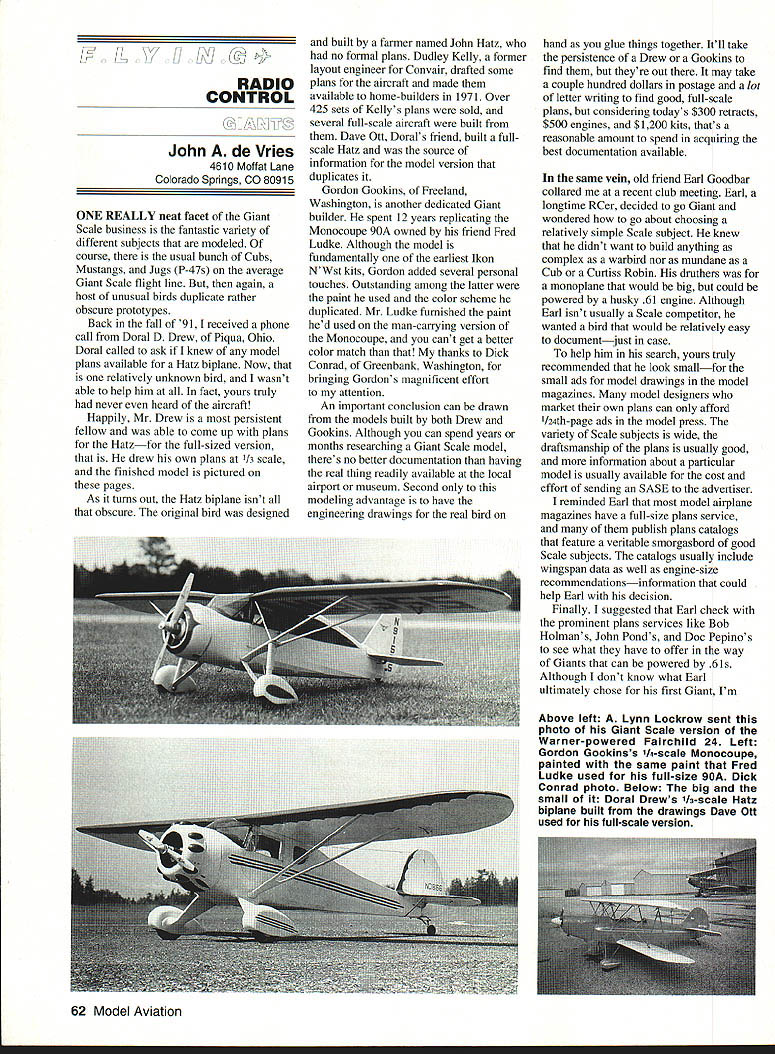
Happily, Mr. Drew is a most persistent fellow and was able to come up with plans for the Hatz—for the full-size version he drew his own plans at 1/3 scale, and the finished model is pictured on these pages.
As it turns out, the Hatz biplane isn't all that obscure. The original bird was designed and built by a farmer named John Hatz, who had no formal plans. Dudley Kelly, a former layout engineer for Convair, drafted some plans for the aircraft and made them available to homebuilders in 1971. Over 425 sets of Kelly's plans were sold, and several full-size aircraft were built from them. Dave Ott, Doral's friend, built a full-size Hatz and was the source of information for the model version that duplicates it.
Monocoupe 90A
Gordon Gookins, of Freeland, Washington, is another dedicated Giant builder. He spent 12 years replicating the Monocoupe 90A owned by his friend Fred Ludke. Although the model is fundamentally one of the earliest Ikon Northwest kits, Gordon added several personal touches. Outstanding among the latter were the paint he used and the color scheme he duplicated. Mr. Ludke furnished the paint he had used on the man-carrying version of the Monocoupe, and you can't get a better color match than that! My thanks to Dick Conrad, of Greenbank, Washington, for bringing Gordon's magnificent effort to my attention.
Research and documentation
An important conclusion can be drawn from the models built by both Drew and Gookins. Although you can spend years or months researching a Giant Scale model, there's no better documentation than having the real thing readily available at the local airport or museum. Second only to this modeling advantage is having the engineering drawings for the real bird on hand as you glue things together. It'll take the persistence of a Drew or a Gookins to find them, but they're out there. It may take a couple hundred dollars in postage and a lot of letter writing to find good, full-size plans, but considering today's $300 retracts, $500 engines, and $1,200 kits, that's a reasonable amount to spend in acquiring the best documentation available.
Choosing a Giant
In the same vein, old friend Earl Goodbar collared me at a recent club meeting. Earl, a longtime RCer, decided to go Giant and wondered how to go about choosing a relatively simple Scale subject. He knew that he didn't want to build anything as complex as a warbird nor as mundane as a Cub or a Curtiss Robin. His druthers was for a monoplane that would be big, but could be powered by a husky .61 engine. Although Earl isn't usually a Scale competitor, he wanted a bird that would be relatively easy to document—just in case.
To help him in his search, I recommended that he look small—for the small ads for model drawings in the model magazines. Many model designers who market their own plans can only afford 1/24-page ads in the model press. The variety of Scale subjects is wide, the draftsmanship of the plans is usually good, and more information about a particular model is usually available for the cost and effort of sending an SASE to the advertiser. I reminded Earl that most model airplane magazines have a full-size plans service, and many of them publish plans catalogs that feature a veritable smorgasbord of good Scale subjects. The catalogs usually include wingspan data as well as engine-size recommendations—information that could help Earl with his decision.
Finally, I suggested that Earl check with prominent plans services like Bob Holman, John Pond, and Doc Pepino to see what they have to offer in the way of Giants that can be powered by .61s. Although I don't know what Earl ultimately chose for his first Giant, I'm sure that he had hundreds of drawings to select from.
Main landing gear — Wheels
In the past two columns, I've dealt at length with tail skids and tail wheels. This month I'll move to the front of the model and look at the main landing gear, specifically the wheels. Although a lot of us are addicted to the use of wheel collars to hold wheels on their axles, collars aren't all that sporty when it comes to scale appearance.
There are several alternatives to wheel collars, and I'm going to suggest some methods that may interest you. Both involve sleeving music wire axles with brass tubing whose inside diameter slips snugly over the wire. The brass tubing then is glued (using epoxy or CyA) or soldered in place.
- Short-sleeve method
- In the first method, the axle is shortened a bit before the brass tubing is fitted.
- A short length of dowel that fits within the tubing is glued in place and cut off flush with the end of the tube.
- The dowel is then drilled for a wood screw that, together with a simple washer, holds the wheel in place.
- Full-sleeve, threaded method
- The second method sleeves the axle for its full length with brass tubing that is in turn threaded to accept an appropriately sized nut and washer.
- Brass tubing is used, of course, because it's almost impossible to cut a thread into hard, tempered music wire with the tools that most of us have in our shops.
- Happily, this latter method duplicates full-scale practice for aircraft during the teens and '20s.
With either method, make sure the wheels are well oiled so that they don't bind and cause the screws or nuts to unwind. If you have a friend with a small metal lathe or if you have one yourself, there's yet another way of holding Giant Scale wheels on axles. I'll detail that for you in my next column, which will appear in the December issue. Stay tuned!
Upcoming projects
Although the local hangar queen, the Ryan B-5, still needs some wing struts, a lot of covering, and a bunch of painting, it has a new hangar mate. The next Giant project around here, a Ziroli AT-6, is at hand. It's going to have a big red Kioritz in the cowling and a set of retracts to make it look scale in flight. Scale documentation, in the form of the great Paul Matt drawings and some photographs of one of the birds I flew in the USAAF Training Command, is safely tucked into a manila folder. I plan to duplicate a "D" model of the Texan and add the radio compass teardrop that our instrument training class had. At the moment, the 102-in. wingspan project is a bit daunting, but the prospect of Craig Field #502 flying again in Giant model form is a tremendous incentive.
I won't be with you next month because the November issue of Model Aviation will be devoted to the Nationals.
AMA: Modelers Working For Modelers!
Transcribed from original scans by AI. Minor OCR errors may remain.

