
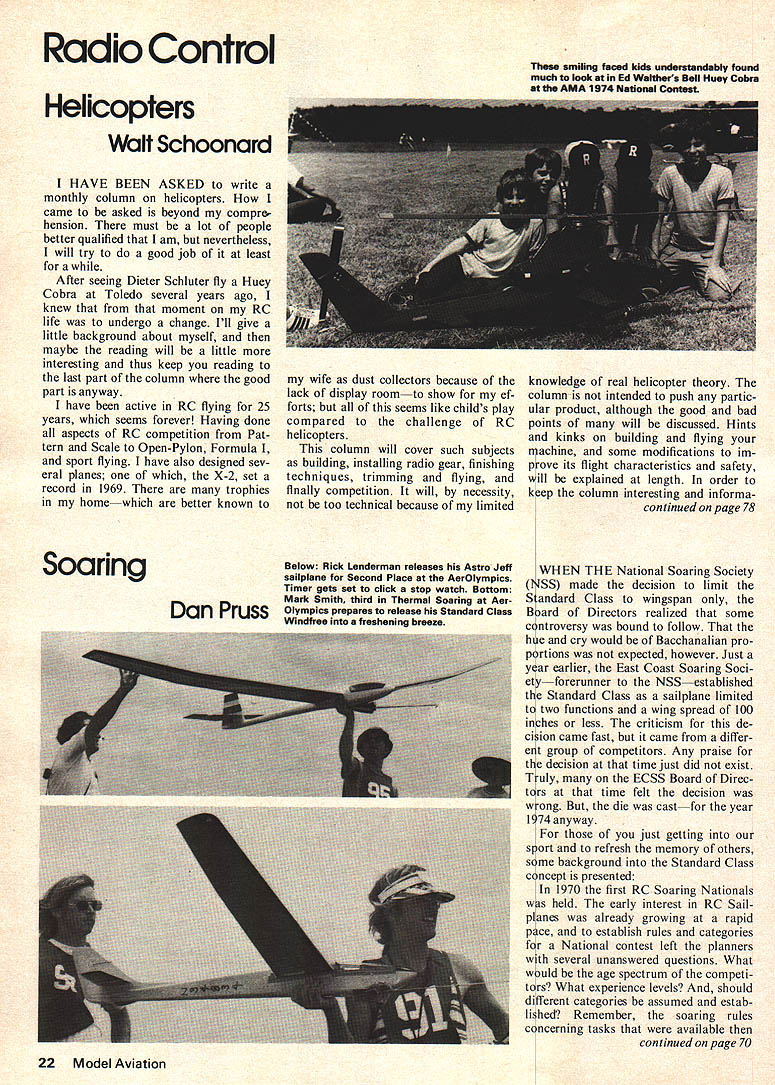
Radio Control: Helicopters
Walt Schoonard
I HAVE BEEN ASKED to write a monthly column on helicopters. How I came to be asked is beyond my comprehension. There must be a lot of people better qualified that I am, but nevertheless, I will try to do a good job of it at least for a while.
After seeing Dieter Schluter fly a Huey Cobra at Toledo several years ago, I knew that from that moment on my RC life was to undergo a change. I'll give a little background about myself, and maybe the reading will be a little more interesting and thus keep you reading to the last part of the column where the good part is anyway.
I have been active in RC flying for 25 years, which seems forever! Having done all aspects of RC competition from Pattern and Scale to Open-Pylon, Formula I, and sport flying, I have also designed several planes; one of which, the X-2, set a record in 1969. There are many trophies in my home—which are better known to my wife as dust collectors because of the lack of display room—to show for my efforts; but all of this seems like child's play compared to the challenge of RC helicopters.
This column will cover such subjects as building, installing radio gear, finishing techniques, trimming and flying, and finally competition. It will, by necessity, not be too technical because of my limited knowledge of real helicopter theory. The column is not intended to push any particular product, although the good and bad points of many will be discussed. Hints and kinks on building and flying your machine, and some modifications to improve its flight characteristics and safety, will be explained at length. In order to keep the column interesting and informative. Also, I am soliciting your help. We can pay nominal fees for press ready sketches and pictures if used. Pictures should be clear, preferably in black and white, and sized 5x7—or polaroids if they are really good. A monthly contest report and schedules will be printed as the information is made available. Information on "fly for fun" and demonstrations should include who, when, where, and what helicopters were flown.
When you are learning to fly, you may want to be alone with your machine; but there will soon come a time when you will like to fly with others of the same interest. Maybe you don't even know of anyone else in your home state who flies helicopters. How do you find out who and where they are? The first thing to do is join the National R/C Helicopter Association sponsored by RCM magazine. The benefits will be tenfold if you do. You can go to work on a well thought out self-improvement program, and you'll get a worldwide membership list. The second thing to do is to form a statewide helicopter association. In Florida we have a very successful group called the Florida R/C Helicopter Association with about 50 members of which I am president, and we are having a ball!
Here is how you do it: Take the ball and run with it yourself; the others will follow later. First, set a date covering a Saturday night and Sunday far enough ahead to get all the work done. Make arrangements to have exclusive use of the local flying site for all day Sunday. Contact a good local motel that has a good restaurant and meeting room and book your group in for a Dutch-treat dinner Saturday night. Dinner will take about two hours, so it is best to start around 6:30 p.m. The dinner is followed by show and tell and movies. Allow about an hour for show and tell, and then have your organizational meeting. Select your officers and set dues and pick someone to write a monthly newsletter. In Florida we are lucky to have Aubrey Radford do this, because he is a very colorful and interesting individual.
Sunday go to the flying site and fly in your can and help those who cannot or haven't yet tried. Where do you get people to attend? From the National Radio Control Helicopter list and from interested people from your R/C club. Send announcements and flyers to all hobby shops that you can get in touch with. Be enthusiastic, for it spreads! Why have dinner together? It is a good way to get acquainted, and you've got to eat somewhere anyhow. Get everyone who has a machine, regardless of its state of completion, to bring it to show and tell. Have them tell who they are and where they are from and tell about their machine. Believe me when I say that you will enjoy this and won't be able to wait till the next one. So set the year up in six- week segments and set the next get-together date six weeks away at another city and in that way the sport will spread. In the next city advertise through the local hobby shops and R/C clubs. Get someone at this meeting to volunteer to do this leg work. This system is working here in my state of Florida. Some members have found people in their own town that fly helicopters, and they didn't even know them.
There may have been somewhere in the neighborhood of 4,000 helicopter kits sold in this country so let's find them and get them flying. The newsletter should cover such things as who is flying, what special hints and kinks, and where parts are available. The first couple of newsletters can be sent to prospective members, but then they should be sent only to paid-up members. Dues are needed to cover postage, printing, and phone calls to set up meeting dates. The Florida association dues are five dollars ($5.00) a year, and all members must have an AMA and FCC license. Also be sure that anyone who flies on Sundays has the same.
We have found that the five dollars does not cover expenses so keep this in mind. AMA has an excellent 16 millimeter color-sound movie called "R/C Helicopters" that you can get for your first meeting. Above all, be friendly; this is for fun!
You may be having some problems with your machine that seem to be unsolvable. Write to us and let someone else take a crack at your problem. Chances are that someone already has come up with the answer and will be glad to share it with you. Maybe you are having problems getting parts or you are being gouged on the prices. Parts are available and at reasonable prices! We would also like to hear from you about your successes and any particular approaches to successful elimination of your problems.
Next month's column will be "Toledo Report and How to Make a Schlüter Gazell Super Smooth and Competitive." Coming soon is a product report and evaluation on M&M Lark 19, new DuBro 40 size with collective pitch, and Kavan Alouette. Keep those cards and letters coming! Remember, this is for your enjoyment!
Direct correspondence to Walt Schoonard, 2080 Sharon Rd., Winter Park, Florida 32789.
Transcribed from original scans by AI. Minor OCR errors may remain.

