
Radio Control: Helicopters
Larry Jolly
FLY-INS
West Coast RC Helicopter Fly-In — Merced, CA (September 28–29)
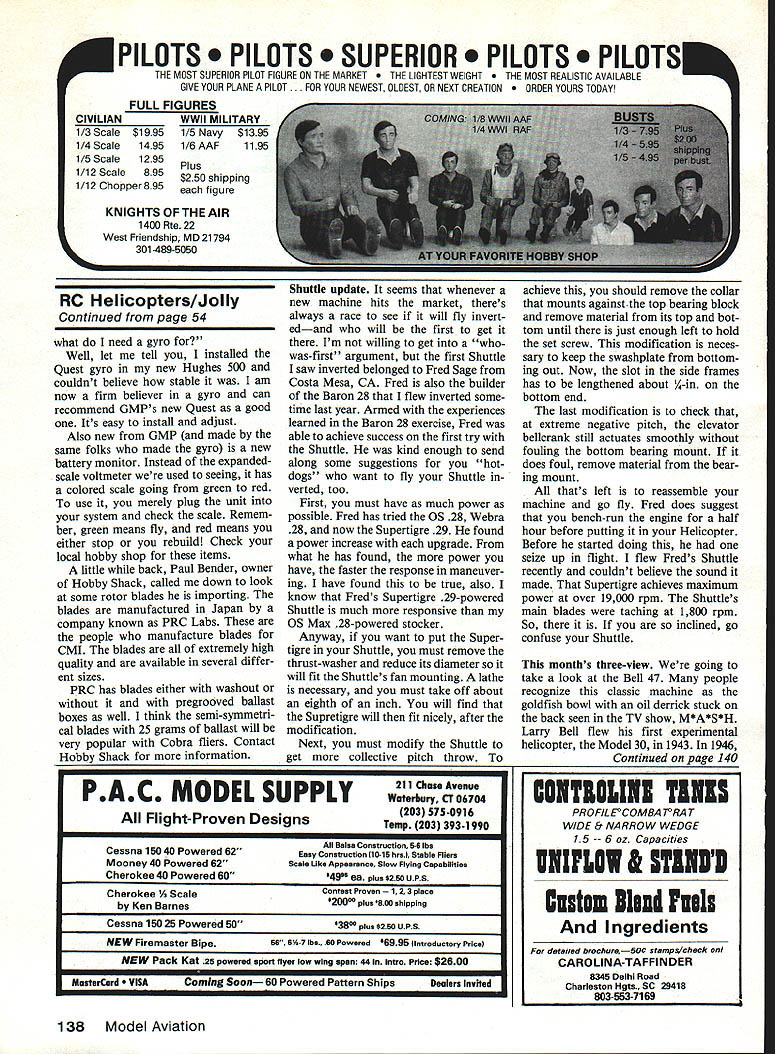
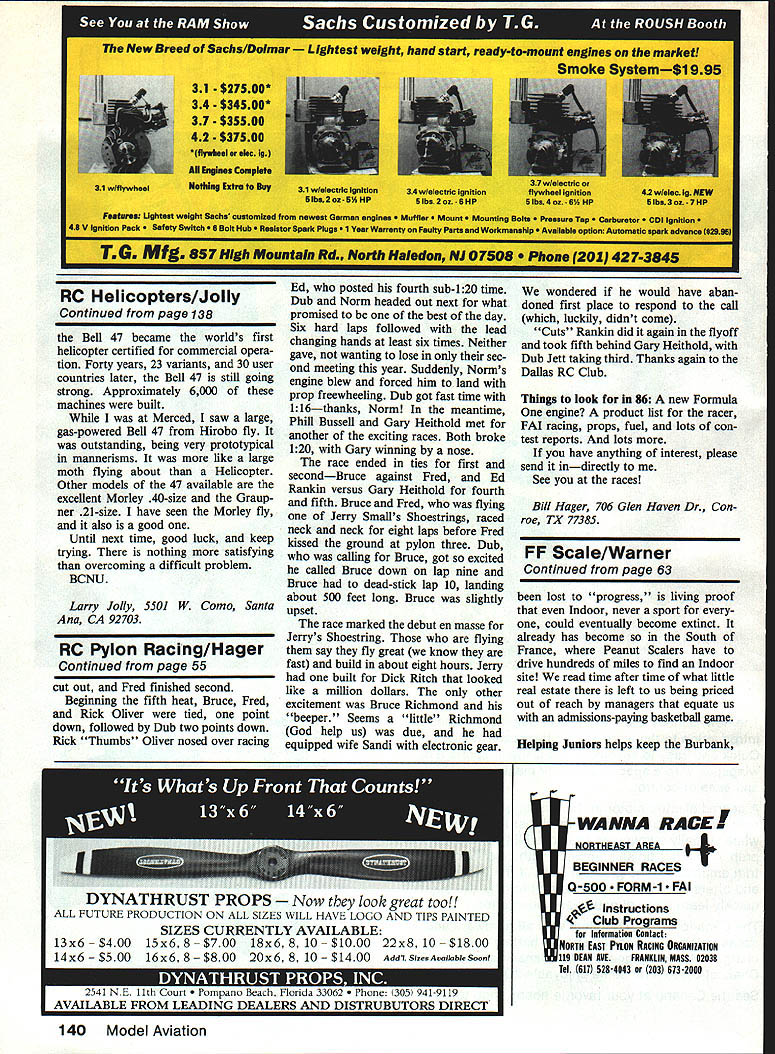
The third annual West Coast RC Helicopter Fly-In at Merced, CA drew an impressive turnout. Hats off to Chuck Winter and the co-sponsors — in three years this has grown into the largest chopper get-together in California and perhaps the U.S. On Sunday I counted about 125 machines and roughly 70 pilots.
One reason for the meet's success is the spirit of fellowship among fliers and hosts. The event flyer stated the objective well: to encourage and expand the safe and successful flight of model radio-controlled helicopters. RCM columnist Ray Hostetler and I noted a real change in the hobby — the fuel-foaming, boom-bouncing, poorly maintained machines were largely gone and replaced by smooth-running, well-tuned helicopters. People are learning to fly, maintain, and detail their models, with many wrapping fiberglass scale fuselages around their ships.
Manufacturers were present, showing new products such as CMI's new gas-powered Fox and GMP's Shuttle. The field, organization, and flying were all great — but the overall harmony was the best part. Mark the last weekend in September on your 1986 calendar and join us in Merced.
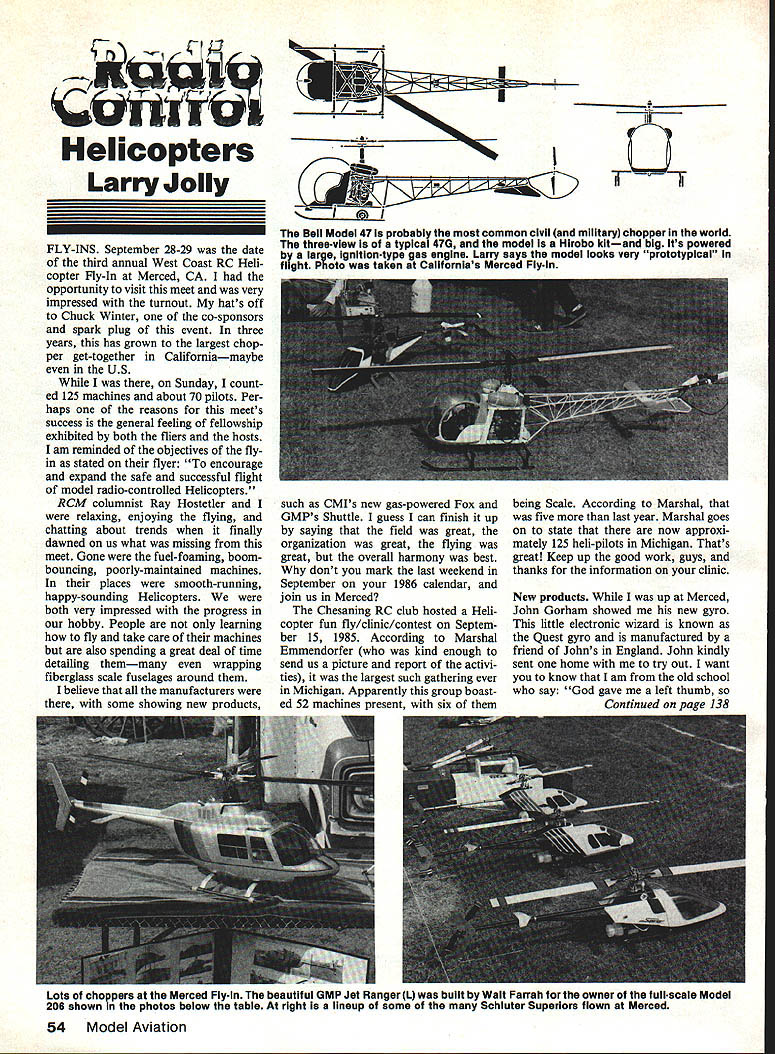
(The Bell Model 47 pictured at the fly-in was noted as a very prototypical-looking ship in flight — a typical 47G model and Hirobo kit with a big ignition-type gas engine.)
Chesaning RC Club Helicopter Fun Fly/Clinic/Contest — Chesaning, MI (September 15, 1985)
The Chesaning RC Club hosted a helicopter fun fly/clinic/contest that reportedly was the largest such gathering ever in Michigan. According to Marshal Emmendorfer, the group had 52 machines present (six of them Scale), five more than the previous year. Marshal also reported there are now approximately 125 heli-pilots in Michigan. Great work — thanks for the clinic report and photo.
NEW PRODUCTS
- Quest gyro (GMP): John Gorham showed me the Quest gyro, manufactured by a friend in England. I was skeptical at first, but after installing the Quest in my Hughes 500 I was impressed by how stable the ship became. The gyro is easy to install and adjust and comes recommended.
- GMP battery monitor: Instead of an expanded-scale voltmeter, this monitor uses a colored scale from green to red. Plug the unit into your system to check battery condition: green means fly; red means stop or rebuild.
- PRC Labs rotor blades (imported by Hobby Shack): Paul Bender of Hobby Shack is importing high-quality blades manufactured in Japan by PRC Labs (the makers of CMI blades). They are available in several sizes and in variants with washout, pre-grooved ballast boxes, or semi-symmetrical sections. A 25-gram ballast will be popular with Cobra fliers. Contact Hobby Shack for details.
Check your local hobby shop for these items.
SHUTTLE UPDATE
There’s always a race to be first to fly a new machine inverted. The first Shuttle I saw inverted belonged to Fred Sage (Costa Mesa, CA). Fred, who also built and flew a Baron 28 inverted, succeeded on his first try with the Shuttle and shared suggestions for those who want to fly the Shuttle inverted.
Key points and recommended modifications:
- Maximize power. Fred tested several engines (.05, .28, Super Tigre .29) and found increased power improved response and maneuverability. The Super Tigre .29 made the Shuttle noticeably more responsive than an O.S. Max .28-powered stocker.
- Fitting the Super Tigre .29:
- Remove the thrust washer and reduce its diameter so the engine will fit the Shuttle's fan mounting.
- A lathe is necessary; remove about 1/8 inch from the thrust washer diameter for a proper fit.
- Increase collective pitch throw:
- Remove the collar that mounts against the top bearing block.
- Remove material from the collar's top and bottom until only enough remains to hold the set screw. This prevents the swashplate from bottoming out.
- Lengthen the slot in the side frames by about 1/4 inch at the bottom end.
- Check elevator bellcrank travel:
- Ensure that at extreme negative pitch the elevator bellcrank actuates smoothly without fouling the bottom bearing mount.
- If fouling occurs, remove material from the bearing mount.
- Bench-run the engine for about a half hour before installing it in the helicopter — Fred recommends this because he experienced an in-flight seizure before he began bench-running.
A note on performance: Fred’s Super Tigre reaches maximum power at over 19,000 rpm while the Shuttle’s main blades were turning around 1,800 rpm — an impressive pairing. If you decide to modify your Shuttle, proceed carefully and bench-test thoroughly.
THIS MONTH'S THREE-VIEW
The Bell Model 47 is probably the most common civil/military chopper in the world. Many people recognize this classic machine as the "goldfish bowl" with an oil derrick-like structure on the back, as seen in the TV show M*A*S*H. Larry Bell flew his first experimental helicopter, the Model 30, in 1943. In 1946,...
SIGN-OFF
Until next time, good luck, and keep trying. There is nothing more satisfying than overcoming a difficult problem.
BCNU.
Larry Jolly 5501 W. Como, Santa Ana, CA 92703
Transcribed from original scans by AI. Minor OCR errors may remain.

