
Radio Control: Helicopters
Larry Jolly
WELCOME BACK. I hope this column finds you healthy and your chopper running smoothly. This month we're going to take a look at a radio and a new Scale machine.
New Airtronics Helicopter Radio
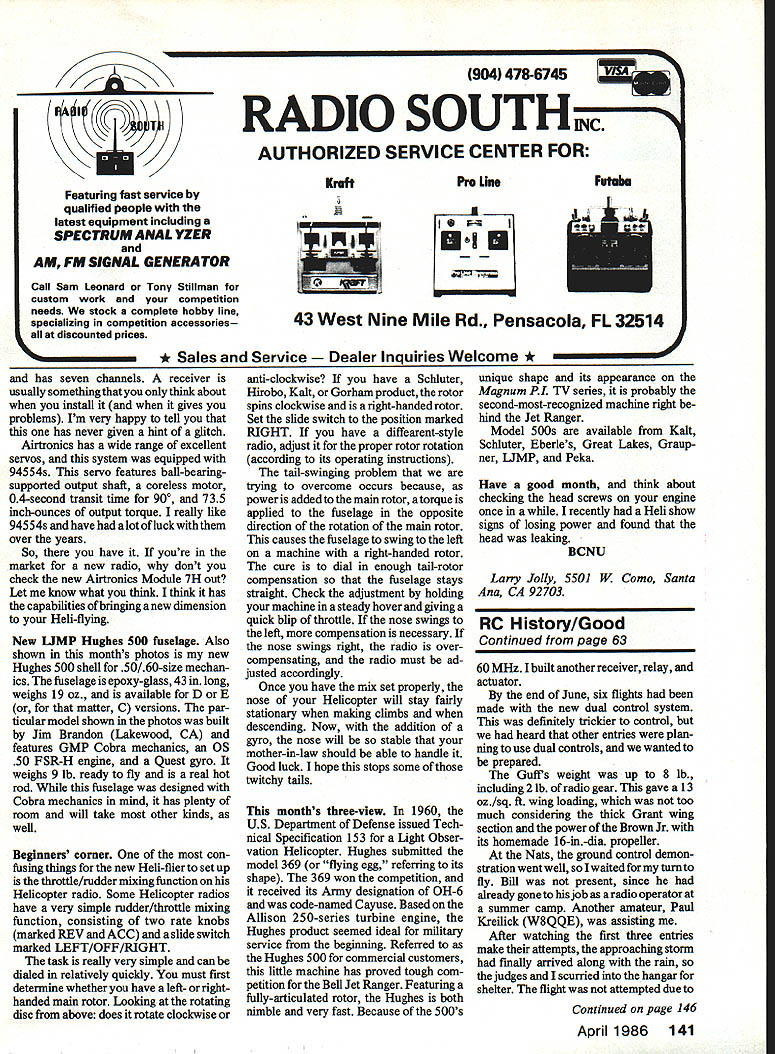
The folks at Airtronics kindly supplied one of their new Module 7H radios for review. The Module 7H is a member of their top-of-the-line Module family and is available in two styles. The major difference between the two is that the 7H1 trades one of the two pitch-curve options for an Invert function. If you are a serious FAI flier, you would probably choose the 7H because its two separate pitch curves allow far more flexibility in setting up your machine.
Before going too far into functions, I should point out that the radio is supplied with one of the finest instruction manuals I've read. It's written in simple English so even the novice heli-pilot should be able to read and understand it.
What makes a radio a dedicated helicopter radio is the way functions can be mixed — in particular, the mixing of throttle, collective pitch, and rudder. All this mixing is accomplished in the transmitter, and this is where you'll find the difference from other sets.
The transmitter features the familiar silver-and-black Airtronics Module case, and includes a clock and digital-readout stopwatch. It weighs 2.3 pounds and has a nicely balanced feel. Reversing switches on all seven channels are standard, as is end-point adjustment on all flight controls and throttle high end.
Key features of the Module 7H1 include:
- Adjustable throttle/rudder mix for torque compensation
- One-touch pitch-curve adjustment (both high and low)
- Hovering memory
- Idle-up
- Pitch trim with 25% authority
- Invert switch
- Throttle hold
- Two methods of gyro control
- Retard switch
- Dual rates on aileron and elevator functions
- Inhibit options on invert, throttle hold, gyro, and throttle/rudder mix (to prevent accidental use or for fixed-wing use)
If all that sounds like a lot — it's because it is! The 7H1 has just about everything the helicopter jock could want, and it’s laid out so you can get to everything while your 'copter is screaming around the sky. With so many functions it's easy to get lost in the programming at first, but the manual and logical layout make learning the set quick.
My test radio came with Airtronics' new dual-conversion, narrow-band receiver. It measures 2 3/4 x 1 3/4 x 3/4 inches and is compact enough to fit easily into most installations. A receiver is usually something you only think about when you install it (and when it gives you problems). I'm happy to report this one never gave a hint of a glitch during my flight evaluations — no spurious signals or dropouts.
Airtronics supplied 94554 servos with the system. The 94554 features a ball-bearing-supported output shaft, a coreless motor, a 0.4-second transit time for 90°, and 73.5 inch-ounces of output torque. I've had a lot of luck with these servos over the years.
If you are in the market for a dedicated helicopter radio, the Module 7H1 is hard to beat for the price. It offers a breadth of helicopter-specific features, solid construction, and ease of use that will satisfy both the novice Heli-pilot and the experienced sport flier. Airtronics Module 7H1 — tested and recommended.
New LJMP Hughes 500 Fuselage
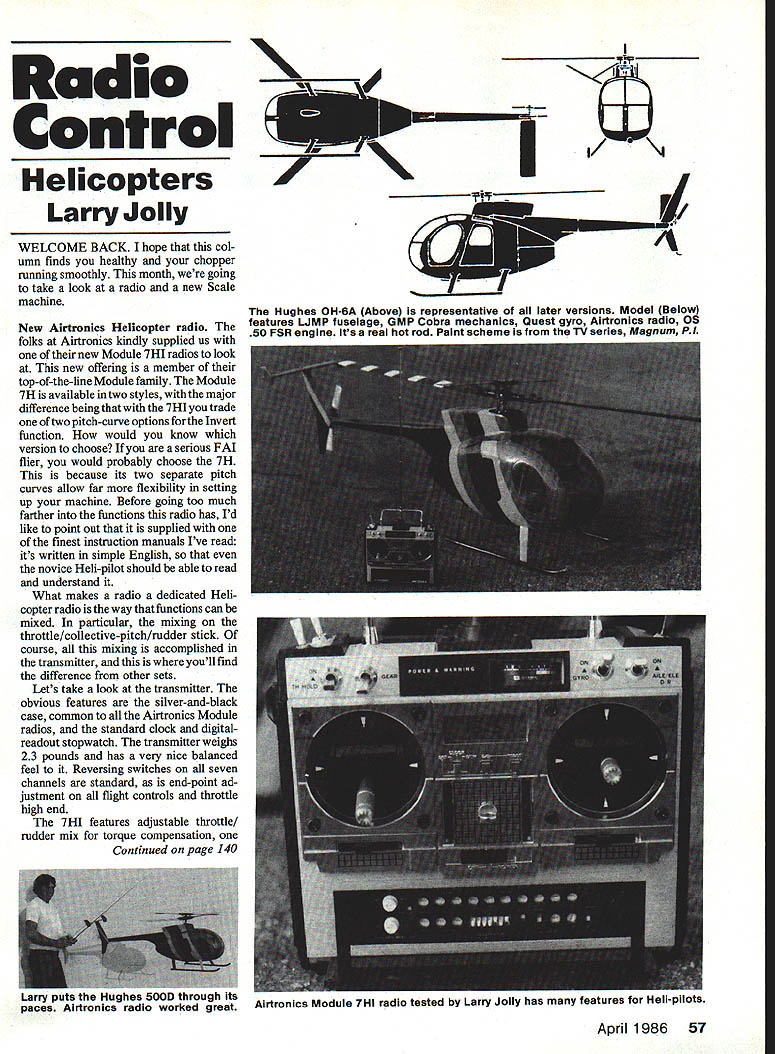
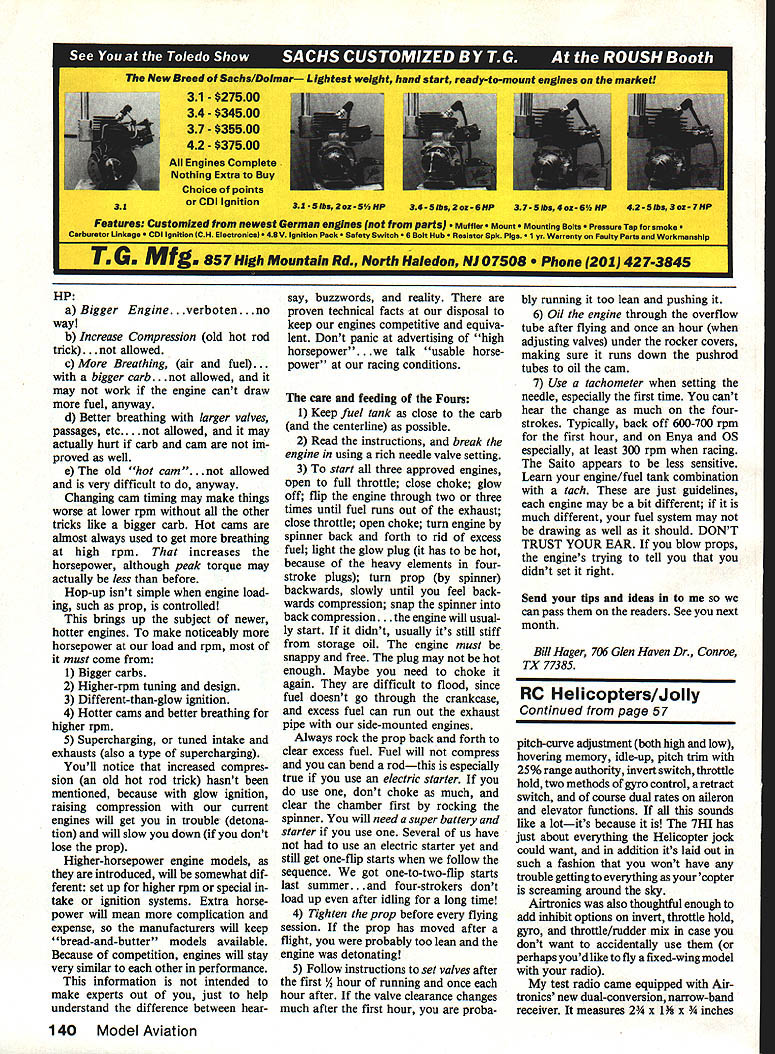
Also shown in this month's photos is my new Hughes 500 shell for .50/.60-size mechanics. The fuselage is epoxy-glass, 33 in. long, weighs 19 oz., and is available for D or E (or C) versions. The particular model shown was built by Jim Brandon (Lakewood, CA) and features GMP Cobra mechanics, an OS .50 FSR-H engine, and a Quest gyro. It weighs about 9 lb. ready to fly and is a real hot rod. While this fuselage was designed with Cobra mechanics in mind, it has plenty of room and will take most other kinds as well.
Beginners' Corner
One of the most confusing things for the new heli-flier to sort out is the throttle/rudder mix function on the helicopter radio. Some helicopter radios have a very simple rudder/throttle mixing function consisting of two rate knobs (marked REV and ACC) and a slide switch marked LEFT/OFF/RIGHT.
The task is really simple and can be dialed in relatively quickly. First determine whether you have a left- or right-handed main rotor. Looking at the rotating disc from above, does it rotate clockwise or counterclockwise? If you have a Schluter, Hirobo, Kalt, or Gorham product, the rotor spins clockwise and is a right-handed rotor. Set the slide switch to the position marked RIGHT. If you have a different-style rotor, adjust according to your radio's operating instructions.
The tail-swinging problem occurs because as power is added to the main rotor, torque is applied to the fuselage in the opposite direction of the rotor's rotation. On a machine with a right-handed rotor, this causes the fuselage to swing to the left as power increases. The cure is to dial in enough tail-rotor compensation so the fuselage stays straight.
Check the adjustment by holding your machine in a steady hover and giving a quick blip of throttle:
- If the nose swings left, more compensation is necessary.
- If the nose swings right, the radio is over-compensating and must be adjusted the other way.
Once the mix is set properly, the nose of your helicopter will stay fairly stationary when climbing and descending. With the addition of a gyro, the nose will be so stable that your mother-in-law should be able to handle it. Good luck — I hope this stops some of those twitchy tails.
This Month's Three-View
In 1960 the U.S. Department of Defense issued Technical Specification 153 for a Light Observation Helicopter. Hughes submitted the Model 369 (nicknamed the "flying egg" because of its shape). The 369 won the competition and received the Army designation OH-6 and the code-name Cayuse.
Based on the Allison 250-series turbine engine, the Hughes product seemed ideal for military service from the beginning. Referred to as the Hughes 500 for commercial customers, this little machine proved tough competition for the Bell Jet Ranger. Featuring a fully-articulated rotor, the Hughes is both nimble and very fast. Because of the 500's unique shape and its appearance on the Magnum P.I. TV series, it is probably the second-most-recognized machine right behind the Jet Ranger.
Model 500s are available from:
- Kalt
- Schluter
- Eberle's
- Great Lakes
- Graupner
- LJMP
- Peka
Have a good month, and think about checking the head screws on your engine once in a while. I recently had a heli show signs of losing power and found that the head was leaking.
BCNU
Larry Jolly 5501 W. Como, Santa Ana, CA 92703.
Transcribed from original scans by AI. Minor OCR errors may remain.

