
Radio Control: Helicopters
Larry Jolly
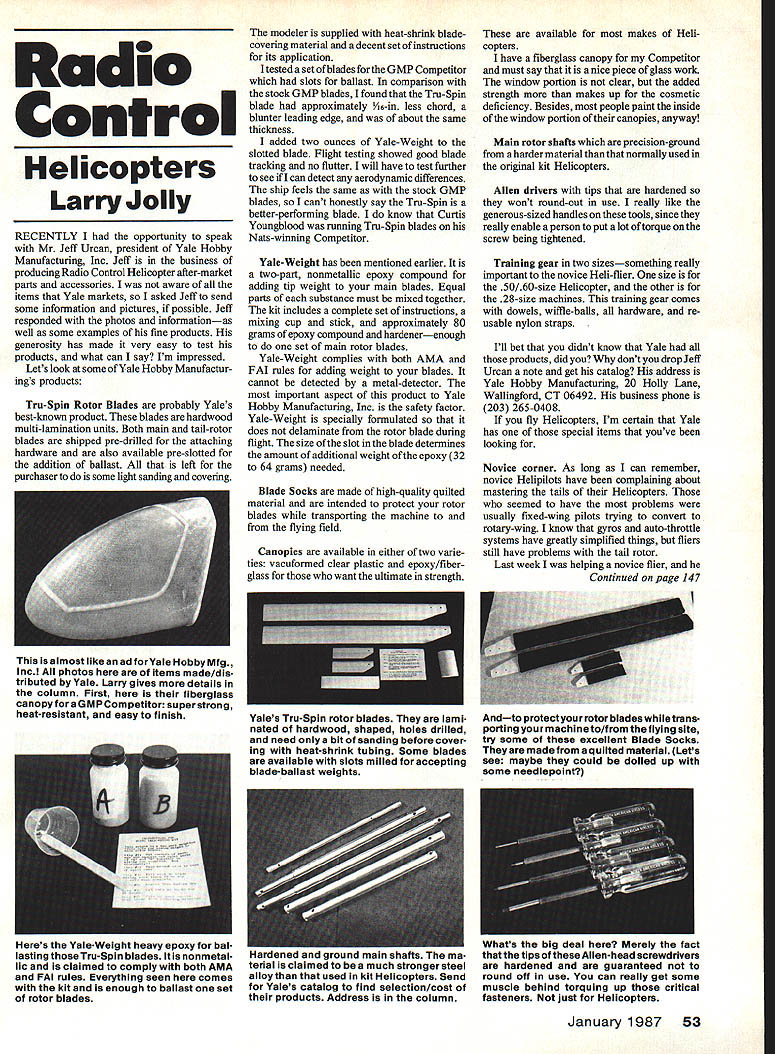
Recently I had the opportunity to speak with Mr. Jeff Urcan, president of Yale Hobby Manufacturing, Inc. Jeff is in the business of producing radio-control helicopter after-market parts and accessories. I was not aware of all the items that Yale markets, so I asked Jeff to send some information and pictures, if possible. Jeff responded with photos and information—as well as some examples of his fine products. His generosity has made it very easy to test his products, and what can I say? I'm impressed.
Yale Hobby Manufacturing products
Let's look at some of Yale Hobby Manufacturing's products:
- Tru-Spin Rotor Blades
Tru-Spin blades are probably Yale's best-known product. These blades are hardwood, multi-lamination units. Both main and tail-rotor blades are shipped pre-drilled for the attaching hardware and are also available pre-slotted for the addition of ballast. All that is left for the purchaser to do is some light sanding and covering. The modeler is supplied with heat-shrink blade-covering material and a decent set of instructions for its application.
I tested a set of blades for the GMP Competitor which had slots for ballast. In comparison with the stock GMP blades, I found that the Tru-Spin blade had approximately 1/16 in. less chord, a blunter leading edge, and was about the same thickness.
I added two ounces of Yale-Weight to the slotted blade. Flight testing showed good blade tracking and no flutter. I will have to test further to see if I can detect any aerodynamic differences. The ship feels the same as with the stock GMP blades, so I can't honestly say the Tru-Spin is a better-performing blade. I do know that Curtis Youngblood was running Tru-Spin blades on his Nats-winning Competitor.
- Yale-Weight
Yale-Weight is a two-part, nonmetallic epoxy compound for adding tip weight to your main blades. Equal parts of each substance must be mixed together. The kit includes a complete set of instructions, a mixing cup and stick, and approximately 80 grams of epoxy compound and hardener—enough to do one set of main rotor blades.
Yale-Weight complies with both AMA and FAI rules for adding weight to your blades. It cannot be detected by a metal detector. The most important aspect of this product to Yale Hobby Manufacturing, Inc. is the safety factor. Yale-Weight is specially formulated so that it does not delaminate from the rotor blade during flight. The size of the slot in the blade determines the amount of additional weight of the epoxy (approximately 32 to 64 grams may be needed).
- Blade Socks
Blade socks are made of high-quality quilted material and are intended to protect your rotor blades while transporting the machine to and from the flying field.
- Canopies
Canopies are available in two varieties: vacuformed clear plastic and epoxy/fiberglass for those who want the ultimate in strength. I have a fiberglass canopy for my Competitor and must say that it is a nice piece of glass work. The window portion is not clear, but the added strength more than makes up for the cosmetic deficiency. Besides, most people paint the inside of the window portion of their canopies anyway.
- Main Rotor Shafts
Main rotor shafts are precision-ground from a harder material than that normally used in original kit helicopters.
- Allen Drivers
Allen drivers have hardened tips so they won't round out in use. I really like the generous-sized handles on these tools, since they enable a person to put a lot of torque on the screw being tightened.
- Training Gear
Training gear comes in two sizes—one for the .50/.60-size helicopters and the other for the .28-size machines. This training gear comes with dowels, wiffle balls, all hardware, and reusable nylon straps.
I'll bet that you didn't know that Yale had all those products, did you? Why don't you drop Jeff Urcan a note and get his catalog?
Contact
Yale Hobby Manufacturing 20 Holly Lane Wallingford, CT 06492 Phone: (203) 265-0408
If you fly helicopters, I'm certain that Yale has one of those special items that you've been looking for.
Novice corner
As long as I can remember, novice heli-pilots have been complaining about mastering the tails of their helicopters. Those who seemed to have the most problems were usually fixed-wing pilots trying to convert to rotary-wing. I know that gyros and auto-throttle systems have greatly simplified things, but fliers still have problems with the tail rotor.
Last week I was helping a novice flier, and he was simply not getting anywhere with his machine. The helicopter was jumping up and down and twisting from side to side. I went out to watch what he was doing on the transmitter and realized that he was trying to fly his chopper the same way he flew his Ugly Stick!
He would carry his machine out of the pits and set it in the flying area. Then he would bring the throttle trim up to get the blades turning. Checking the controls, he would throw the throttle forward—I don't know why! Just as suddenly, he would throttle back.
Gentlemen, at this point I realized that most people do not need a proportional throttle. Most fixed-wing fliers are satisfied with an on/off switch for engine control. That is not, however, the proper way to fly a helicopter—and will certainly not work with a helicopter.
The throttle is as delicate a control as the cyclic-pitch stick and must be handled gently. Advance and decrease the throttle as smoothly and as slowly as possible. The slower the movement, the more chance the helicopter will reach equilibrium where the tail will not swing.
BCNU.
Larry Jolly 5501 W. Como Santa Ana, CA 92703
Transcribed from original scans by AI. Minor OCR errors may remain.

