
Radio Control: Helicopters
Larry Jolly
Welcome back
This month we're going to take a look at a different sort of rotorcraft known as an autogyro. An autogyro, by definition, is an aircraft supported in flight by an unpowered main rotor. Unlike a helicopter, which has the main rotor mechanically linked to the power plant, an autogyro has a freewheeling main rotor that is propelled through the air by the relative wind as the gyro's fuselage moves forward.
Because the autogyro's rotor is attached to the fuselage with its disk at a positive angle of attack, the relative wind enters the bottom side of the rotor disk and spins the rotors from this upward flow of air. You can think of an autogyro as a helicopter whose main rotor is always in autorotation.
Similarly, because the rotor is unpowered, there is no torque transferred to the fuselage; therefore, there is no need for a tail rotor. Although the autogyro and the helicopter share some common parts, they are not the same.
Key differences from helicopters
- The autogyro's main rotor provides lift only when there is forward movement of the disk caused by the fuselage dragging the rotor through the air.
- An autogyro cannot hover unless there is enough wind to overcome the machine's normal ground speed.
- Most autogyros cannot take off from one spot; instead, they must taxi briskly until enough ground speed has been reached to spin the main rotor up to flight RPM.
Full-size and model autogyros
There have been dozens of successful full-size autogyros built over the years. Many readers will be familiar with home-built Benson GyroCopters and the Wallis Autogyro used in the James Bond films. These machines are maneuverable and truly stable.
Some autogyros have become very sophisticated with main rotor collective pitch control and powered spin-up devices that allow "jump" takeoffs. Spin-up has proven essential in at least one model design and will eventually become standard on all single-rotor miniature autogyros.
Personal experiences
I have always been interested in autogyros and wanted to fly one by radio control. In 1976 I saw Kevin Flynn fly a double-rotor machine manufactured in England by D.B. While the model flew, it was not truly successful—it didn't seem to care which way the rotors turned, and it would also fly with the rotors removed. It featured a rather large-chord rotor support that looked suspiciously like a wing.
A little later I had a personal experience with a prototype of the Kate Robin. This was a .40-size machine with cyclic control and a rudder and throttle. The instructions said to make a taxi-run into the wind and it would fly when the rotor had enough RPM. I can still remember placing the model autogyro on the runway's centerline, checking the controls, and giving 'er gas. That thing shot off like a rocket ship, although its appearance was more like one of Don Quixote's windmills. After a ground run of about 70 feet I applied a bit of back-pressure on the stick. The machine immediately broke ground, did a half-roll to the right, and disintegrated on impact.
I later saw film footage of Mike Maas successfully flying a Robin, so I have since decided my crash was due to pilot inexperience, poor setup, a tricky craft, and mostly general incompetence.
The Micro Mold Wallis Autogyro kit
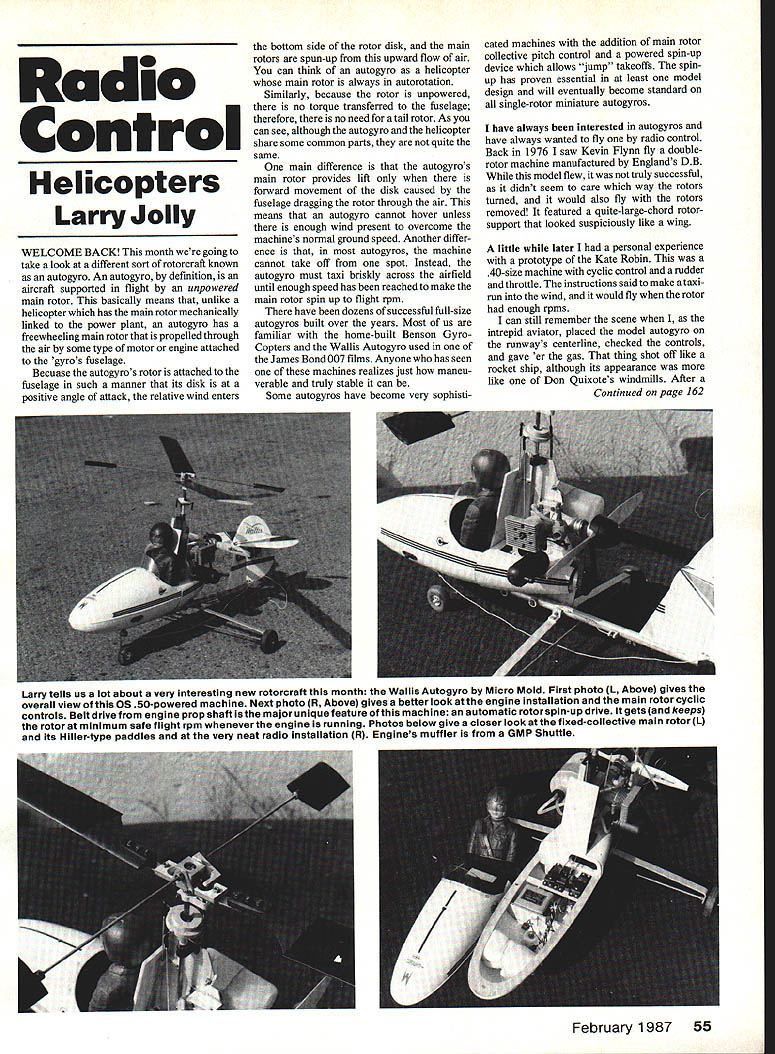
I recently saw an ad for the Micro Mold-produced Wallis Autogyro. Through the help of Cliff Norman I was able to procure a kit. The pictures at the lead of this article are of this model.
To describe the Micro Mold model, imagine a GMP Cricket in general layout, but with a 64-inch rotor span and a heavy tricycle landing carriage. Add a streamlined body fairing and vertical and horizontal tail surfaces and you would be looking at a Wallis.
Mr. Roy Sturman, the designer of this model, spent a great deal of time and effort producing a safe, spot-on working gyro. While the system looks elementary, it is a very clever design. Sturman knew that most model autogyros were not successful because they could not easily attain and maintain minimum rotor RPM for safe flight. This is caused by the low mass of the rotor system, which is susceptible to rapid loss of RPM during maneuvering flight.
He cleverly put a spin-up device in the main gear. The device will spin the rotor to the upper end of the RPM range immediately prior to takeoff. As soon as the gyro is flying, the rotor freewheels. This ingenious system makes it virtually impossible to stop the rotor from turning and having the model subsequently fall out of control.
Kit quality and required items
The Micro Mold version is a pretty decent kit. I know some of you will laugh at the manufacturer's extensive use of plastics, but the die-cast parts are well made. The parts require very little hand-fitting and the instruction sheets are good and complete. There are some minor omissions in the assembly instructions, but anyone with helicopter experience should have no problem assembling the Wallis.
Once you have the kit, you'll need some additional items, such as:
- An engine
- A four-channel RC system to actuate cyclic controls, rudder, and throttle
- A muffler (not supplied with the kit)
I chose an OS .50FSR for power and have found it to be more than adequate. One thing neither mentioned nor supplied in the kit is a muffler for the engine. I began flying my Wallis without a muffler (Shame on you, Larry! — R. McM.) and had the engine suffer from a lean-running mid-range and bottom-end—exactly the power range where this machine operates most of the time. I cured this problem by mounting a GMP Shuttle muffler that fit my OS .50 with very little tinkering required.
Flying and handling
Follow the instructions precisely when it comes to flying. The Wallis becomes quite unstable if you make the machine fly around at full throttle. Realistically, this autogyro wants to fly at about 15 mph—right along the lines of a true autogyro.
- Use throttle control to climb and descend.
- Use fore-and-aft cyclic for slight trimming, such as flaring at the bottom of the landing approach.
- The Wallis is virtually stall-proof and is very gentle if you give it too much down-elevator (forward cyclic) or fly too fast.
- To recover from a near-stall with power back: release the cyclic inputs, watch for the recovery, then add power.
Once you get used to this model's handling qualities, you'll be amazed how maneuverable it is. It is really quite fun to fly across the airfield. It's not quite a helicopter but still deserving of a place in anyone's hangar.
Where to buy
If you're interested in buying a Wallis, try contacting: SAVON Hobbies P.O. Box 421160 Miami, FL 33242
They have them, and they generously supplied me with new rotor blades after I pranged mine while making too fast a touchdown on an athletic field.
Until next month!
Larry Jolly 5501 W. Corso Santa Ana, CA 92703
Transcribed from original scans by AI. Minor OCR errors may remain.

