
Radio Control: Helicopters
Walt Schoonard
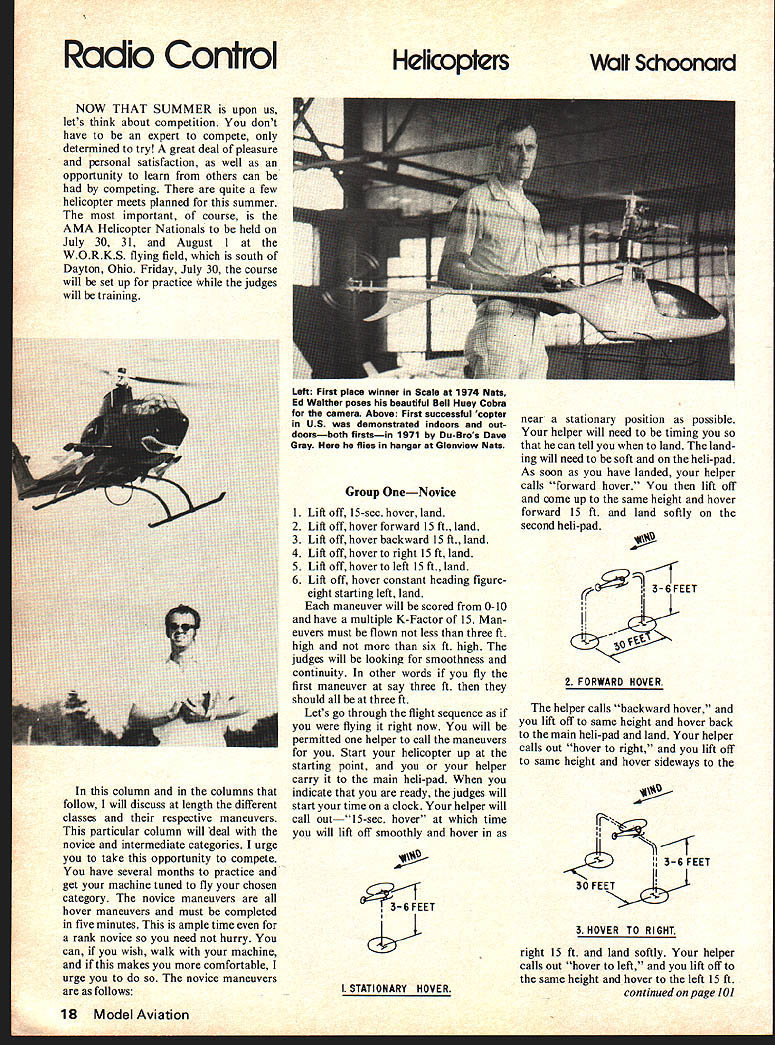
NOW THAT SUMMER is upon us, let's think about competition. You don't have to be an expert to compete, only determined to try! A great deal of pleasure and personal satisfaction, as well as an opportunity to learn from others can be had by competing. There are quite a few helicopter meets planned for this summer. The most important, of course, is the AMA Helicopter Nationals to be held on July 30, 31, and August 1 at the W.O.R.K.S. flying field, which is south of Dayton, Ohio. Friday, July 30, the course will be set up for practice while the judges will be training.
In this column and in the columns that follow, I will discuss at length the different classes and their respective maneuvers. This particular column will deal with the novice and intermediate categories. I urge you to take this opportunity to compete. You have several months to practice and get your machine tuned to fly your chosen category. The novice maneuvers are all hover maneuvers and must be completed in five minutes. This is ample time even for a rank novice so you need not hurry. You can, if you wish, walk with your machine, and if this makes you more comfortable, I urge you to do so. The novice maneuvers are as follows:
Group One—Novice
- Lift off, 15-sec. hover, land.
- Lift off, hover forward 15 ft., land.
- Lift off, hover backward 15 ft., land.
- Lift off, hover to right 15 ft., land.
- Lift off, hover to left 15 ft., land.
- Lift off, hover constant heading figure-eight starting left, land.
Each maneuver will be scored from 0-10 and have a multiple K-Factor of 15. Maneuvers must be flown not less than three ft. high and not more than six ft. high. The judges will be looking for smoothness and continuity. In other words, if you fly the first maneuver at, say, three ft., then they should all be at three ft.
Let's go through the flight sequence as if you were flying it right now. You will be permitted one helper to call the maneuvers for you. Start your helicopter up at the starting point, and you or your helper carry it to the main heli-pad. When you indicate that you are ready, the judges will start your time on a clock. Your helper will call out—"15-sec. hover"—at which time you will lift off smoothly and hover in as near a stationary position as possible. Your helper will need to be timing you so that he can tell you when to land. The landing will need to be soft and on the heli-pad. As soon as you have landed, your helper calls "forward hover." You then lift off and come up to the same height and hover forward 15 ft. and land softly on the second heli-pad.
- STATIONARY HOVER
- FORWARD HOVER
The helper calls "backward hover," and you lift off to same height and hover back to the main heli-pad and land. Your helper calls out "hover to right," and you lift off to same height and hover sideways to the right 15 ft. and land softly. Your helper calls out "hover to left," and you lift off to the same height and hover to the left 15 ft. and land softly on the main heli-pad. Your helper calls out "constant heading figure of eight starting left." You lift off to the same height and hover obliquely to the left 15 ft. to a marker. You should be a little ahead of this marker and then hover backward around the marker and then hover obliquely to the right and cross over the main heli-pad, continuing to the right and around the marker and back to the left, coming to a stationary hover over the main heli-pad and then softly land. Your helper calls out "flight complete," and the clock is stopped. Now that wasn't so bad, was it? You have started on your way to becoming a national champion!
4 CONSTANT HEADING FIGURE OF EIGHT
I suggest that you build three heli-pads — three ft. in diameter, and lay out the course as follows and then practice and practice until you feel comfortable — then practice some more! Locate main heli-pad to suit your area, then locate the second heli-pad 15 ft. into the wind. The third pad should then be located 90 degrees to the wind and 15 ft. to the right of the main heli-pad.
The heli-pad can be made of any material such as fiber-board, masonite, plywood, or any rigid material. It should not be thicker than 1/4 in. Thicker material may possibly be a hazard, causing the helicopter to catch the edge and tip over.
When you practice, have a helper with you call out the maneuvers and time your flight. Your helper should criticize your flying until you get better. If he doesn't, you may possibly become an expert at doing it wrong! Remember that smoothness and continuity is what counts!
Intermediate contestants will fly Group 1 and 2 so need to practice Group 1 Novice in the same manner. In addition to the heli-pad layout, Group 2 contestants should lay out a flag marker 100 ft. into the wind from the main heli-pad. Their maneuvers include Group 1 and the following:
Group Two—Intermediate
- Lift off—climb at 45° to 25 ft.
- One-hundred ft. straight flight.
- Ninety-degree left turn followed by 270° right turn.
- Return flight same path as #2.
- Figure-eight away from spectators.
- Landing.
- Lift off—starting left fly 360° fly around and land.
Your helper should call out "45° climb." Lift off and climb 45° into the wind to 25 ft. altitude. Your helper should now be calling "100 ft. straight flight." You should now be flying at 25 ft. height straight and level into the wind. A flagman will indicate when you have reached the 100 ft. point. Your helper should call "90° left turn and 270° right turn." Your 90° left turn should be sharp followed by a smooth 270° right turn at a constant altitude. The 270° right turn should bring you downwind on the same course as you went into the wind.
Your helper should now be calling "return flight followed by a figure-eight (away from the spectators)." The entry of the figure of eight should be over the heli-pad. Both segments of the figure-eight should be round and have a good identical cross-over point and at the same altitude. Your helper should now call "landing." Upon completion of the figure-eight, bring your helicopter to the main heli-pad and softly land. Your helper calls "flight complete," and the clock is stopped. You have seven minutes to do these. This is ample time, and you should not have to hurry. Remember that smoothness and continuity is what the judges will be looking for.
These rules have been used in several contests that I have conducted, and they have caused no problems as to the contestants' ability to perform them or any problems as to safety.
I am looking for judges for this year's Nats. If you would like to judge, I will be glad to train you. I think that you will find it a very rewarding experience. You will be able to see some of the nation's best helicopter pilots perform close up. You need not have had previous experience to become a good judge. A willingness to do it right and an open mind are the best assets. If you are willing to help, write to me, and I will send you the rules and some judging material to study. My aim is to make the National Helicopter Championships the most prestigious meet in the country. My address is: Walt Schoonard, 2080 Sharon Rd., Winter Park, FL 32789.
Transcribed from original scans by AI. Minor OCR errors may remain.

