
Radio Control: Helicopters
Larry Jolly
"HELLO, Larry Jolly? This is David Quick. I'm property master at Warner's, and I understand you fly model helicopters." That's how my last week's work started.
Ten days would elapse from the first phone call to the final shot. These days included:
- Selection of the helicopters.
- Working out the changes desired by the studio's art director.
- One day's flying for the director and producer to work out the storyboard.
- One day's flying with the star's stunt double as a rehearsal.
- Building and testing four machines.
- Three days of actual filming.
Once it was determined that I would be doing the job, I was privy to more information, such as the fact that this would be a comedy sequence where an obnoxious neighbor chases the lead actor with a model helicopter — with the chase ultimately ending in the helicopter striking the front door of a house just as it is slammed shut.
"Sounds OK. Who'll be playing the lead?" I asked.
"Richard Pryor! But don't worry, we have Ron Oliney, Richard's double."
And that's how I envisioned the filming of this picture. The chase could prove hairy, but, as the director stated, "That's what we are paying you and Ron for."
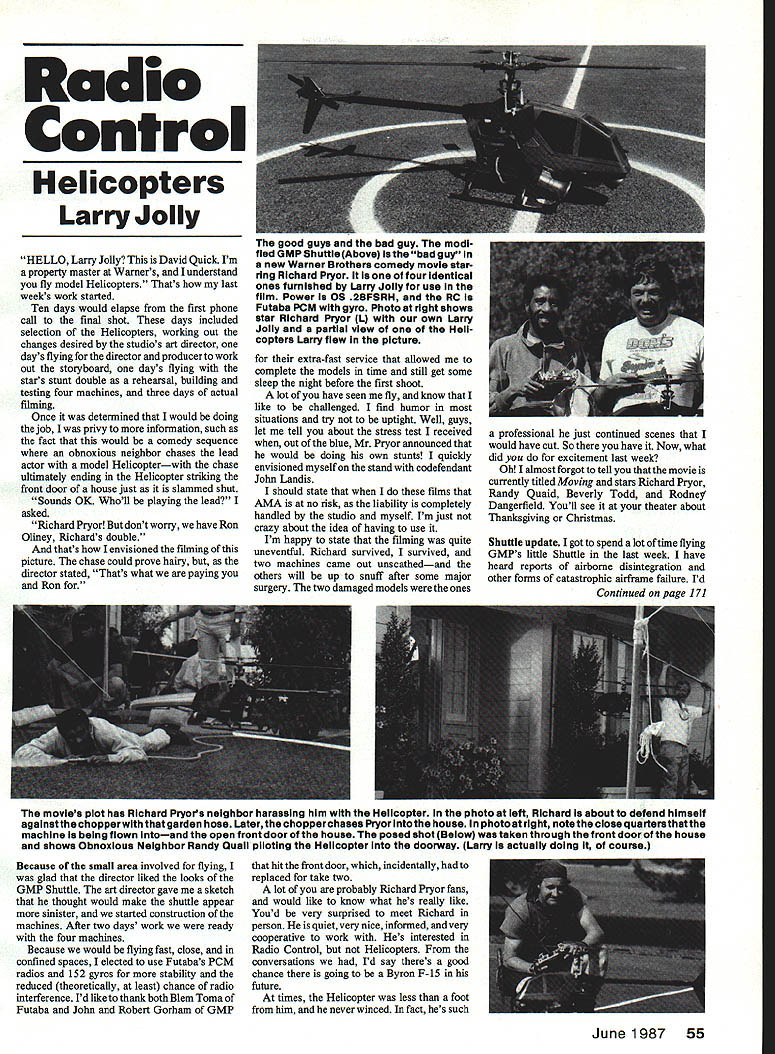
Because of the small area involved for flying, I was glad that the director liked the looks of the GMP Shuttle. The art director gave me a sketch that he thought would make the shuttle appear more sinister, and we started construction of the machines. After two days' work we were ready with the four machines.
Because we would be flying fast, close, and in confined spaces, I elected to use Futaba's PCM radios and 152 gyros for more stability and the reduced (theoretically, at least) chance of radio interference. I'd like to thank both Blem Toma of Futaba and John and Robert Gorham of GMP for their extra-fast service that allowed me to complete the models in time and still get some sleep the night before the first shot.
A lot of you have seen me fly, and know that I like to be challenged. I find humor in most situations and try not to be uptight. Well, guys, let me tell you about the stress test I received when, out of the blue, Mr. Pryor announced that he would be doing his own stunts! I quickly envisioned myself on the stand with co-defendant John Landis.
I should state that when I do these films that AMA is at no risk, as the liability is completely handled by the studio and myself. I'm just not crazy about the idea of having to use it.
I'm happy to state that the filming was quite uneventful. Richard survived, I survived, and two machines came out unscathed — and the others will be up to snuff after some major surgery. The two damaged models were the ones that hit the front door, which, incidentally, had to be replaced for take two.
A lot of you are probably Richard Pryor fans, and would like to know what he's really like. You'd be very surprised to meet Richard in person. He's quiet, very nice, informed, and very cooperative to work with. He's interested in radio control, but not helicopters. From the conversations we've had, I'd say there's a good chance there is going to be a Byron F-15 in his future.
At times, the helicopter was less than a foot from him, and he never winced. In fact, he's such a professional he just continued scenes that I would have cut. So there you have it. Now, what did you do for excitement last week?
Oh! I almost forgot to tell you that the movie is currently titled Moving and stars Richard Pryor, Randy Quaid, Beverly Todd, and Rodney Dangerfield. You'll see it at your theater about Thanksgiving or Christmas.
Shuttle update
I got to spend a lot of time flying GMP's little Shuttle in the last week. I have heard reports of airborne disintegration and other forms of catastrophic airframe failure. I'd be interested in hearing from anyone who has had any sort of serious in-flight Shuttle failure. Please give me as much information about it as you can.
Anyway, back when I did the Shuttle review (December 1985 issue), I recommended that, even though the machine arrives assembled, you take the time and check everything for tightness.
I have found a possible problem area with the Shuttle. It is the screw that retains the bell-mixing arm to the yoke. What I noticed was that the bushing was a hair undersized. I tightened the screw to the point that I still had smooth movement of the mixing arm, but the screw was still not truly seated.
If that arm comes loose in flight the blade will feather wildly, and a boom strike or side-frame failure will be likely. I was lucky; I had just landed, and the rotor was spinning down when the screw fell out. No damage occurred, but if the failure had occurred while the machine was at high rpm, I'd have had a mess on my hands.
What I recommend that you do to remedy this problem (if it exists in your Shuttle) is:
- Remove the mixing arm and sand the outside face so that the bushing protrudes .010–.020 in.
- Reattach and really tighten the screw.
- If the screw is still loose, take it out and put a small drop of thick CyA glue in the hole, and lock it down tight.
I still stand by my original opinion of the Shuttle. I think it is an excellent machine incorporating great ideas and flyability. I know that there is play in the linkage and that many people say that it is fragile. But I'll tell you this: I just hovered one to within inches of Richard Pryor's face, and it and the other three Shuttles were as steady as could be and never gave me any fears of their airworthiness.
New products
There will soon be two new American-made helicopters on the market. Both are .60-size machines and feature new technology. Jon Gorham calls his the New Edition Stork, and Walt Schoonard calls his the X-Cell Series. Both machines look very good, and I am looking forward to presenting them to you here.
That's all until next month.
Larry Jolly 5501 W. Como, Santa Ana, CA 92703
Transcribed from original scans by AI. Minor OCR errors may remain.

