
Radio Control: Helicopters
Larry Jolly
Taking a breather this month, I asked another modeler, Paul Tradelius, to be our guest author. He's going to talk about the basics of the helicopter radio.
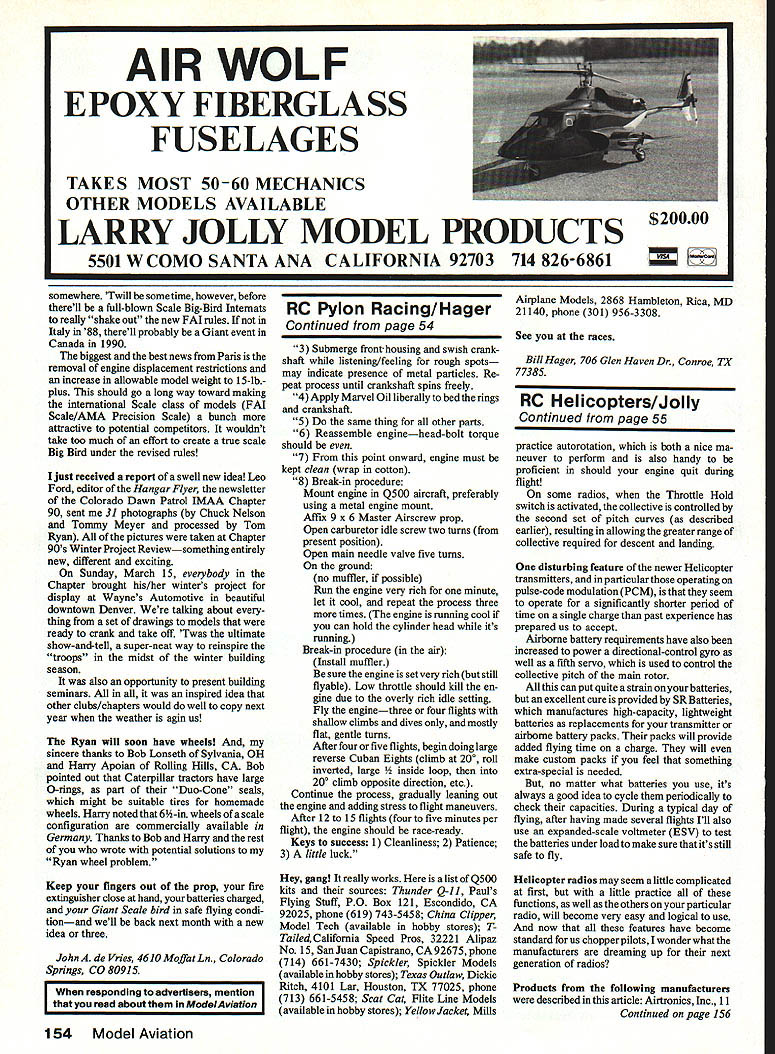
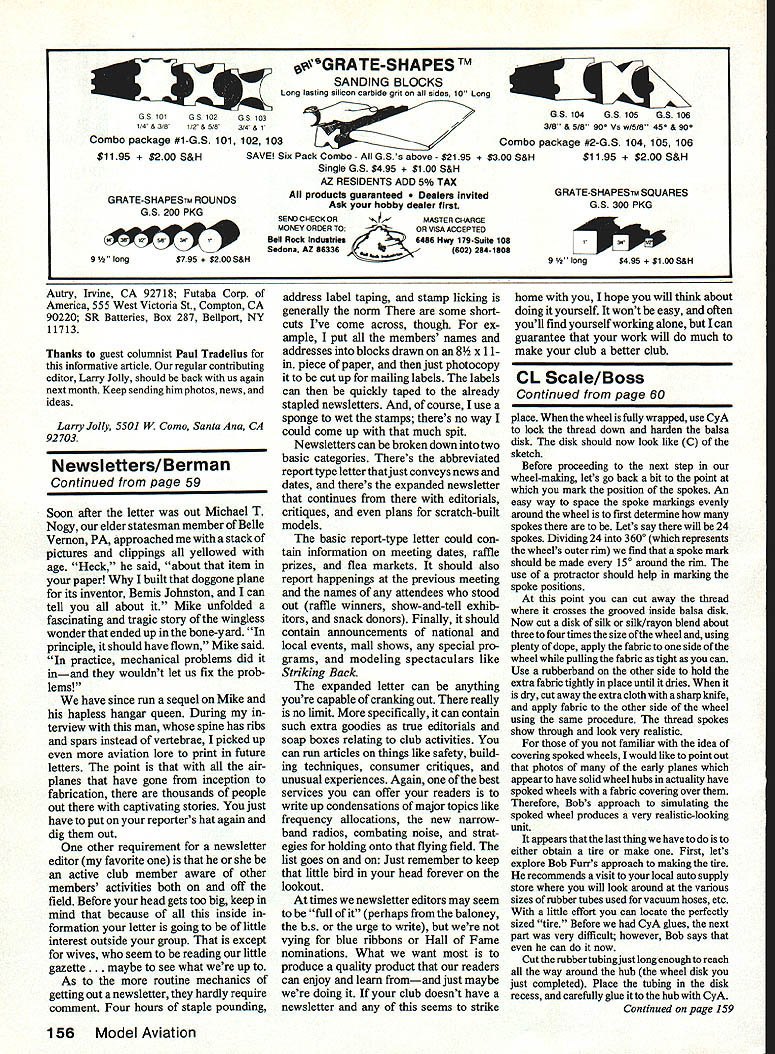
Helicopter radios weren't always like they are today. Years ago radios had two control sticks and a few trim levers. Then came a new era of radio features—servo reverse, dual rates and more. At first many called these additions "bells and whistles"—features not strictly necessary but nice to have—yet those extras soon became standard equipment. Now a newer generation of radios with even more features is standard for helicopter fliers. Each manufacturer uses a different layout of switches and knobs, but modern helicopter radios all include the basic mixing functions needed for helicopter control. Below are some key features you can expect.
Tail Rotor Compensation
Tail Rotor Compensation is a mixer that automatically moves the tail rotor (rudder) servo to compensate for rotor torque changes caused by climbs or descents.
- Example: If the helicopter is hovering and collective (power) is increased to start a climb, main-rotor torque increases and will tend to yaw the nose (left for clockwise-turning rotors) if not corrected. The Tail Rotor Compensation mixer senses the increased collective and adds tail-rotor input to keep the nose straight.
- The reverse occurs when reducing power for a descent; the mixer provides opposite tail-rotor input to counter the yaw caused by reduced main-rotor torque.
- Two trim knobs—one for climb and one for descent—adjust the amount of compensation to suit the machine and flying conditions.
Pitch Curve Adjustment
Pitch Curve Adjustment means the radio can set limits (maximum and minimum) for the collective pitch (angle of incidence) of the main rotor blades. Both high and low collective points can be adjusted; some radios provide multiple pitch-curve sets for different flight phases.
- Normal flying: Limit the high-pitch setting so blade drag doesn't overload the engine. An average starting point might be about +7°.
- Low collective: Set the minimum collective for a comfortable descent rate; an initial setting might be about −2°.
- Autorotations: Practice autorotations typically require a pitch range around −4° to +10°. Negative pitch helps maintain rotor RPM during descent; larger positive pitch aids soft landings as rotor speed decreases.
- Having separate pitch curves for normal flight and autorotations is ideal; without separate curves, you must compromise between settings and be permanently trimmed for one mode.
Idle Up
Idle Up keeps the throttle above idle even when the throttle stick is moved to full idle. The collective can still be reduced to the low-pitch limit, but the throttle remains at a preset higher value.
- Usefulness: During landing without Idle Up, reducing throttle/collective can let rotor RPM drop toward idle, making the helicopter sluggish. When power is reapplied for a hover transition, rotor RPM (and torque) can surge, causing abrupt yaw.
- With Idle Up set to keep the engine well above idle, rotor speed stays high during descent, improving control and smoothing transition back to hover.
- Some radios provide multiple Idle Up settings—one tuned for landings and another for aerobatics (higher rotor rpm across the collective range).
Throttle Hold
Throttle Hold locks the throttle at a predetermined setting regardless of stick position. On a typical two-stick transmitter, the left stick controls both throttle and collective; when Throttle Hold is activated, the stick controls only the collective.
- Purpose: Throttle Hold is used for practicing precise autorotations and can be a safety measure if the engine fails in flight.
- On some radios, activating Throttle Hold also switches to a second set of pitch curves, providing the greater collective range needed for descent and landing during autorotation.
Batteries and Power
One noticeable change with newer radios—especially those using pulse-code modulation (PCM)—is shorter operating time on a single charge compared with older units. At the same time, airborne battery requirements have increased to power additional devices such as direct-control gyros and extra servos (tail or collective servos).
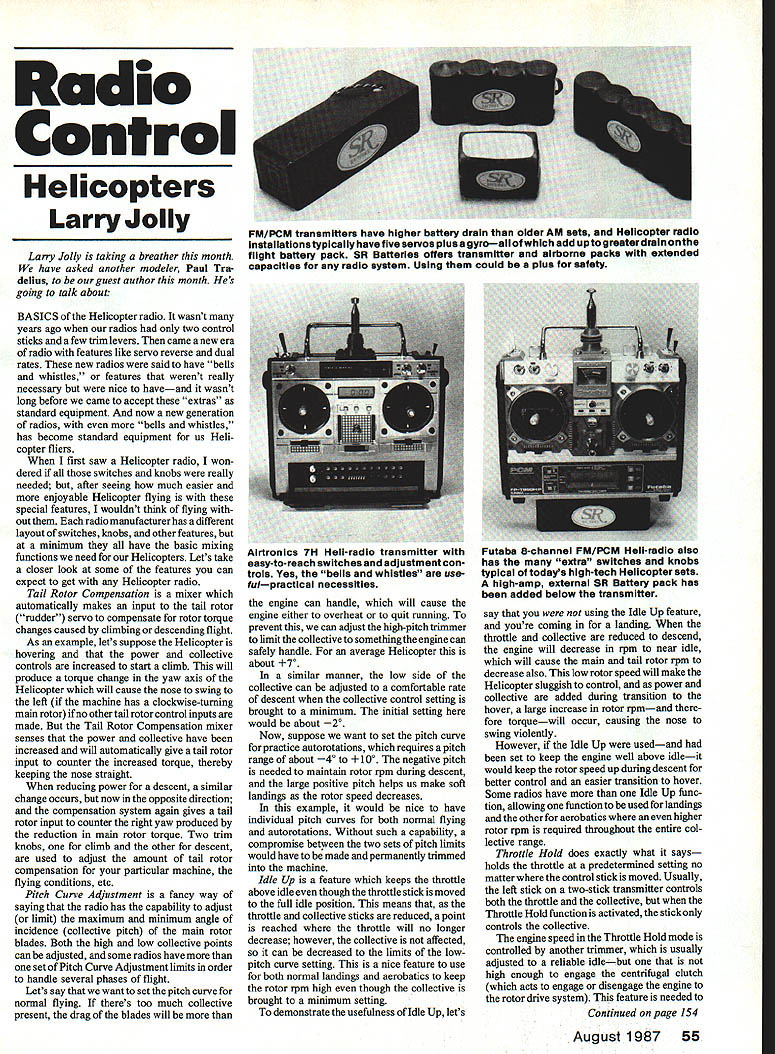
- High-capacity, lightweight replacement packs are available from specialty manufacturers (for example, SR Batteries) and can extend transmitter or airborne operating time. Custom packs can be made when special configurations are needed.
- Regardless of the pack you use, periodically cycle and test batteries to check capacity. During a typical flying day, after several flights, check the transmitter’s voltmeter or ESV under load to ensure the pack remains safe for continued flying.
Helicopter radios may seem complicated at first, but with a little practice the functions on your radio will become logical and easy to use. Now that many advanced features have become standard for chopper pilots, it's interesting to wonder what manufacturers will add next.
Transcribed from original scans by AI. Minor OCR errors may remain.

