

Radio Control: Helicopters
Larry Jolly
WELCOME BACK! As you may recall, a recent article asked readers for comments about their experiences with the GMP Shuttle. I received an excellent letter from Mr. James Katz of Massachusetts. The full letter was too long to reproduce here, but the highlights are worth discussing.
Katz's Shuttle modification
Katz's Shuttle was his first RC helicopter. He and his son learned to fly it without outside help, but hard landings often caused boom strikes (main rotor blade hitting the tail boom), damaging the mixing arm, main rotor blades, tail tube, and fuselage main frames.
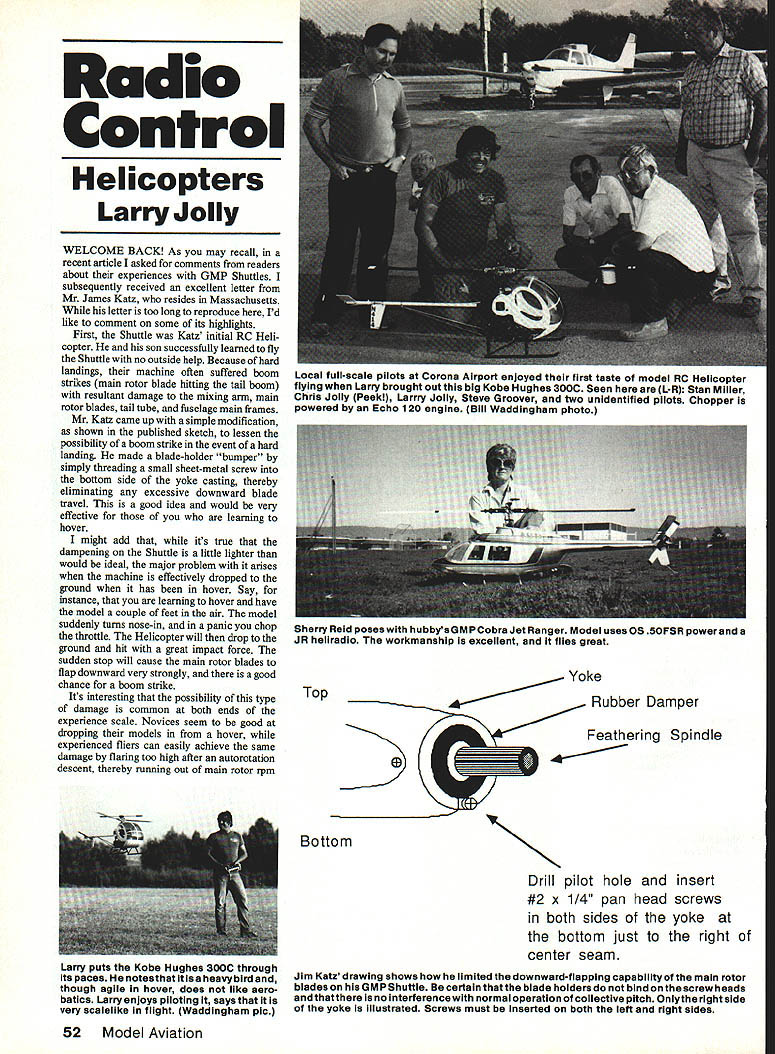
Mr. Katz devised a simple, effective modification to reduce the chance of a boom strike: he made a blade-holder "bumper" by threading a small sheet‑metal screw into the underside of the yoke casting to limit excessive downward blade travel.
- Drill a pilot hole.
- Insert #2 x 1/4" pan head screws in both sides of the yoke at the bottom, just to the right of the center seam.
- Be certain the blade holders do not bind on the screw heads and that there is no interference with normal collective-pitch operation.
- Screws must be installed on both left and right sides.
(Note: only the right side of the yoke is typically illustrated in Katz's drawing — install screws on both sides.)
Cause of boom strikes
The Shuttle's damping is a little light; the major problem occurs when the helicopter is effectively dropped from a hover. Example: while learning to hover at a couple of feet, the model suddenly turns nose-in and the pilot chops throttle in a panic. The helicopter drops and hits the ground with great impact force. The sudden stop lets the main rotor blades flap downward strongly, creating a high chance of a boom strike.
This type of damage occurs at both ends of the experience scale:
- Novices may drop the model from a hover.
- Experienced pilots can cause the same damage by flaring too high after an autorotation descent and running out of main-rotor rpm.
Mr. Katz also mentioned modifications to the clutch, mixing arms, and ball links. Many of these were outlined by Terry Moore in his "Super Shuttle" article in the British RC Helicopter magazine. While not strictly necessary, these modifications can improve the overall helicopter.
Blade tightness
A common problem is running main rotor blades too loose. Blades should not swing freely in flight; they should be snug enough to hold position.
- Running blades loose to avoid breakage on ground strikes is logical, but if one blade is looser than the other it will swing in and out of track, causing excessive vibration.
- Excessive swinging increases the likelihood of a boom strike in the event of a bounce.
Set blade retention so blades are secure and properly tracked.
Novice perspective
Mr. Katz observed — and I agree — that magazine columnists, who are usually experts, may forget the mistakes a novice might make with the same machine. I will endeavor to include more information and articles that address the novice's point of view.
CMI update
I recently announced that California Model Imports would no longer be importing the KKK line of RC helicopter kits. I’m sorry to see this happen; Dave and Sandra Robertson put a lot of work into the product line. I hope someone sees the potential in the KKK kits and continues their work.
Hughes 300 gas-powered chopper (Dave Robertson's)
I recently had the opportunity to purchase Dave Robertson's personal Hughes 300 gas-powered helicopter. Highlights:
- Uses the main frame and drivetrain from the successful R-22 machine, with a new tail tube and a Bell/Hiller rotor head.
- Rotor diameter: about 55 in.
- Engine: Echo 120 (similar in appearance to a Kioritz).
- All-up weight (with Airtronics radio and DigiGyro): ~13 lb.
- Engine uses spark ignition and burns a mixture of oil and low-lead gasoline.
- Endurance: over 30 minutes on a single 10‑oz tank of fuel.
- This particular Hughes has no autorotation clutch and does not like to autorotate, yet it is one of the most fun machines I've flown because of its low engine rpm and realistic power-to-weight ratio.
- Flight characteristics: drones along like its full-size counterpart, tolerates turbulence better, and shows a realistic tail wag in slow flight.
If you haven't flown a gas-powered model, try one. Because they are usually heavier than glow-engined machines, they hover more slowly and handle turbulence better — making them particularly enjoyable for slow-flying, public demonstrations.
Transcribed from original scans by AI. Minor OCR errors may remain.

