
Radio Control: Helicopters
Larry Jolly
Welcome back. Before I start this month I'd like to thank those readers who have responded to my pleas for more reader input. In the last month I received 10 responses, some even with pictures. That's great news to a columnist. It makes him feel good that someone out there is listening, and it gives him some ammunition for the next column. It's really a pain in the neck to try to think up an interesting subject for each month's writing. When the readers contribute, all of us are rewarded.
Please, if you have an idea, a new ship, or you've got some pictures of you and your flying buddies doing your thing, why don't you think about sending a copy and maybe a little note. I'll do my best to answer questions and get the information out in the open.
Just recently I had a reader tell me that we need more help for beginners—that we experts can fly anything, and that we've forgotten what it's like to be at the first rung of the ladder. He's right, I know. Recently I had a gold mine of a novice experience fall into my lap.
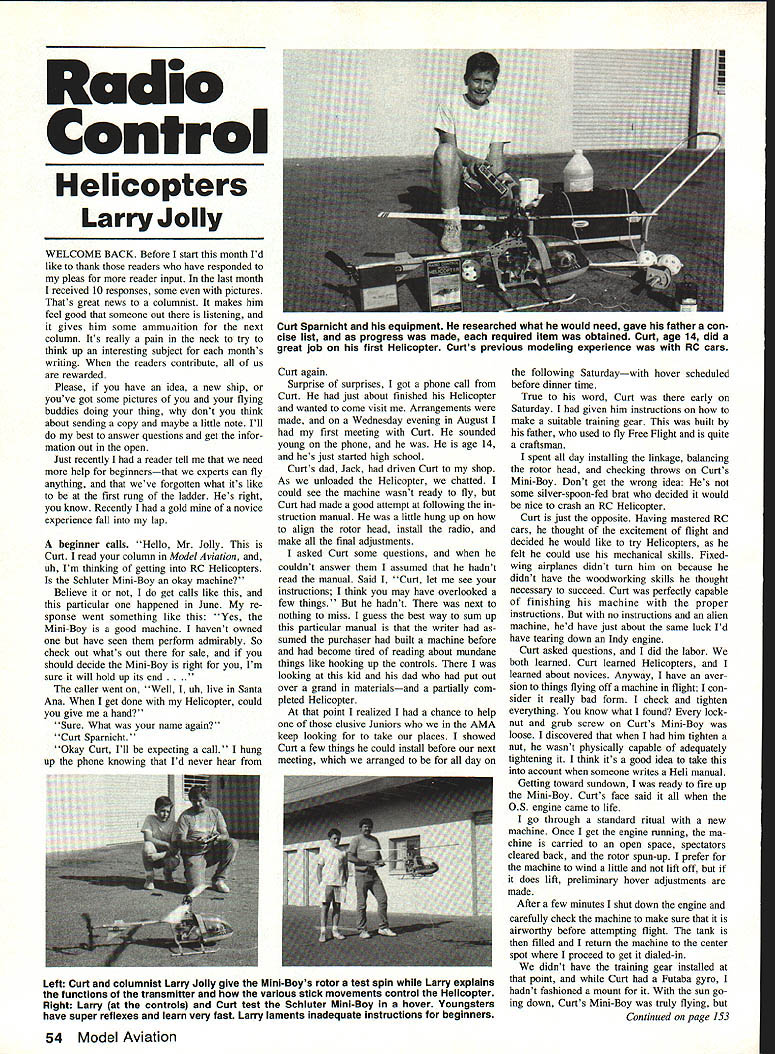
A beginner calls. "Hello, Mr. Jolly. This is Curt. I read your column in Model Aviation, and, uh, I'm thinking of getting into RC helicopters. Is the Schluter Mini-Boy an okay machine?"
Believe it or not, I do get calls like this, and this particular one happened in June. My response went something like this: "Yes, the Mini-Boy is a good machine. I haven't owned one but have seen them perform admirably. So check out what's out there for sale, and if you should decide the Mini-Boy is right for you, I'm sure it will hold up its end..."
The caller went on, "Well, I, uh, live in Santa Ana. When I get done with my helicopter, could you give me a hand?"
"Sure. What was your name again?"
"Curt Sparnicht."
"Okay Curt, I'll be expecting a call." I hung up the phone knowing that I'd never hear from Curt again. Surprise, surprise, I got a phone call from Curt again. He had just finished his helicopter and wanted to come visit me. Arrangements were made and on a Wednesday evening in August I had my first meeting with Curt. He sounded young on the phone, and he was. He is 14, and he's just started high school.
Curt's dad, Jack, had driven Curt to my shop. As we unloaded the helicopter, we chatted. I could see the machine wasn't ready to fly, but Curt had made a good attempt at following the instruction manual. He was a little hung up on how to align the rotor head, install the radio, and make all the final adjustments.
I asked Curt some questions, and when he couldn't answer them I assumed that he hadn't read the manual. I said, "Curt, let me see your instructions; I think you may have overlooked a few things." He hadn't. There was next to nothing to miss. I guess the best way to sum up this particular manual is that the writer had assumed the purchaser had built a machine before and had become tired of reading about mundane things like hooking up the controls. There I was looking at this kid and his dad who had put out over a grand in materials—and a partially completed helicopter.
At that point I realized I had a chance to help one of those curious juniors who live in the AMA. I keep looking for young fellows to take our places. I showed Curt a few things he could install before our next meeting, which we arranged to be for all day on the following Saturday—with hover scheduled before dinner time.
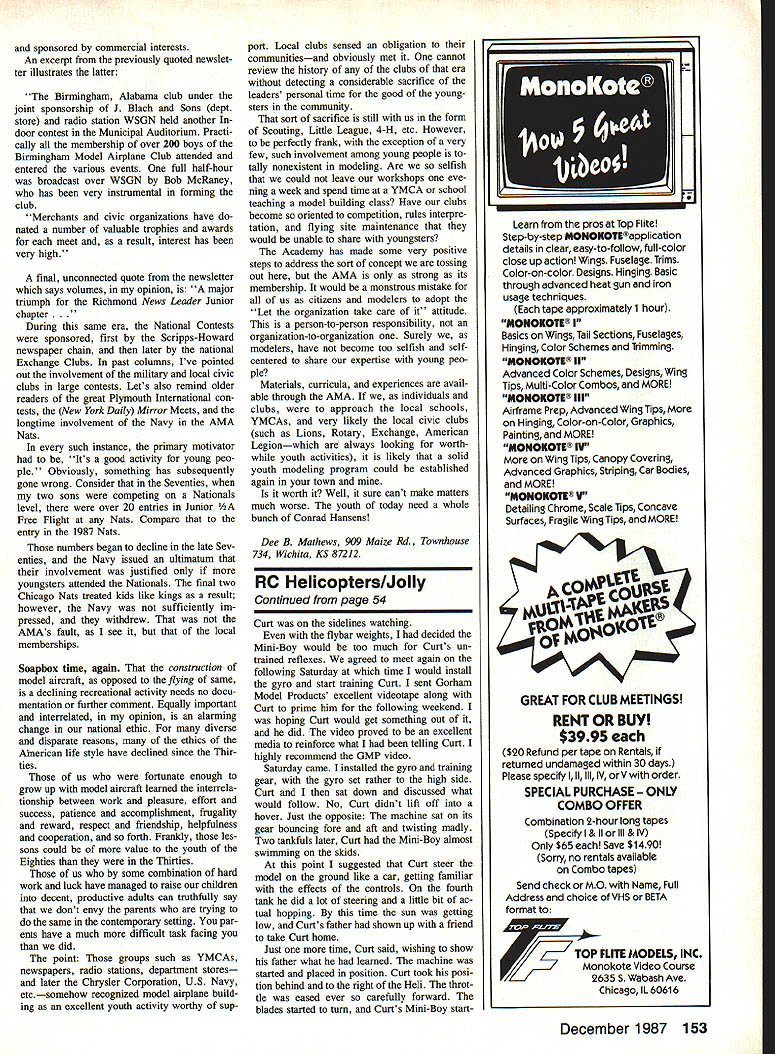
True to his word, Curt was there early on Saturday. I had given him instructions on how to make suitable training gear. This was built by his father, who used to fly free flight and is quite a craftsman.
I spent all day installing the linkage, balancing the rotor head, and checking throws on Curt's Mini-Boy. Don't get the wrong idea: he's not some silver-spoon-fed brat who decided it would be nice to crash an RC helicopter. Curt is just the opposite. Having mastered RC cars, he thought of the excitement of flight and decided he would like to try helicopters, as he felt he could use his mechanical skills. Fixed-wing airplanes didn't turn him on because he didn't have the woodworking skills he thought necessary to succeed. Curt was perfectly capable of finishing the machine with the proper instructions; had he bought the Mini-Boy and put it together without instructions and an unfamiliar machine he'd have about the same luck I'd have tearing down an Indy engine.
Curt asked questions, and I did the labor. We both learned. Curt learned helicopters, and I learned about novices. Anyway, I have an aversion to things flying off a machine in flight and I check and tighten everything. You know what I found? Every locknut and grub screw on Curt's Mini-Boy was loose. I discovered that when I had him tighten a nut, he wasn't physically capable of adequately tightening it. I think it's a good idea to take the time to check someone's work.
Getting toward sundown, I was ready to fire up the Mini-Boy. Curt's face said it all when the O.S. engine came to life.
I go through the standard ritual with a new machine. Once I get the engine running, the machine is carried to an open space, spectators cleared back, and the rotor spun up. I prefer for the machine to wind a little and not lift off, but if it does lift, preliminary hover adjustments are made.
After a few minutes I shut down the engine and carefully check the machine to make sure it is airworthy before attempting flight. The tank is then filled and I return the machine to the center spot where I proceed to get it dialed in.
We didn't have the training gear installed at that point, and while Curt had a Futaba gyro, I hadn't fashioned a mount for it. With the sun going down, Curt's Mini-Boy was truly flying. Curt was on the sidelines watching. Even with the wobble weights, I had decided the Mini-Boy would be too much for Curt's untrained reflexes. We agreed to meet again on the following Saturday at which time I would install the gyro and start training Curt. I sent Gorham Model Products' excellent videotape along with Curt to prime him for the following weekend. I was hoping Curt would get something out of it, and he did. The video proved to be an excellent way to reinforce what I had been telling Curt. I highly recommend the GMP video.
Saturday came. I installed the gyro and training gear, set the gyro so it would be somewhat less sensitive, and we got the machine ready. Curt and I then sat down and discussed what would follow. No, Curt didn't lift off into a hover. Just the opposite. The machine sat on its gear and started to gyrate until it was bouncing fore and aft and twisting madly. Two tankfuls later Curt had the Mini-Boy almost swimming on the skids.
At this point I suggested that Curt steer the model on the ground like a car, getting familiar with the effects of the controls. On the fourth tank he did a lot of steering and a little bit of lift. By this time the sun was getting low and Curt's father had shown up with a friend to take Curt home.
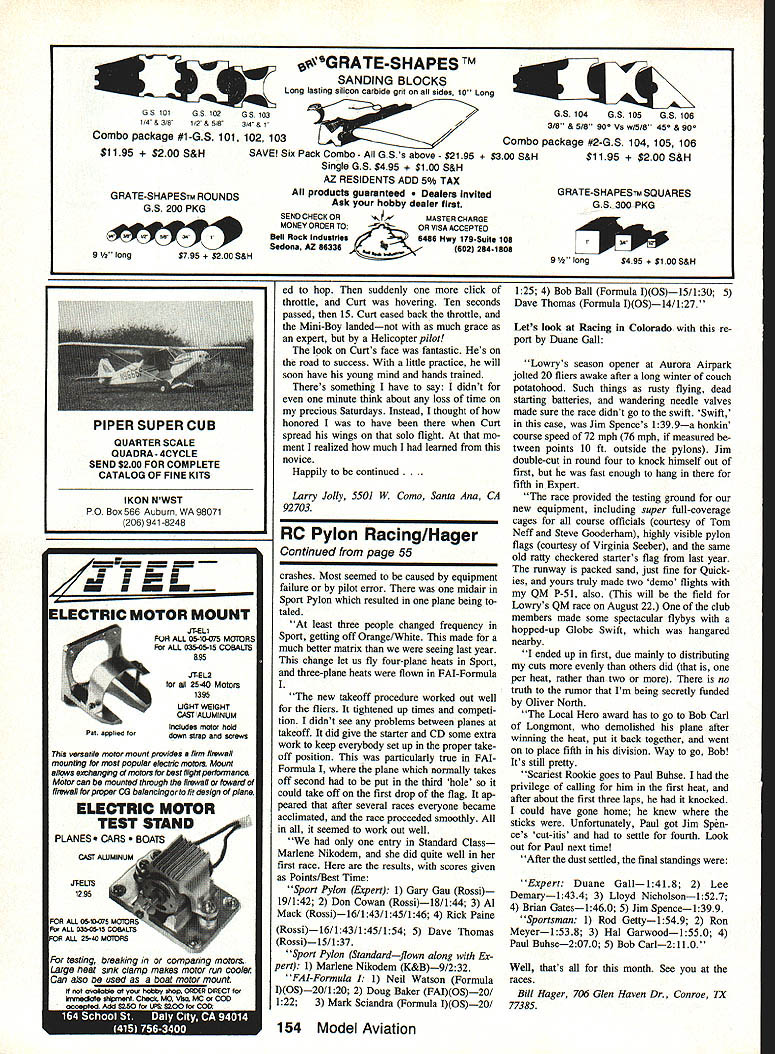
"Just one more time," Curt said, wishing to show his father what he had learned. The machine was started and placed in position. Curt took his position behind and to the right of the ship. The throttle was eased very carefully forward. The blades started to turn, and Curt's Mini-Boy started to climb. He made a couple of small corrections, and it was away. It began to hop. Then suddenly one more click of throttle, and Curt was hovering. Ten seconds passed, then 15. Curt eased back the throttle, and the Mini-Boy landed—not with as much grace as an expert, but by a helicopter pilot!
The look on Curt's face was fantastic. He's on the road to success. With a little practice, he will soon have his young mind and hands trained.
There are several points to be made from this experience:
- Don't assume anyone has read the instructions.
- Check and tighten everything before the first flight—locknuts and grub screws will often be loose.
- Use a gyro and training gear for novices until they develop the necessary coordination.
- A little preparation—videos, parental involvement, and some ground work—will go a long way toward making a successful first flight.
I didn't for even one minute think about any loss of time on my precious Saturdays. Instead, I thought of how honored I was to have been there when Curt spread his wings on that solo flight. At that moment I realized how much I had learned from this novice.
Happily to be continued . . .
Larry Jolly 5501 W. Como, Santa Ana, CA 92703
Transcribed from original scans by AI. Minor OCR errors may remain.

