
Radio Control: Helicopters
Larry Jolly
If you recall, last month's column was dedicated to a novice named Curt Sparnicht and my involvement in helping him finish his Schluter Mini-Boy. I'm also helping another first-time chopper pilot, Dale Garcia.
After my adventure with Curt, I questioned Dale about his experience finishing his first machine. What I found interesting was that their problems were pretty much the same. I had thought that because of Curt's young age he might have problems associated with general lack of experience. However, Dale is in his late 20s, and his problems and questions were identical to Curt's. By the way, Dale is working on a Kobe Fox, so my comments which follow don't relate to just one particular make or model.
I hope that some of the manufacturers, importers, and distributors are listening, because my observations could be of interest to you. The single biggest problem for a first-time helicopter builder/pilot is that the instruction manuals are too vague. Neither Dale nor Curt could finish their machines without help.
Often the instruction manual is the last task in a long list before the kit goes to market. It's not uncommon for a manufacturer to have one of his flying team members or an employee write the instructions. If the individual writing the manual happens to be an advanced builder/flier, he will tend to write the instructions at a level too high for the novice to understand.
There are certain basic points in building an RC helicopter that are universal to most machines. Because my space isn't limitless I won't be able to complete a list of everything that should be included in instructions, but I'm pretty sure the idea will come across.
What instructions should include
- Clear drawings that explain construction details; every part should be well documented and shown in its proper position.
- Drawings must be clear and usable.
- Emphasis on which parts must be tight and which parts must move freely.
- All pushrods illustrated at full size with the ball links in place.
- Clear direction if a ball link must be shortened, and explicit warning about what will happen if a ball link is over-tightened.
- Tools required for each assembly step (for example, when assembling threaded ball ends into a swashplate: should you use pliers or an open-end wrench? Both will work, but pliers can ruin the ball if used carelessly).
- Recommendations for radio, engine, servos, and other components, including tested brands and minimum specifications.
The builder should be made aware of the proper tools needed in each sequence. I'm aware that what I'm saying is pretty elementary, but most new people just don't know what to do. By the way, what constitutes a good four- to five-channel radio? Or a good .50- to .60-size engine? Can you imagine the consternation a newcomer has when he reads "Mount optional gyro here"—have you ever gone to the hobby shop and asked for an optional gyro?
It's natural for a kit manufacturer to be cautious about pushing another manufacturer's products in his instructions. From the builder's point of view, however, it would be very worthwhile and adaptable for the kit manufacturer to document a product or products that he has used and found to work well. For instance, the instructions might say, "We recommend a good .50- to .60-size engine for our machine. We have tested the O.S. FSR, Enya .60X, and Super Tigre .60 in our prototype and found all of them to be reliable and easy to adjust."
What about servos? The instructions could specify a ball-race torque servo with a minimum of 45 in.-oz. of torque. If the kit manufacturer doesn't specify these things, someone is going to put an inadequate servo in a machine and promptly bash it because of a servo not adequate for the job. If a manufacturer has tested one brand that proved to be better or a lot less than any comparable brand, then tell the builder: he deserves to know.
Most of all, the manufacturer should state who the instructions are written for—a person who has never seen an RC helicopter. Try as you might, you just can't oversimplify an instruction manual.
I've aimed this primarily toward the manufacturers, and there is a reason: Everything I've noticed leads to success. There are plenty of helicopters stuck in the back of garages because the builder became frustrated and couldn't finish the job. If your product baffles someone, you've lost a potential future customer, and we've lost a potential new recruit to our sport. Also, don't forget to remind your customers of the advantages of being an AMA member.
If you are a novice out there with a question or a problem, don't be afraid to write me (address at the end of the column). If I can't help you, then I can at least point you in the right direction.
An old friend writes
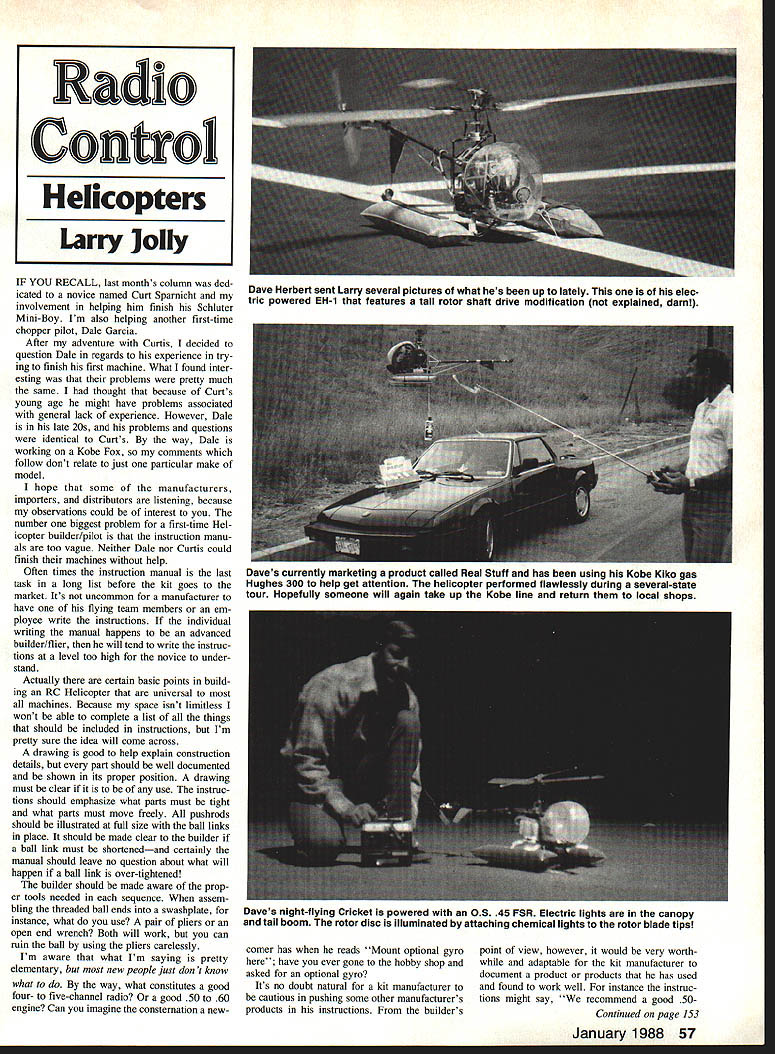
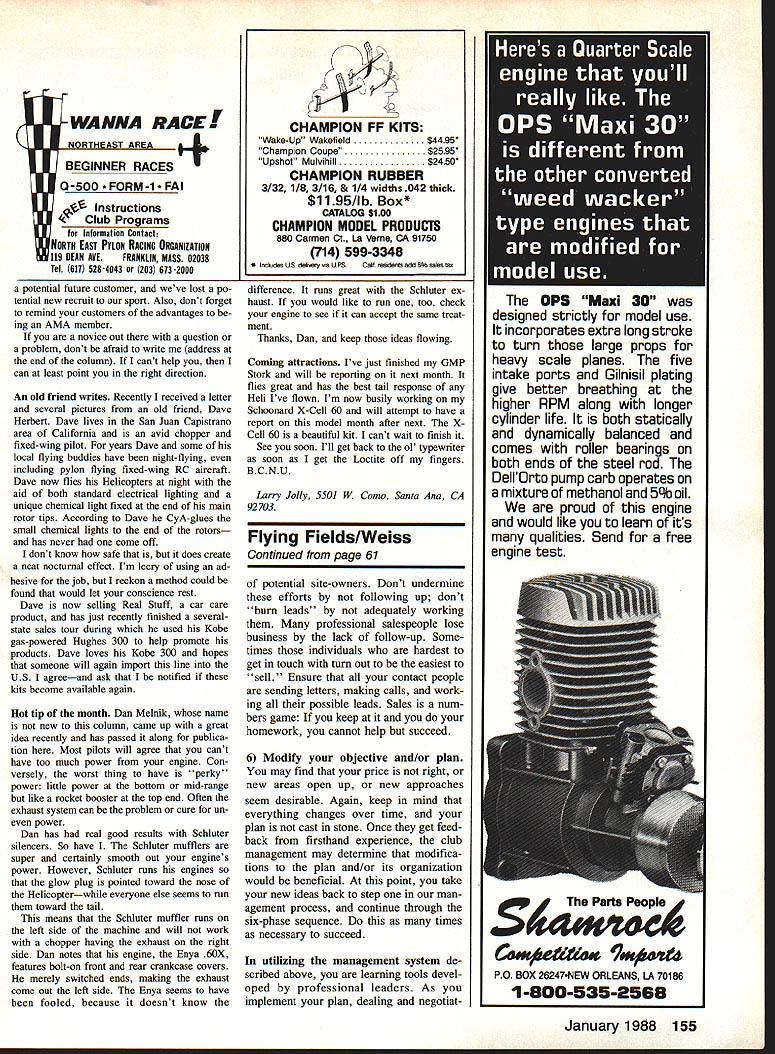
Recently I received a letter and several pictures from an old friend, Dave Herbert. Dave lives in the San Juan Capistrano area of California and is an avid chopper and fixed-wing pilot. For years Dave and some of his local flying buddies have been night-flying, even including pylon flying fixed-wing RC aircraft. Dave now flies his helicopters at night with the aid of both standard electrical lighting and a unique chemical light fixed at the end of his main rotor tips.
According to Dave, he uses CA (cyanoacrylate) glue to attach the small chemical lights to the rotor tips—OK, they have been done this way in other circles. I don't know how safe that is, but it does create a neat nocturnal effect. I'm leery of using an adhesive for this job, but I reckon a method could be found that would let your conscience rest.
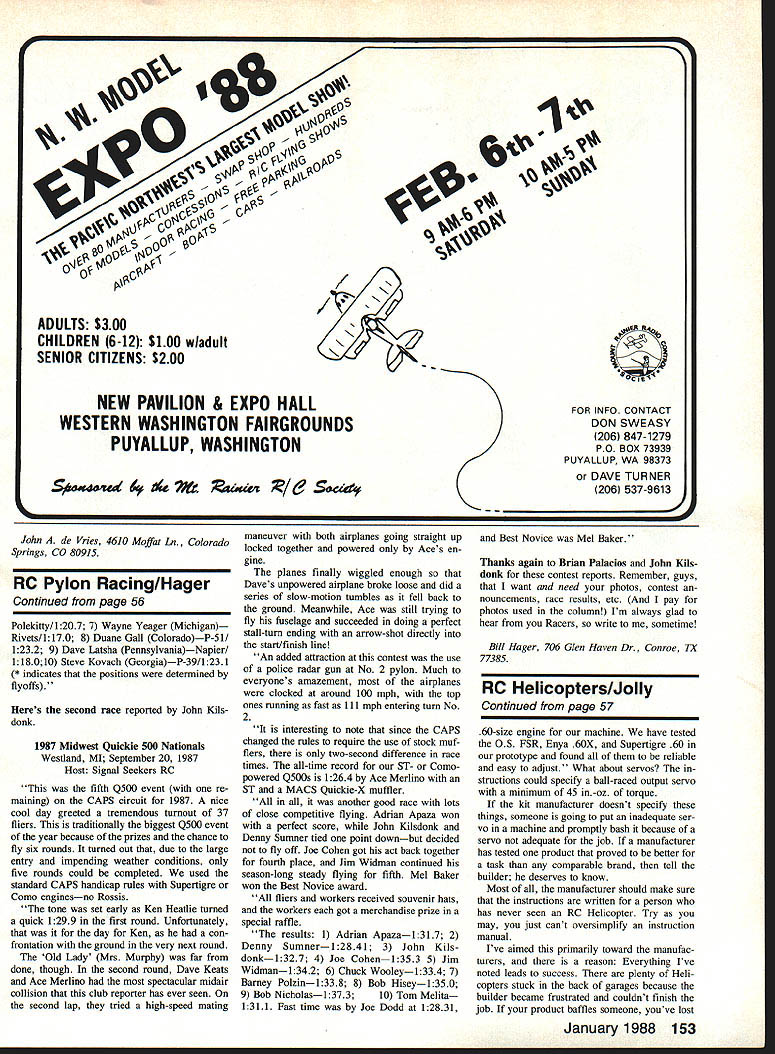
Dave is now selling Real Stuff, a car care product, and has just recently finished a several-state sales tour during which he used his Kobe gas-powered Hughes 300 to help promote his products. Dave loves his Kobe 300 and hopes that someone will again import this line into the U.S. I agree—and ask that I be notified if these kits become available again.
Hot tip of the month
Dan Melnik, whose name is not new to this column, came up with a great idea recently and has passed it along. Most pilots will agree that you can't have too much power from your engine. Conversely, the worst thing to have is "jerky" power: little power at the bottom or mid-range or a rocket booster at the top end. Often the exhaust system can be the problem—or the cure—for uneven power.
Dan has had good results with Schluter mufflers. So have I. The Schluter mufflers are super and certainly smooth out your engine's power. However, Schluter runs his engines so that the glow plug is pointed toward the nose of the helicopter—while everyone else seems to run them toward the tail.
This means that the Schluter muffler runs on the left side of the machine and will not work with a chopper having the exhaust on the right side. Dan notes that his engine, the Enya .60SX, features bolts-on front and rear crankcase covers. He merely switched ends, making the exhaust come out the left side. The Enya seems to have been fooled, because it doesn't know the difference. It runs great with the Schluter exhaust. If you would like to run one, too, check your engine to see if it can accept the same treatment.
Thanks, Dan, and keep those ideas flowing.
Coming attractions
I've just finished my GMP Stork and will be reporting on it next month. It flies great and has the best tail response of any helicopter I've flown. I'm now busy working on my Schoonord X-Cel 60 and will attempt to have a report on this model month after next. The X-Cel 60 is a beautiful kit. I can't wait to finish it.
See you soon. I'll get back to the typewriter as soon as I get the Loctite off my fingers.
B.C.N.U.
Larry Jolly 5501 W. Como Santa Ana, CA 92703
Transcribed from original scans by AI. Minor OCR errors may remain.

