
Radio Control: Helicopters
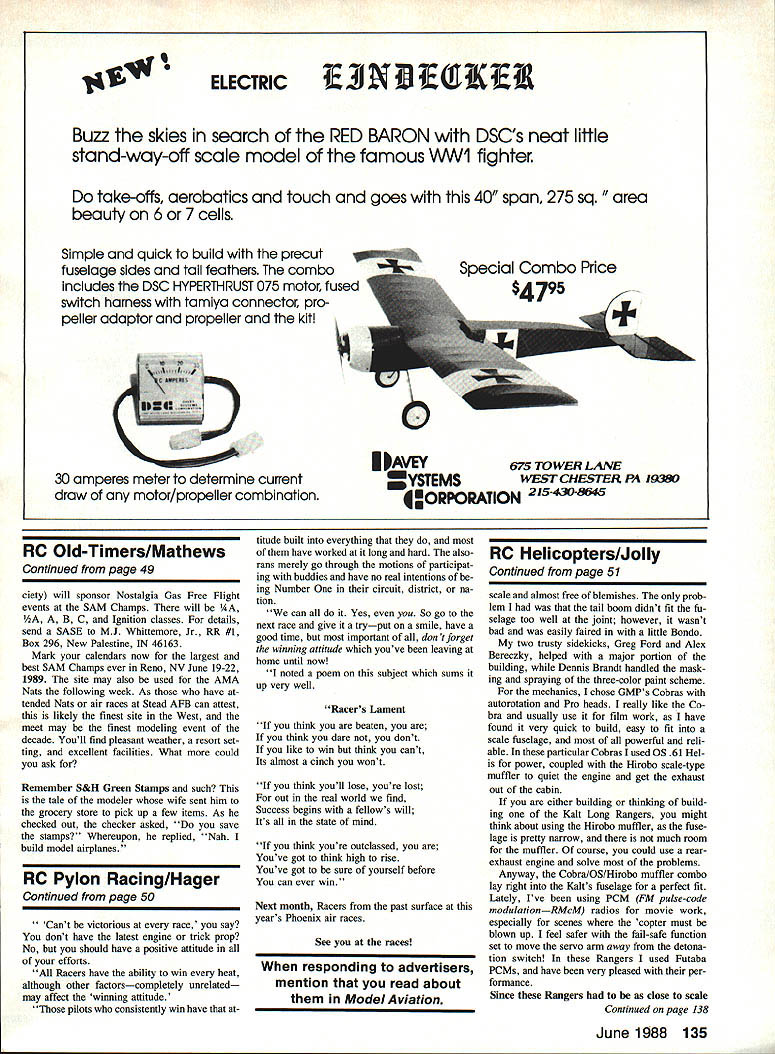
Larry Jolly
5501 W. Como Santa Ana, CA 92703
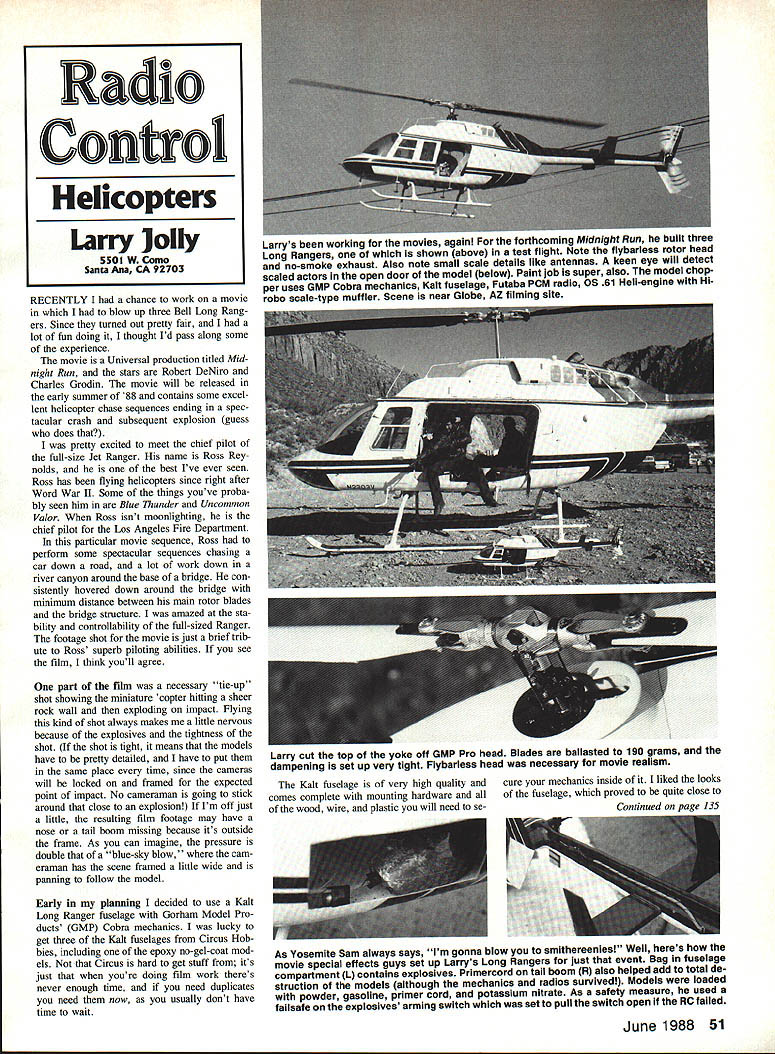
Movie assignment — Midnight Run
Recently I had a chance to work on a movie in which I had to blow up three Bell Long Rangers. Since they turned out pretty fair, and I had a lot of fun doing it, I thought I'd pass along some of the experience.
The movie is a Universal production titled Midnight Run, starring Robert De Niro and Charles Grodin. The film was scheduled for release in the early summer of 1988 and contains some excellent helicopter chase sequences ending in a spectacular crash and subsequent explosion.
Meeting the full-size pilot
I was pretty excited to meet the chief pilot of the full-size Jet Ranger, Ross Reynolds. He is one of the best pilots I've ever seen and has been flying helicopters since right after World War II. You may have seen him in Blue Thunder and Uncommon Valor. When not moonlighting, Ross is the chief pilot for the Los Angeles Fire Department.
In the sequence he flew, Ross performed spectacular maneuvers chasing a car down a road and flying down a river canyon around the base of a bridge. He consistently hovered very close to the bridge structure with minimal clearance between the main rotor blades and the bridge. I was amazed at the stability and controllability of the full-size Ranger. The footage shot is a brief tribute to Ross' superb piloting abilities — if you see the film, I think you'll agree.
The miniature "tie-up" shot and explosives
One necessary shot showed the miniature 'copter hitting a sheer rock wall and then exploding on impact. Flying this kind of shot makes me nervous because of the explosives and the tight framing. A tight shot means models must be highly detailed and placed in the same spot every take, since the cameras are locked and framed for the expected point of impact. No cameraman is going to stick around that close to an explosion. If I'm off just a little, the resulting footage may show a missing nose or tail boom because it's outside the frame. The pressure is double compared with a "blue-sky blow," where the cameraman frames a little wide and pans to follow the model.
For the effect I used models loaded with:
- powder
- gasoline
- primer cord
- potassium nitrate
The explosives were arranged so that the charge would hit the wall, produce a flash on impact, and then cause total disintegration of the fuselage with the mechanics falling to the ground. As a safety measure we used a failsafe on the explosives' arming switch set to pull the switch open if the RC failed.
Model selection and building
Early in planning I decided to use a Kalt Long Ranger fuselage with Gorham Model Products' (GMP) Cobra mechanics. I was lucky to get three Kalt fuselages from Circus Hobbies, including one of the epoxy no-gel-coat models. The Kalt fuselage is of very high quality, almost free of blemishes, and comes complete with mounting hardware and all of the wood, wire, and plastic needed to secure the mechanics inside. The fuselage closely resembled the full-size version; the only problem was the tail boom joint fit, which I faired in easily with a little Bondo.
My two sidekicks, Greg Ford and Alex Berezesky, helped with a major portion of the building, while Dennis Brandt handled the masking and spraying of the three-color paint scheme.
For mechanics and power:
- Mechanics: GMP Cobra with autorotation and Pro head
- Engine: OS .61 Heli
- Muffler: Hirobo scale-type muffler (quiets the engine and routes exhaust out of the cabin)
If you build a Kalt Long Ranger, consider the Hirobo muffler because the fuselage is narrow. Alternatively, a rear-exhaust engine can solve muffler clearance problems.
I cut the top of the yoke off the GMP Pro head. Blades were ballasted to 190 grams, and the dampening was set up very tight. A flybarless head was necessary for movie realism.
Flybarless rotor head setup and tuning
Since these Rangers needed to be as close to scale as possible, we went flybarless. I have been flying GMP's heads flybarless for several years and had excellent results by modifying them as follows:
- Bandsaw the center yoke off even with the top of the machined portion of the head.
- Assemble the head normally, but make the dampening as tight as possible.
- Use two links direct from the swashplate (no mixer on the head).
- Reduce collective/cyclic throws so pitch changes remain normal.
Specific setup used on the Rangers:
- Rotor diameter: 58 in. (GMP blades cut to this diameter)
- Blade ballast: 190 grams each (center-of-gravity corrected)
- Dampening: very tight
With this setup the ships were super to fly. Because I use no mixer on the head, cutting down the collective/cyclic throws is important to avoid excessive response. With 190-gram blades, autorotations were excellent — very forgiving with lots of inertia.
Radios, failsafe, and flight testing
Lately I've used PCM (pulse-code modulation) radios for movie work, especially for scenes where the 'copter must be blown up. I feel safer with the fail-safe function that moves the servo arm away from the detonator switch. For these Rangers I used Futaba PCM radios and was very pleased with their performance.
We finished the three Rangers in time and shipped them ahead to Globe, AZ, where filming would take place. I arrived two days later and found minimal damage from air freight.
We flew at an elevation of 4,000 ft. — a concern because higher altitude reduces performance — but even loaded to about 13 lb., the Rangers flew excellently at that altitude. After building three helicopters and shipping them to location in a month, the flying itself was anticlimactic. The director locked off two high-speed cameras, panned with two more, and I hit the spot.
This was the first time I'd used real explosives like potassium nitrate and primer cord on a shoot. After destroying the third ship and loading up, I felt grateful I could depend on the various model companies to provide quality equipment capable of doing the job safely. If you see Midnight Run, look for the small part model aviation played in producing a believable explosion.
New GMP machine coming
Gorham Model Products has given permission to announce their new aerobatic helicopter, the Legend. I have flown the prototype and can tell you the Legend is capable of very daring aerobatic maneuvers. GMP showed the ship at Toledo.
The Legend is a cooperative effort between Gorham and Hirobo, but this one is more Gorham. Features include:
- Flybarless rotor head
- Toothed-belt tail rotor drive
- Extremely light weight
As John says, the ship "...is made of mostly two new space age materials called aluminum and steel." As soon as I can get some pictures, I'll give a preview.
Transcribed from original scans by AI. Minor OCR errors may remain.

