
Radio Control: Helicopters
Larry Jolly
5501 W. Como Santa Ana, CA 92703
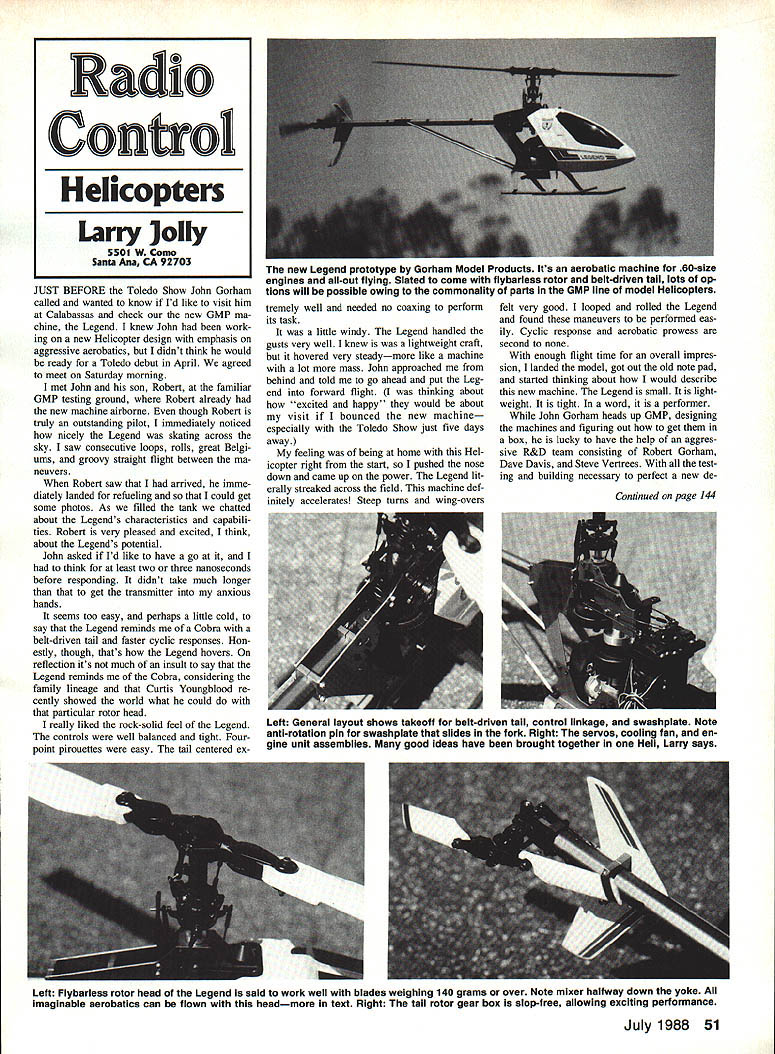
Just before the Toledo Show John Gorham called and wanted to know if I'd like to visit him at Calabasas and check out the new GMP machine, the Legend. I knew John had been working on a new helicopter design with emphasis on aggressive aerobatics, but I didn't think he would be ready for a Toledo debut in April. We agreed to meet on Saturday morning.
I met John and his son, Robert, at the familiar GMP testing ground, where Robert already had the new machine airborne. Even though Robert is truly an outstanding pilot, I immediately noticed how nicely the Legend was skating across the sky. I saw consecutive loops, rolls, great Belgiums, and groovy straight flight between maneuvers.
When Robert saw that I had arrived, he immediately landed for refueling and so that I could get some photos. As we filled the tank we chatted about the Legend's characteristics and capabilities. Robert is very pleased and excited, I think, about the Legend's potential.
John asked if I'd like to have a go at it, and I had to think for at least two or three nanoseconds before responding. It didn't take much longer than that to get the transmitter into my anxious hands.
It seems too easy, and perhaps a little cold, to say that the Legend reminds me of a Cobra with a belt-driven tail and faster cyclic responses. Honestly, though, that's how the Legend hovers. On reflection it's not much of an insult to say that the Legend reminds me of the Cobra, considering the family lineage and that Curtis Youngblood recently showed the world what he could do with that particular rotor head.
I really liked the rock-solid feel of the Legend. The controls were well balanced and tight. Four-point pirouettes were easy. The tail centered extremely well and needed no coaxing to perform its task.
It was a little windy. The Legend handled the gusts very well. I knew it was a lightweight craft, but it hovered very steady—more like a machine with a lot more mass. John approached me from behind and told me to go ahead and put the Legend into forward flight. (I was thinking about how "excited and happy" they would be about my visit if I bounced the new machine—especially with the Toledo Show just five days away.)
My feeling was of being at home with this helicopter right from the start, so I pushed the nose down and came up on the power. The Legend literally streaked across the field. This machine definitely accelerates! Steep turns and wing-overs felt very good. I looped and rolled the Legend and found these maneuvers to be performed easily. Cyclic response and aerobatic prowess are second to none.
With enough flight time for an overall impression, I landed the model, got out the old notepad, and started thinking about how I would describe this new machine. The Legend is small. It is lightweight. It is tight. In a word, it is a performer.
While John Gorham heads up GMP, designing the machines and figuring out how to get them in a box, he is lucky to have the help of an aggressive R&D team consisting of:
- Robert Gorham
- Dave Davis
- Steve Vertrees
With all the testing and building necessary to perfect a new design, many good ideas have been brought together in one heli. In design, these guys sure helped the Legend happen a lot sooner than it otherwise would have.
The Legend was designed to be a ship capable of contest flying—and especially for advanced aerobatics, which is again popular in the U.S. It is a step in the evolution of the GMP line, using many components common to other current models. Commonality, however, was not the determining factor as to whether a part was suitable for the new model.
As the design evolved, weight reduction was a key goal. For instance, several grams were removed from the main-gear autorotation unit. This practice was applied wherever it was practical. I have always found that if you worry about the grams, the ounces will take care of themselves. This is certainly true of the Legend, because a ready-to-fly machine weighs under nine pounds.
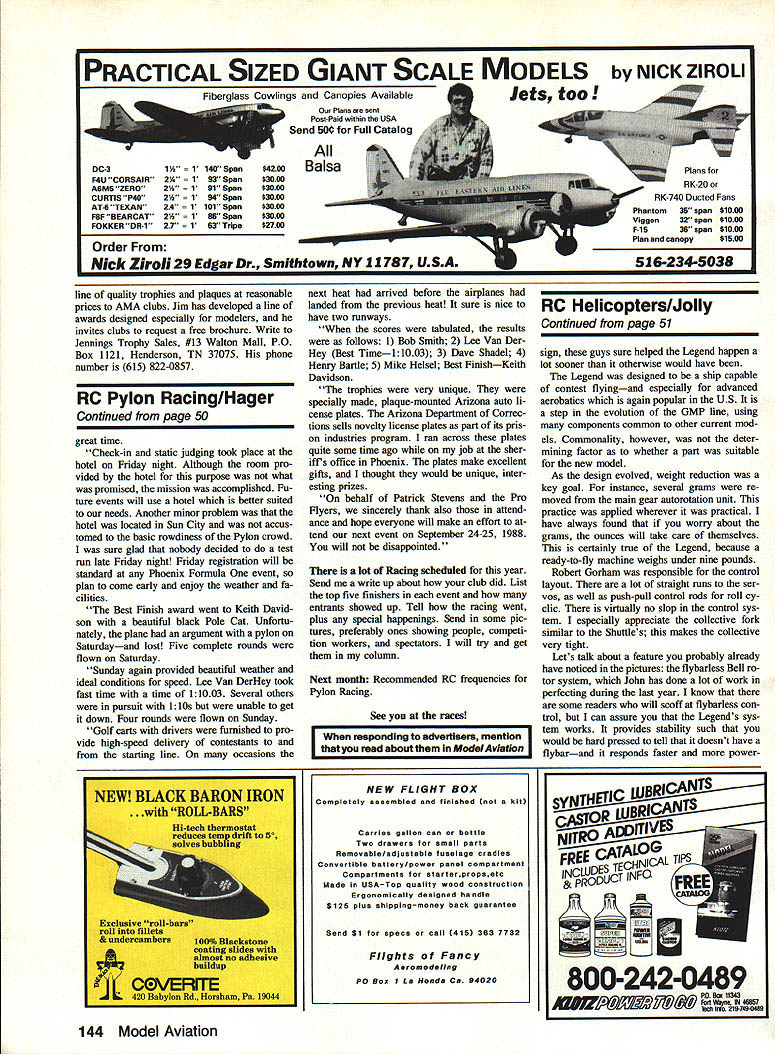
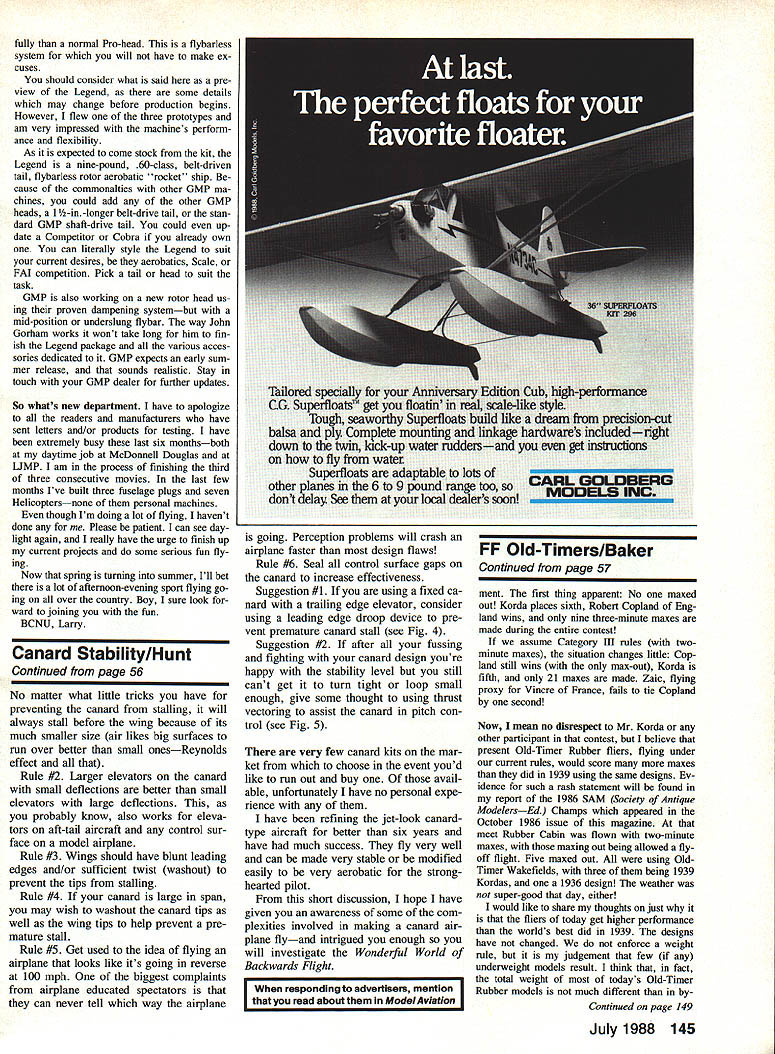
Robert Gorham was responsible for the tail rotor. There are a lot of straight runs to the servos, as well as push-pull control rods for roll cycle. There is virtually no slop in the control system. I especially appreciate the collective fork similar to the Shuttle's; this makes the collective very tight.
Let's talk about a feature you probably already have noticed in the pictures: the flybarless Bell rotor system, which John has done a lot of work in perfecting during the last year. I know that there are some readers who will scoff at flybarless control, but I can assure you that the Legend's system works. It provides stability such that you would be hard pressed to tell that it doesn't have a flybar—and it responds faster and more powerfully than a normal Pro-head. This is a flybarless system for which you will not have to make excuses.
You should consider what is said here as a preview of the Legend, as there are some details which may change before production begins. However, I flew one of the three prototypes and am very impressed with the machine's performance and flexibility.
As it is expected to come stock from the kit, the Legend is a nine-pound, .60-class, belt-driven-tail, flybarless rotor aerobatic "rocket" ship. Because of the commonalities with other GMP machines, you could add any of the other GMP heads, a 1-1/2-in.-longer belt-drive tail, or the standard GMP shaft-drive tail. You could even update a Competitor or Cobra if you already own one. You can literally tailor the Legend to suit your current desires, be they aerobatics, scale, or FAI competition. Pick a tail or head to suit the task.
GMP is also working on a new rotor head using their proven dampening system—but with a mid-position or underslung flybar. The way John Gorham works it won't take him long to finish the Legend package and all the various accessories dedicated to it. GMP expects an early summer release, and that sounds realistic. Stay in touch with your GMP dealer for further updates.
So what's new department. I have to apologize to all the readers and manufacturers who have sent letters and/or products for testing. I have been extremely busy these last six months—both at my daytime job at McDonnell Douglas and with J.M.P. I am in the process of finishing the third of three consecutive moves. In the last few months I've built three fuselage plugs and seven helicopters—one of them personal machines. Even though I'm doing a lot of flying, I haven't done any for myself. Please be patient. I can see daylight again, and I really have the urge to finish up my current projects and do some serious fun flying.
Now that spring is turning into summer, there is a lot of afternoon-evening sport flying going on all over the country. Boy, I sure look forward to joining you with the fun.
BCNU, Larry
Transcribed from original scans by AI. Minor OCR errors may remain.

