
Radio Control: Helicopters
Larry Jolly 5501 W. Como Santa Ana, CA 92703
DIE HARD. That's the name of my latest movie project, and I'd like to pass along some ideas and experiences I've gained while working on it.
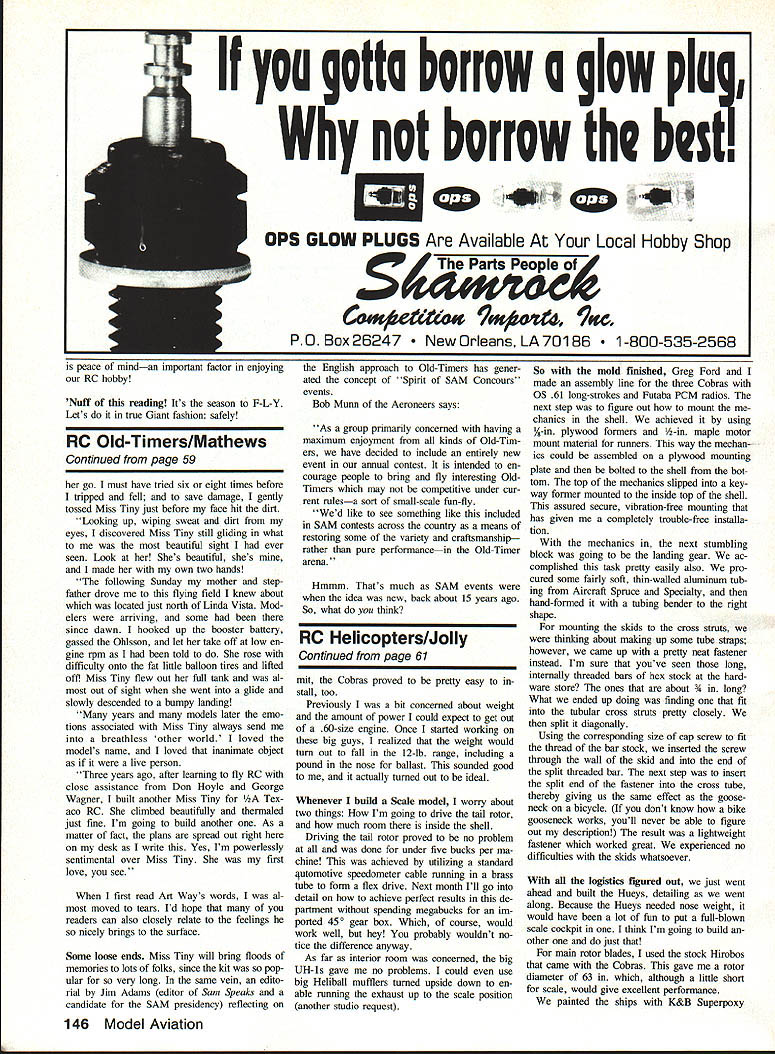
Die Hard is a new Fox production starring Bruce Willis. There is some spectacular full-size helicopter flying done in the film; flying close to buildings—and at night, to boot. I was pretty thrilled when offered the chance to do the film, as it meant building some UH-1s, and I would be working for Boss Films (which is fast becoming the premier special effects house in Hollywood).
There were two major shots requiring miniatures:
- A crane shot looking down on top of a building while a miniature flew through a giant fireball.
- A crash sequence off the top of a building, ending with the tail boom totally separating from the Huey in flight.
I have to admit it: I really have a "thing" for the old UH-1. There is something about its pollywog shape and the Wop! Wop! Wop! of the main rotors.
Choosing a model and scale
I wasn't too worried about getting the fuselages, as I had previously pulled a mold off the old Hirobo UH-1B, 1/5-scale, which is no longer available. As often happens, I went in to talk to Boss and made a deal for the movie—and promptly had to make larger, 1/4-scale Hueys.
As most of you know, Hirobo makes a great 1/5-scale UH-1B powered with a gas engine. I was a little worried about using that combination, as I knew I would be hauling lights and explosives. I wasn't sure the gas engine would put out enough power to carry the necessary weight and still be agile.
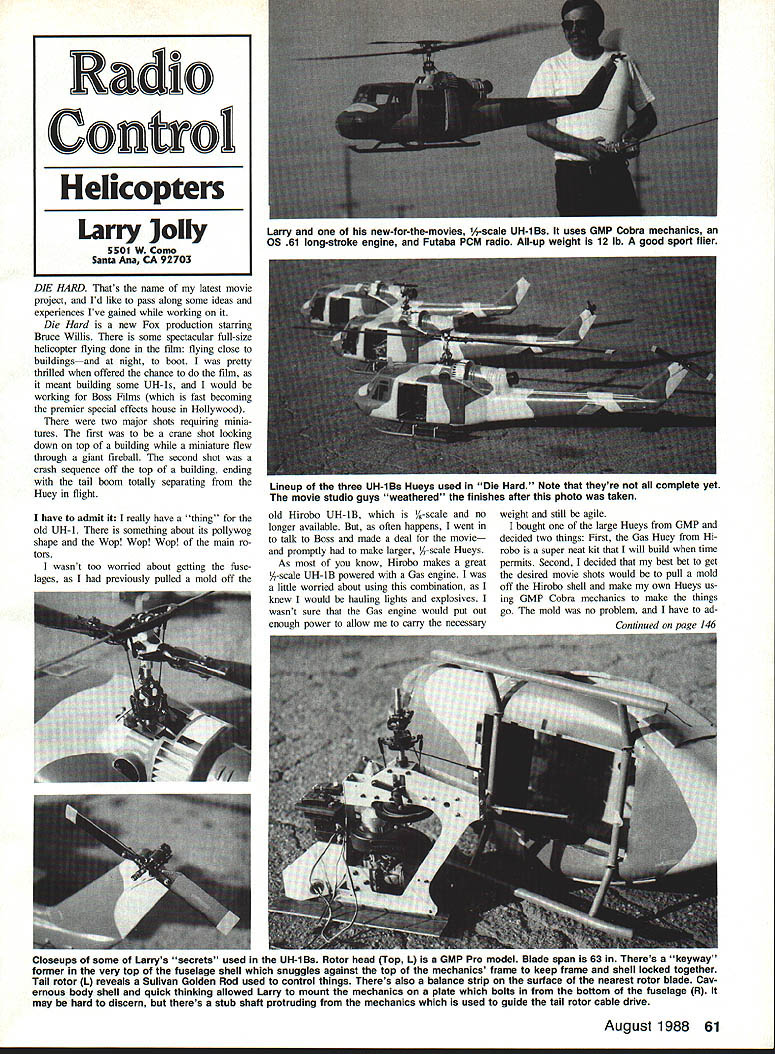
I bought one of the large Hueys from GMP and decided two things: first, the gas Huey from Hirobo is a super neat kit that I will build when time permits; second, my best bet to get the desired movie shots was to pull a mold off the Hirobo shell and make my own Hueys using GMP Cobra mechanics to drive them.
Mechanics and mounting
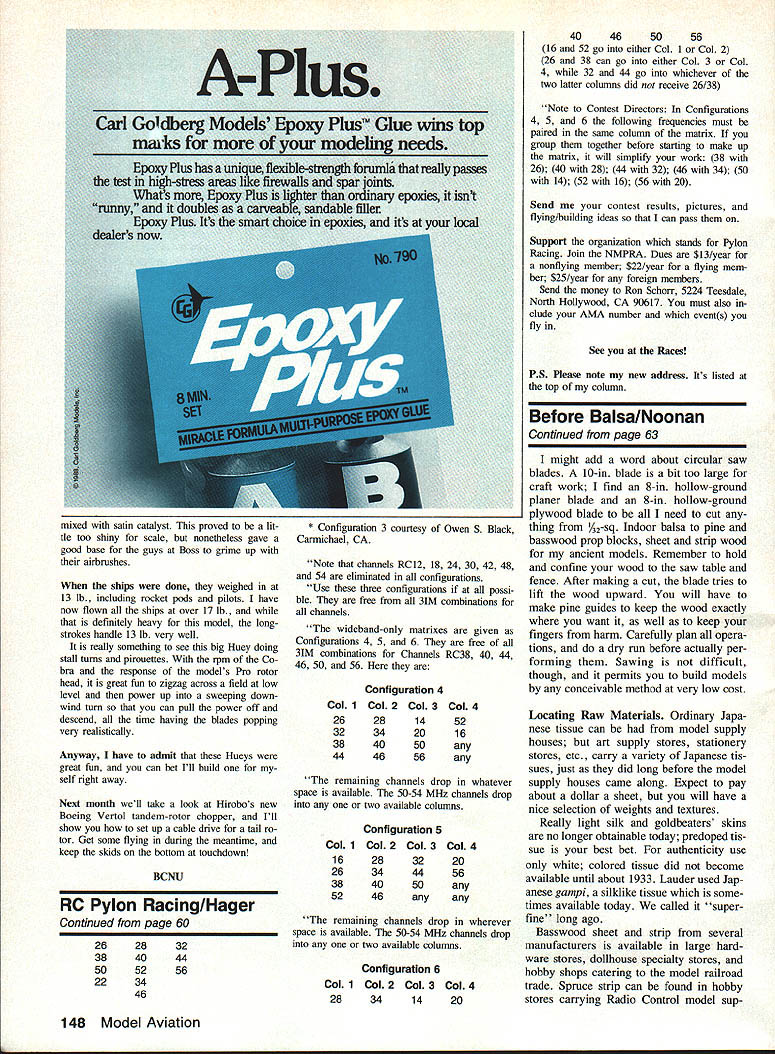
The mold was no problem, and with the mold finished, Greg Ford and I made an assembly line for the three Cobras with OS .61 long-strokes and Futaba PCM radios. The next step was to figure out how to mount the mechanics in the shell.
We achieved that by using 1/2-in. plywood formers and 4-1/2-in. maple motor-mount material for runners. This way the mechanics could be assembled on a plywood mounting plate and then bolted to the bottom from underneath. The top of the mechanics slipped into a keyway former mounted to the inside top of the shell. This assured secure, vibration-free mounting and has given me a completely trouble-free installation.
For main rotor blades, I used the stock Hirobo blades that came with the Cobras. This gave a rotor diameter of 63 in., which, although a little short for scale, provided excellent performance.
Landing gear
The next stumbling block was the landing gear. We procured fairly soft, thin-walled aluminum tubing from Aircraft Spruce and Specialty, and then hand-formed it with a tubing bender to the right shape.
For mounting the skids to the cross struts, we considered making up some tube stubs, but came up with a neat fastener instead. You may have seen long, internally threaded bars of hex stock at the hardware store (about 3/4 in. long). We found one that fit closely into the tubular cross struts and then split it diagonally.
Using the corresponding size of cap screw to fit the thread of the bar stock, we inserted the screw through the wall of the skid and into the end of the split threaded bar. The next step was to insert the split end of the fastener into the cross tube, thereby giving us the same effect as the gooseneck on a bicycle. The result was a lightweight fastener that worked great. We experienced no difficulties with the skids whatsoever.
Detailing, painting, and weight
With all the logistics figured out, we built the Hueys and detailed them as we went along. Because the Hueys needed nose weight, it would have been fun to put a full-blown scale cockpit in one—I think I'm going to build another and do just that!
We painted the ships with K&B Superoxy mixed with satin catalyst. This proved to be a little too shiny for scale, but nonetheless gave a good base for the guys at Boss to grime up with their airbrushes.
When the ships were done, they weighed in at 13 lb., including rocket pods and pilots. I have now flown all the ships at over 17 lb., and while that is definitely heavy for this model, the long-strokes handle 13 lb. very well.
Flight impressions
It is really something to see this big Huey doing stall turns and pirouettes. With the rpm of the Cobra and the response of the model's Pro rotor head, it is great fun to zigzag across a field at low level and then power up into a sweeping downwind turn so that you can pull the power off and descend, all the time having the blades popping very realistically.
Anyway, I have to admit that these Hueys were great fun, and you can bet I'll build one for myself right away.
Next month we'll take a look at Hirobo's new Boeing Vertol tandem-rotor chopper, and I'll show you how to set up a cable drive for a tail rotor. Get some flying in during the meantime, and keep the skids on the bottom at touchdown!
BCNU
Transcribed from original scans by AI. Minor OCR errors may remain.

