
Radio Control: Helicopters
Larry Jolly
5501 W. Como Santa Ana, CA 92703
WELCOME BACK. I hope that all of you are getting some flying in the evenings now that summer is here. It sure makes a day's work go faster when you've got a flight session to look forward to.
Last month I talked about the large UH-1s I'd made for a movie and said that we would be taking a look at Hirobo's new Boeing Vertol, but I'd like to save that for next month, as it really is time that I discussed Miniature Aircraft Supply's first solo venture, the X-Cell.
Anyone who has been in the hobby for any length of time knows of Walt Schoonard. If you've been around long enough, you know that Walt was the first (I believe) helicopter columnist for Model Aviation back in the early Seventies. Anyway, Walt has always been an avid helicopter flier and promoter.
For many years Walt Schoonard acted as the U.S. distributor for the German Schluter company, Miniature Aircraft Supply. Walt's company soon marketed both helicopters and their accessories. In the middle Eighties, we witnessed the success of the Schluter Superior and the Champion. Reportedly, Walt had made design input on both of these ships. About the same time Miniature Aircraft started promoting and distributing Ewald Heim's helicopters. Also in the early Eighties, we started hearing about Walt's sons, Ted and Tim. Both are now well known as excellent craftsmen and fliers.
With Walt's experience and strong family support coupled with the U.S. dollar's plummeting value on the world market, the advent of a new American-made helicopter certainly seemed inevitable though conceived and executed in total secrecy. The X-Cell was not a total surprise when it was finally unveiled at the Nuremberg Toy Fair.
As expected, the X-Cell exhibits all that Walt Schoonard has learned in his long involvement in our hobby.
The X-Cell
So what is an X-Cell? It is a highly competitive, American-designed-and-manufactured RC helicopter. It features composite construction. The basic machine as built from the kit has a pod-and-boom fuselage, single-axle Bell/Hiller rotor system with an underslung flybar. It is available in two sizes, the smaller suitable for .50-size engines and the larger for .60-size engines. Since that description is a little vague, I'll elaborate further.
The kit
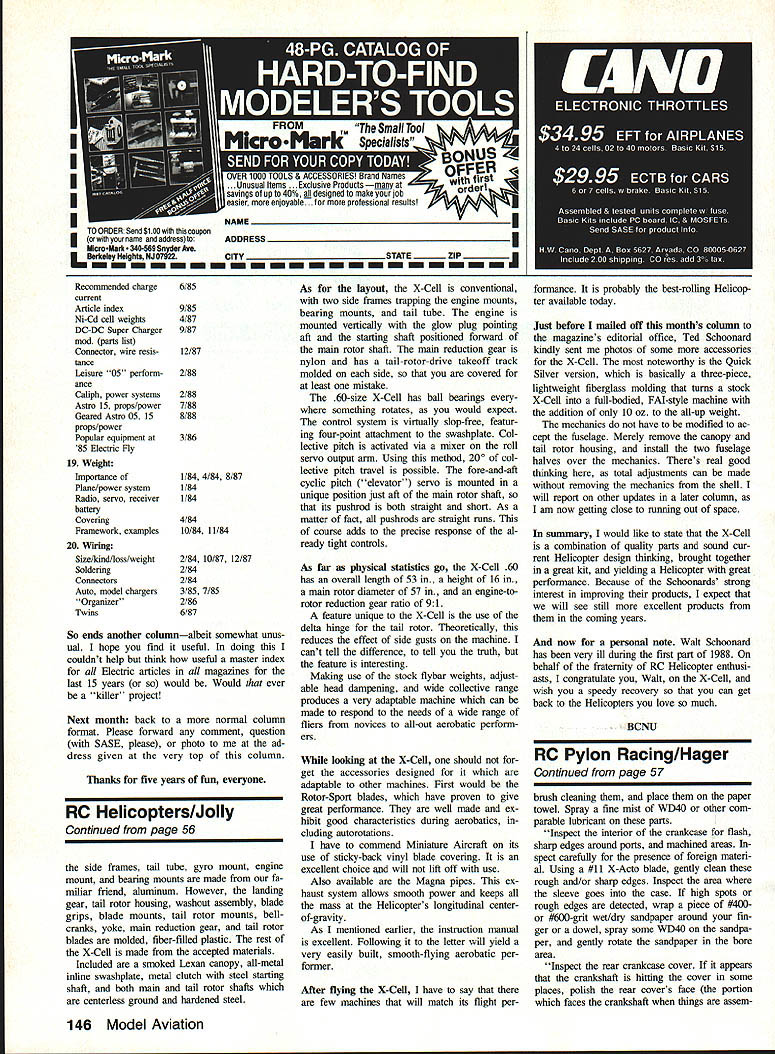
The X-Cell is shipped in a beautiful box which shows the ship to good advantage. Opening the box, one soon becomes acquainted with the X-Cell's excellent 42-page instruction manual, update sheets, a building-sheet summary to go with the instructions, and equally excellent isometric-view drawings.
As a manufacturer myself, I am always impressed when I see a kit of such high quality. If my count is right, there are 313 parts in an X-Cell kit. Think about the amount of work and effort that goes into designing, manufacturing, and procuring all of these parts. Don't even think about the instructional paperwork! Think about the high cost in time and money of putting that first X-Cell kit into its box. I can tell you first hand that this is a wonder a kit ever gets into production.
Investigating the kit reveals that it is certainly a high-quality item. All parts are bagged in accordance with each of the eight major assembly steps.
Construction and layout
Without comparing the X-Cell to other machines, it is sufficient to say that the X-Cell's construction is the accepted standard form for modern helicopters (helis). That is, while most of the X-Cell's features have been seen before, Walt and his crew have done a very nice job of planning and refining, with much attention to detail.
As for the layout, the X-Cell is conventional, with two side-frame trusses supporting the engine mounts, bearing mounts, and tail tube. The engine is mounted vertically with the glow plug pointing aft and the starting shaft positioned forward of the main rotor shaft. The main reduction gear is nylon and has a tail-rotor-drive takeoff molded on each side, so that you are covered for at least one mistake.
The .60-size X-Cell has ball bearings everywhere something rotates, as you would expect. The control system is virtually slope-free, featuring four-point attachment to the swashplate. Collective pitch is activated via a mixer on the roll-servo output arm. Using this method, 20° of collective pitch travel is possible. The fore-and-aft cyclic pitch ("elevator") servo is mounted in a unique position just aft of the main rotor shaft, so that its pushrod is both straight and short. As a matter of fact, all pushrods are straight runs. This of course adds to the precise response of the already tight controls.
As far as physical statistics go, the X-Cell .60 has an overall length of 53 in., a height of 16 in., a main rotor diameter of 57 in., and an engine-to-rotor reduction gear ratio of 9:1.
A feature unique to the X-Cell is the use of the delta hinge for the tail rotor. Theoretically, this reduces the effect of side gusts on the machine. I couldn't tell the difference, to tell you the truth, but the feature is interesting.
Making use of the stock flybar weights, adjustable head dampening, and wide collective range produces a very adaptable machine which can be made to respond to the needs of a wide range of fliers from novices to all-out acrobatic performers.
Accessories
While looking at the X-Cell, one should not forget the accessories designed for it which are adaptable to other machines. Noteworthy items include:
- Rotor-Sport blades — proven to give great performance; well made and exhibiting good characteristics during aerobatics, including autorotations.
- Sticky-back vinyl blade covering — an excellent cover that will not lift off with use.
- Magna pipes — an exhaust system that allows smooth power and keeps all the mass at the helicopter's longitudinal center-of-gravity.
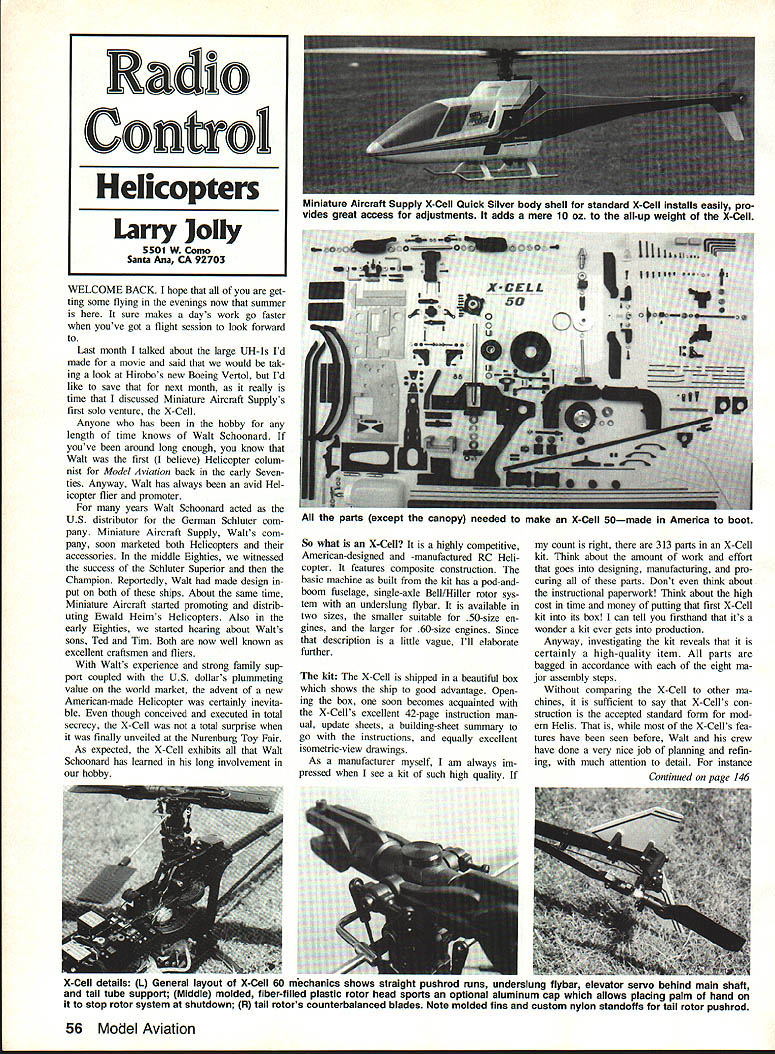
- Quick Silver version — a three-piece, lightweight fiberglass molding that turns a stock X-Cell into a full-bodied machine with the addition of only 10 oz. to 11 oz. of all-up weight. The mechanics do not have to be modified to accept the fuselage; merely remove the canopy and the tail rotor housing, and install the two fuselage halves over the mechanics. Total adjustments can be made without removing the mechanics from the shell.
As I mentioned earlier, the instruction manual is excellent. Following it to the letter will yield a very easily built, smooth-flying, aerobatic performer.
Flight characteristics
After flying the X-Cell, I have to say that there are few machines that will match its flight performance. It is probably the best all-around helicopter available today.
Just before I mailed off this month's column to the magazine's editorial office, Ted Schoonard kindly sent me photos of some more accessories for the X-Cell. The most noteworthy is the Quick Silver version described above. I will report on other updates in a later column, as more new items are starting to run out of space.
Summary
The X-Cell is a combination of quality parts and sound construction. Brought together in a great kit, it yields a helicopter with great performance. Because of the Schoonards' strong interest in improving their products, I expect that this will be just the first in a series of excellent products from them in the coming years.
Personal note
Walt Schoonard has been very ill during the first part of 1988. On behalf of the fraternity of RC helicopter enthusiasts, I congratulate you, Walt, on the X-Cell, and wish you a speedy recovery so that you can get back to the helicopters you love so much.
— BCNU
Transcribed from original scans by AI. Minor OCR errors may remain.

