
Radio Control: Helicopters
Larry Jolly 5501 W. Como Santa Ana, CA 92703
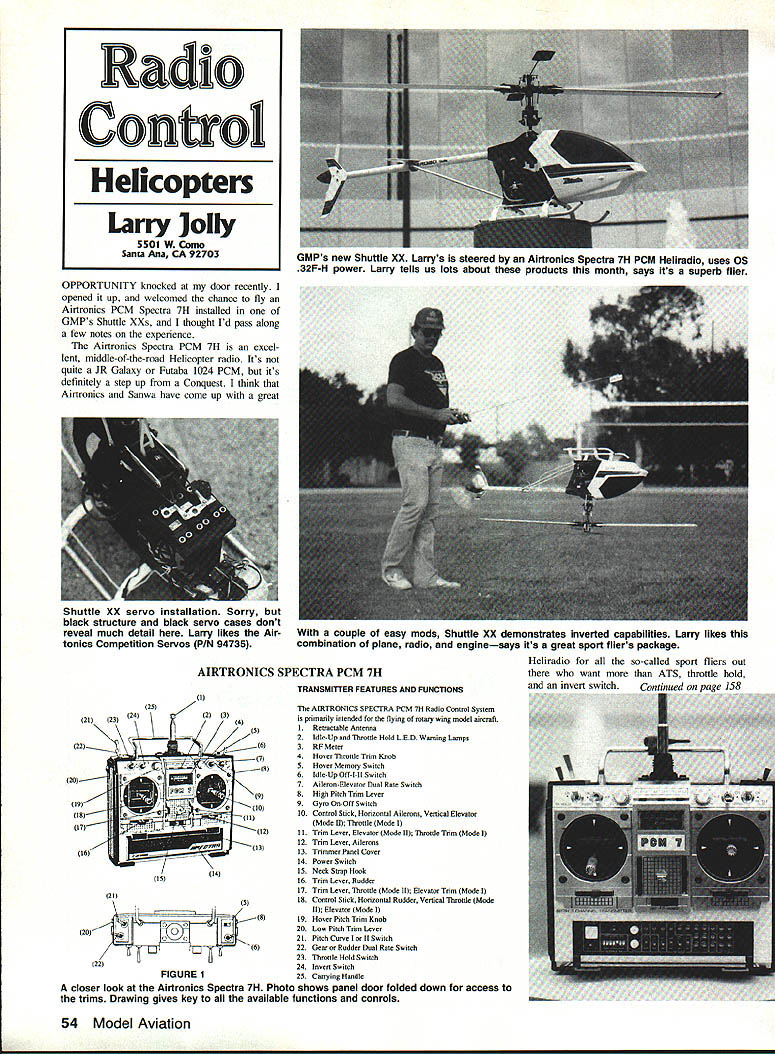
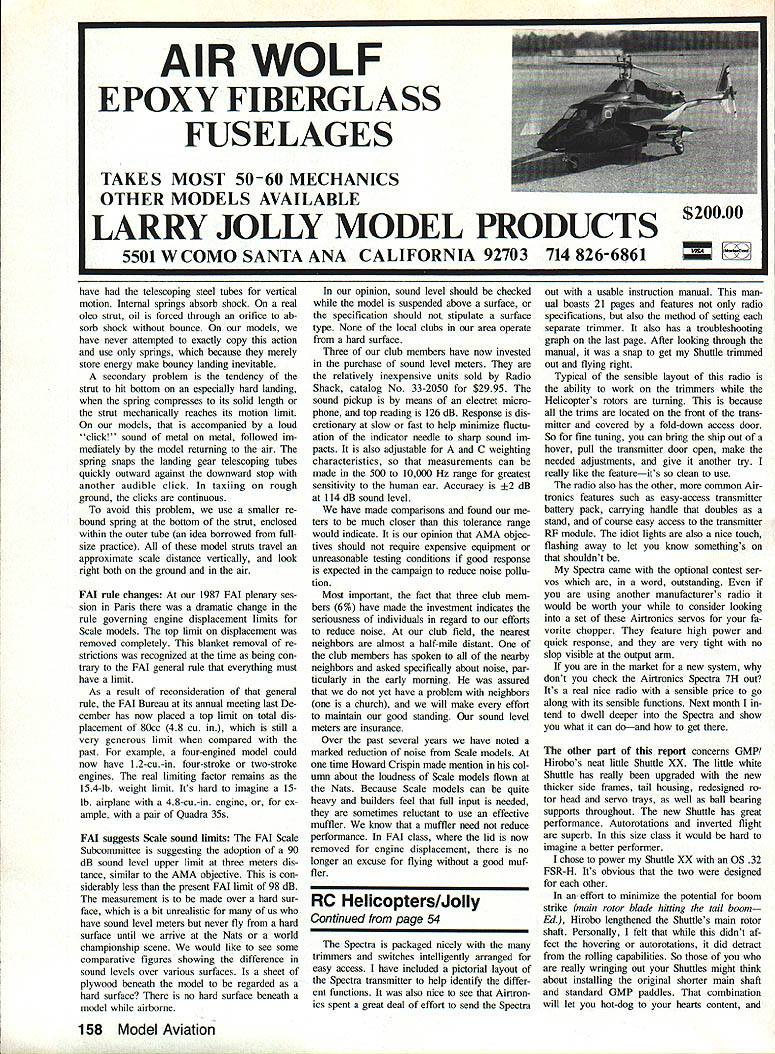
OPPORTUNITY knocked at my door recently. I opened it up and welcomed the chance to fly an Airtronics PCM Spectra 7H installed in one of GMP's Shuttle XXs, and I thought I'd pass along a few notes on the experience.
The Airtronics Spectra PCM 7H is an excellent, middle-of-the-road helicopter radio. It's not quite a JR Galaxy or Futaba 1024 PCM, but it's definitely a step up from a Conquest. I think that Airtronics and Sanwa have come up with a great heli radio for all the so-called sport fliers out there who want more than ATS, throttle hold, and an invert switch.
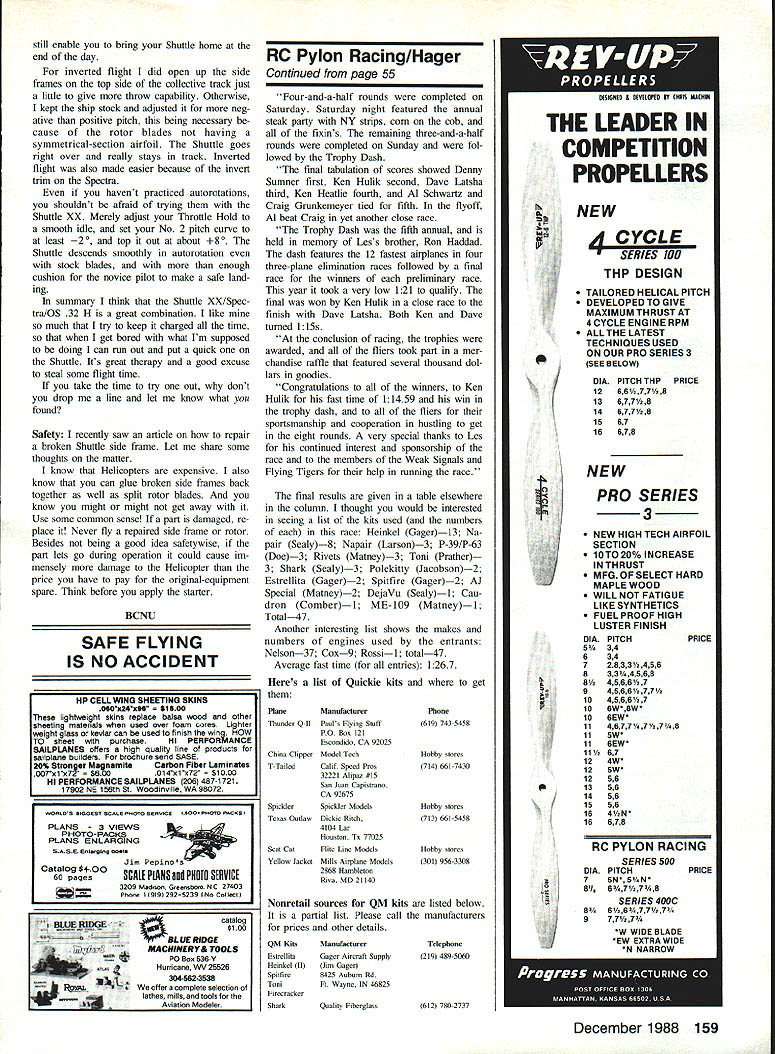
AIRTRONICS SPECTRA PCM 7H
TRANSMITTER FEATURES AND FUNCTIONS
The AIRTRONICS SPECTRA PCM 7H Radio Control System is primarily intended for the flying of rotary wing model aircraft.
- Retractable antenna
- Idle-up and throttle-hold LED warning lamps
- Rx meter
- Hover throttle trim knob
- Hover memory switch
- Idle-up Off I II switch
- Aileron-elevator dual rate switch
- High pitch trim lever
- Gyro on-off switch
- Control stick: horizontal ailerons, vertical elevator (Mode II); throttle (Mode II)
- Trim lever: elevator (Mode II); throttle trim (Mode I)
- Trim lever: ailerons
- Trimmer panel cover
- Power switch
- Neck strap hook
- Trim lever: rudder
- Trim lever: throttle (Mode III); elevator trim (Mode II)
- Control stick: horizontal rudder, vertical throttle (Mode III); elevator (Mode II)
- Hover pitch trim knob
- Low pitch trim lever
- Pitch curve switch
- Gear-rudder dual rate switch
- Throttle hold switch
- Insert switch
- Carrying handle
The Spectra is packaged nicely with the many trimmers and switches intelligently arranged for easy access. I have included a pictorial layout of the Spectra transmitter to help identify the different functions. It was also nice to see that Airtronics spent a great deal of effort to send the Spectra out with a usable instruction manual. This manual boasts 21 pages and features not only radio specifications, but also the method of setting each separate trimmer. It also has a troubleshooting graph on the last page. After looking through the manual, it was a snap to get my Shuttle trimmed and flying right.
Typical of the sensible layout of this radio is the ability to work on the trimmers while the helicopter's rotors are turning. This is because all of the trimmer areas on the front of the transmitter are covered by a fold-down access door. So for fine tuning, you can bring the ship out of a hover, pull the transmitter door open, make the needed adjustments, and give it another try. I really like the feature—it's so clean to use.
The radio also has the other, more common Airtronics features such as an easy-access transmitter battery pack, a carrying handle that doubles as a stand, and of course easy access to the transmitter RF module. The idiot lights are also a nice touch, flashing away to let you know something's on in the transmitter.
My Spectra came with the optional contest servos which are, in a word, outstanding. Even if you are using another manufacturer's radio it would be worth your while to consider looking into a set of these Airtronics servos for your favorite chopper. They feature high power and quick response, and they are very tight with no slip visible at the output arm.
If you are in the market for a new system, why not? It's a real nice radio with a sensible price to go along with its sensible functions. Next month I intend to dwell deeper into the Spectra and show you what it can do—and how to get there.
Landing Gear: Oleo Struts and Rebound Springs
We have had the telescoping steel tubes for vertical motion. Internal springs absorb shock. On a real oleo strut, oil is forced through an orifice to absorb shock without bounce. On our models, we have never attempted to exactly copy this action and use only springs, which, because they merely store energy, make bouncy landings inevitable.
A secondary problem is the tendency of the strut to hit bottom on an especially hard landing, when the spring compresses to its solid length or the strut mechanically reaches its motion limit. On our models, that is accompanied by a loud "click!" sound of metal on metal, followed immediately by the model returning to the air. The spring snaps the landing gear telescoping tubes quickly outward against the downward stop with another audible click. In taxiing on rough ground, the clicks are continuous.
To avoid this problem we use a smaller rebound spring at the bottom of the strut, enclosed within the outer tube (an idea borrowed from full-size practice). All of these model struts travel an approximate scale distance vertically and look right both on the ground and in the air.
FAI RULE CHANGES
At our 1987 FAI plenary session in Paris there was a dramatic change in the rule governing engine displacement limits for Scale models. The top limit on displacement was removed completely. This blanket removal of restrictions was recognized at the time as being contrary to the FAI general rule that everything must have a limit. As a result of reconsideration of that general rule, the FAI Bureau at its annual meeting last December has now placed a top limit on total displacement of 80 cc (48 cu. in.). This is still a very generous limit compared with past examples; a four-engined model could now have 12-cu.-in. four-stroke or two-stroke engines. The real limiting factor remains the 154-lb weight limit. It's hard to imagine a 154-lb airplane with a 4.8-cu.-in. engine, or, for example, with a pair of Quadra 35s.
FAI SUGGESTS SCALE SOUND LIMITS
The FAI Scale Subcommittee is suggesting the adoption of a 90 dB sound level upper limit at three meters distance, similar to the AMA objective (considerably less than the present FAI limit of 98 dB). The measurement is to be made over a hard surface, which is a bit unrealistic for many of us who have sound level meters but never fly from a hard surface until we arrive at the Nats or a world championship scene. We would like to see more comparative figures showing the difference in sound levels over various surfaces. Is a sheet of plywood beneath the model to be regarded as a hard surface? There is no hard surface beneath a model while airborne.
In our opinion, sound level should be checked while the model is suspended above a surface, or the specification should not stipulate a surface type. None of the local clubs in our area operate from a hard surface.
Three of our club members have now invested in the purchase of sound level meters. They are the relatively inexpensive units sold by Radio Shack, catalog No. 33-2050 for $29.95. The sound pickup is by means of an electret microphone, and top reading is 126 dB. Response is discriminatorily slow or fast to help minimize fluctuation of the indicator needle to sharp sound impacts. It is also adjustable for A and C weighting characteristics, so that measurements can be made in the 500 to 10,000 Hz range for greatest sensitivity to the human ear. Accuracy is ±2 dB at 114 dB sound level.
We have made comparisons and found our meters to be much closer than this tolerance range would indicate. It is our opinion that AMA objectives should not require expensive equipment or unreasonable testing conditions if good results are expected in the campaign to reduce noise pollution.
Most important, the fact that three club members (6%) have made the investment indicates the seriousness of individuals in regard to our efforts to reduce noise. At our club field, the nearest neighbors are almost a half-mile distant. One of the club members has spoken to all of the nearby neighbors and asked specifically about noise, particularly in the early morning. He was assured that we do not yet have a problem with neighbors (one is a church), and we will make every effort to maintain our good standing. Our sound level meters are kept in a padlocked box.
Over the past several years we have noted a marked reduction in noise from Scale models. At one time Howard Crispin made mention in his column about the loudness of Scale models at the Nats. Because Scale models can be quite heavy and builders feel that full input is needed, they are sometimes reluctant to use an effective muffler. We know that a muffler need not reduce performance. In FAI class, where the limit is now no longer an engine displacement, there is no longer an excuse for flying without a good muffler.
GMP/HIROBO SHUTTLE XX
The other part of this report concerns GMP/Hirobo's neat little Shuttle XX. The little white Shuttle has really been upgraded with the thicker side frames, taller housing, redesigned rotor head and servo trays, as well as ball-bearing supports throughout. The new Shuttle has great performance. Autorotations and inverted flight are superb.
In an effort to minimize the potential for boom strike/main rotor blade hitting the tail boom (Ed. note: Hirobo lengthened the Shuttle's main rotor shaft), personally I felt that while this didn't affect the hovering or autorotations, it did detract from the rolling capabilities. Those of you who are really into swinging your Shuttles might think about installing the original shorter main shaft and standard GMP paddles. That combination will let you hot-dog to your heart's content and will still enable you to bring your Shuttle home at the end of the day.
For inverted flight I did open up the side frames on the top side of the collective track just a little to give more throw capability. Otherwise, I kept the ship stock and adjusted it for more negative than positive pitch, this being necessary because of the rotor blades not having a symmetrical-section airfoil. The Shuttle goes right over and really stays in track. Inverted flight was also made easier because of the invert trim on the Spectra.
Even if you haven't practiced autorotations, you shouldn't be afraid of trying them with the Shuttle XX. Merely adjust your throttle hold to a smooth idle, set your No. 2 pitch curve to at least -2°, and set your pitch to about +8°. The Shuttle descends smoothly in autorotation even with stock blades, and with more than enough cushion for the novice pilot to make a safe landing.
In summary I think that the Shuttle XX / Spectra / OS .32 H is a great combination. I like mine so much that I try to keep it charged all the time, so that when I get bored with what I'm supposed to be doing I can run out and put a quick one on the Shuttle. It's great therapy and a good excuse to steal some flight time.
If you take the time to try one out, why don't you drop me a line and let me know what you found?
SAFETY
I recently saw an article on how to repair a broken Shuttle side frame. Let me share some thoughts on the matter.
I know that helicopters are expensive. I also know that you can glue broken side frames back together and split rotor blades. You might or might not get away with it. Use some common sense! If a part is damaged, replace it. Never fly a repaired side frame or rotor. Besides not being a good idea safety-wise, if the part lets go during operation it could cause immensely more damage to the helicopter than the price you have to pay for the original-equipment spare. Think before you apply the starter.
BCNU
Transcribed from original scans by AI. Minor OCR errors may remain.

