
Radio Control: Helicopters
Author
Larry Jolly 5501 W. Como Santa Ana, CA 92703
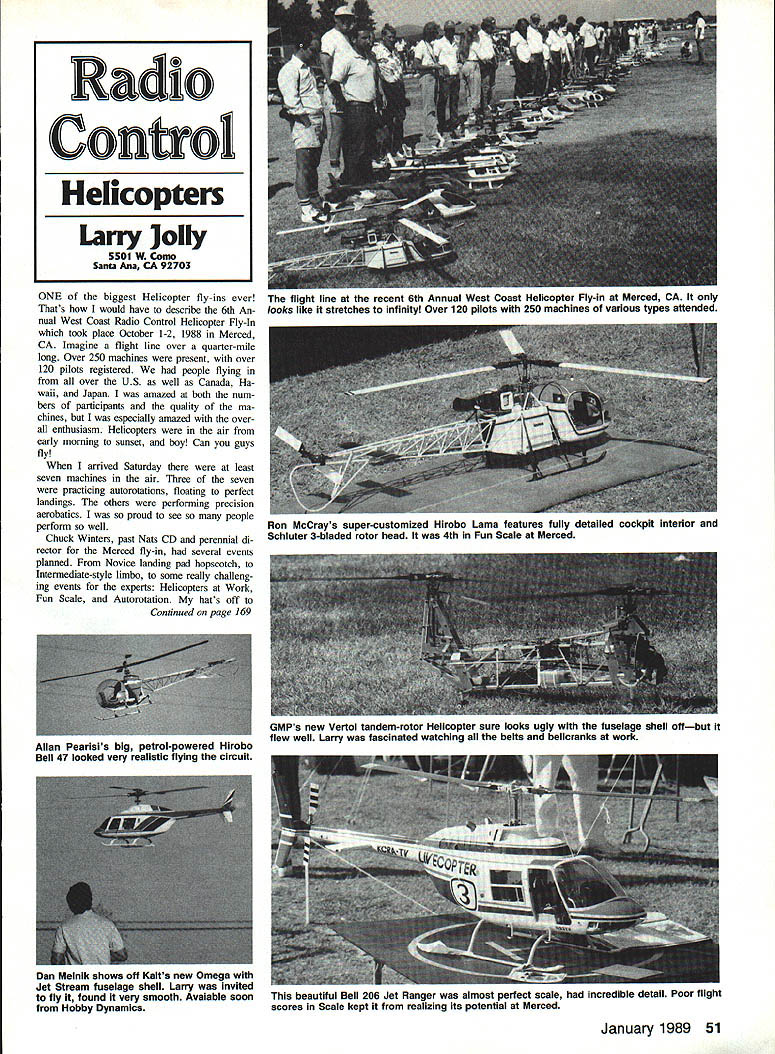
One of the biggest helicopter fly-ins ever! That's how I would have to describe the 6th Annual West Coast Radio Control Helicopter Fly-In, which took place October 1–2, 1988, in Merced, CA. Imagine a flight line over a quarter-mile long. Over 250 machines were present, with more than 120 pilots registered. We had people flying in from all over the U.S. as well as Canada, Hawaii, and Japan. I was amazed at both the number of participants and the quality of the machines, but I was especially impressed with the overall enthusiasm. Helicopters were in the air from early morning to sunset — boy, can you guys fly!
When I arrived Saturday there were at least seven machines in the air. Three of the seven were practicing autorotations, floating to perfect landings. The others were performing precision aerobatics. I was so proud to see so many people perform so well.
Chuck Winters, past Nats CD and perennial director for the Merced fly-in, had several events planned, including:
- Novice landing pad hopscotch
- Intermediate-style limbo
- Challenging events for experts: Helicopters at Work, Fun Scale, and Autorotation
My hat's off to Chuck and the rest of the guys from the Merced County RC Club for running the event, as well as to the big sponsor, GMP, and the rest of the RC industry who donated prizes. This event has to be the highlight of RC helicopter activities on the West Coast.
It's really hard to stop and describe just one facet of this exciting weekend, but to do it justice you could walk up and down the flight line and talk helicopter with a hundred different people — all of them having fun being around so many helicopters and helicopter fliers.
It was good to see so many manufacturers present and participating with the average flier. It is very important that the modeler in the field have someone to talk to and learn from who represents a particular line of machines. I spent a lot of time with the Circus guys (Dan Melnik, Frank Dykes, and Ken Wilson). Not only did I learn lots about Galaxy radios and Kalt helicopters, but it was enlightening to see the number of modelers whose questions were answered satisfactorily. I'm sure most manufacturers are so caught up in selling machines that it's hard to remember that a lot of support is still needed after the machines are in the modelers' hands.
It's a shame that not every helicopter manufacturer/importer was there.
What's new at Merced
Morley U.S.A. (P.O. Box 6026, San Pedro, CA) announced they were the new U.S. distributors for the KKK line of helicopters. Great news for those of you stuck for parts after the demise of California Model Imports. I talked with Tony Moreno, and he is dedicated to keeping both parts and kits in stock. So if you have a busted-up Hughes 300 or R-22, this would be a good time to order those parts from Tony. I'd like to encourage him to keep the KKK line represented in the U.S.
Dan Melnik, Frank Dykes, and Ken Wilson had Kalt machines in the air continuously. Merced was my first experience with the new Kalt Omega and the Jet Stream fuselage. I have to admit I was a bit nervous when Dan said, "Here. Have a ball with it." The beautiful Jet Stream is one of the smoothest fuselage models I've ever flown.
The tail of the Omega has a Kalt-made, TSK-style gearbox and shows impressive performance. The Omega is truly a premier model — and of course its price reflects that. As the old saying goes, "You get what you pay for." In this case it's true: the Omega is a beautiful model with great performance.
Dan and Frank were having a ball with a Baron 60 EX as well. They had set their idle so the throttle curve is shaped like a U. When you apply full stick forward you have max positive pitch and full throttle. As the throttle stick is brought back, the throttle retards through zero pitch at half-stick, then accelerates at bottom stick to full throttle and full negative pitch. When set up this way, a ship can do amazing upright and inverted maneuvers.
GMP had several Legends flying all the time. This great new ship is proving capable even in a novice's hands. GMP also flew a new Hirobo tandem ship for its first public demonstration. The little Vertol lifted off well and showed great stability. It was amazing to see all those belts, bell-cranks, and intermeshing rotors turning in unison.
There was a new company there: RTE (P.O. Box 2589, Longmont, CO 80501). These guys are real machinists and manufacture excellent after-market parts for GMP and Schluter machines. Particularly impressive were the tail drives, which included a custom transverse axle/autorotation combination for Hirobo main rotors and tail-driven autorotation main gears. RTE makes top-quality parts at reasonable prices — get their catalog.
Capitol RC of Hawaii was showing PPC rotor blades from Japan, as well as the new Kyosho Concept 30. This new 30-size machine is designed by Taya and displays some real thought. The Concept 30 flew many times and looked good. More on this ship later.
Back to the flying. CD Chuck Winters should be congratulated on his new innovation: Helicopters at Work. A flyer was judged on his ability to pick up a two-pound sling load, fly a circuit, then fly to another pad, release the load, and fly another circuit. This event was judged on both line and scale-like controlled presentation — a very neat idea indeed.
After it was all over, over $6,000 in prizes had been handed out and at least a thousand flights had been made in those two days.
Highlights
- The nose-to-nose midair on Saturday — it made a truly unbelievable noise.
- Demo flights by Dan Melnik and the Japanese flier flying the Bell 222.
- The very impressive autorotation by Robert Gorham, landing his Legend perfectly on a card table — square in the middle.
It was lots of fun, and I hope to see you all next fall for the 7th Annual Merced Fly-In.
BCNU
Transcribed from original scans by AI. Minor OCR errors may remain.

