
Radio Control: Helicopters
By Larry Jolly
5501 W. Como Santa Ana, CA 92703
WELCOME BACK! This month we're going to take a look at electric RC helicopters — where they've been, and where they are going.
Early experiments with electric power
I'm not certain, but I'm pretty sure that the first use of electric power for helicopter work was by Arthur Young, designer of the famed Bell helicopter rotor system. Back in the early 1930s Young made use of a remote power supply to power a remotely controlled helicopter via a now-familiar extension cord. This proved valuable for his work, as the electric motor was very consistent and produced easily reproducible results.
Besides Young's pioneering work, Lockheed experimented with electric power when they explored a rigid-rotor system in the 1950s. Electric motors are often used in static tests because of their smoothness and ease of operation; their output speeds are easily governed throughout their operating ranges.
Hobbyist beginnings (mid-1970s)
The first use of electric power by RC helicopter hobbyists was around 1975. Many U.S. modelers were experimenting with DC motors installed in examples of the American RC Helicopter Revolution I machine. Power was supplied by a cable similar to those used for electric trains, using a long two-lead extension cord. Up to this time, no one had succeeded in flying an electric helicopter capable of lifting its own power supply (i.e., Ni-Cd batteries).
Charles Gilbert (Fullerton, CA) took up the cause to be the first to make a self-contained electric RC helicopter a success. Those of you active in the hobby back in 1976 may remember Charlie's efforts were documented by John Tucker in Model Builder Magazine and by Charlie's mentor Bob Boucher of Astro Flight in his book Silent Flight.
Charlie’s first efforts were encouraging but not fully successful. He could generate enough lift to fly, but the craft lacked general stability, especially in yaw. In late 1977 Charlie decided to build a new, larger electric helicopter — and it would be scale. I was working for Hobby Shack at the time and chatted with Charlie at length while he bought materials.
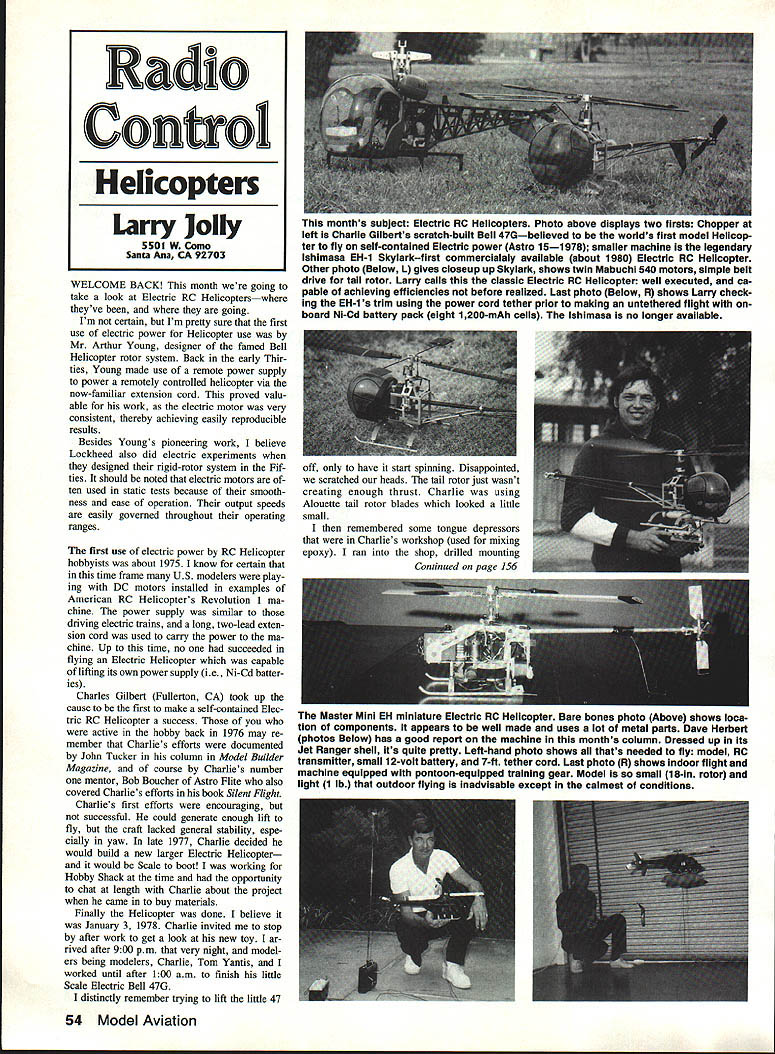
Finally the helicopter was done. I believe it was January 3, 1978. Charlie invited me to stop by after work to see his new toy. I arrived after 9:00 p.m., and modelers being modelers, Charlie, Tom Yantis, and I worked until after 1:00 a.m. to finish his little scale electric Bell 47G.
I distinctly remember trying to lift the little 47 off, only to have it start spinning. Disappointed, we scratched our heads—the tail rotor just wasn't creating enough thrust. Charlie was using Alouette tail rotor blades that looked a little small.
I then remembered some tongue depressors in Charlie's workshop (used for mixing epoxy). I drilled mounting holes in the tongue depressors and had them mounted quickly. Charlie just shook his head, but I can still remember the laughter as Charlie's fluorescent-orange 47 lifted from the picnic site in the backyard and drifted airborne for over a minute into the dark, dank night.
I still wonder what the guy driving home that night thought as Charlie's 47 floated silently overhead, lit by the glow of his car's headlights. I felt a real sense of honor to have been the pilot. Charlie worked more on his ship but eventually lost interest as his business consumed him. Last year old N18A (the Bell 47G) passed into my possession and will be brought back to its original form as it was on the night Charlie Gilbert made history.
Ishimasa Skylark and the early 1980s
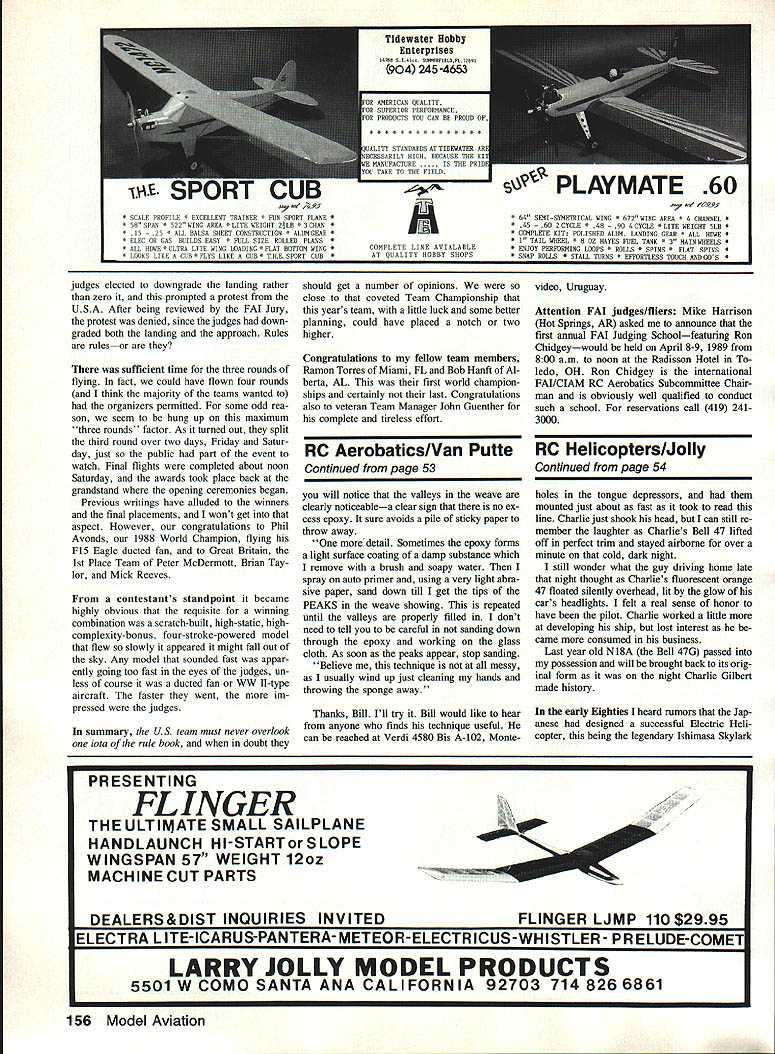
In the early 1980s I heard rumors that the Japanese had designed a successful electric helicopter: the legendary Ishimasa Skylark (EH-1). The Skylark used twin Mabuchi 540S motors and a simple belt-drive tail rotor. It was the classic electric RC helicopter — well executed and capable of efficiencies not seen before.
The Skylark has a rotor diameter of 39 in. and was powered by a pair of Mabuchi 540S electric motors. Power was supplied via a 12-foot extension cord hooked up to a 12-volt car battery, or it could carry eight 1.2 amp-hour Ni-Cd cells.
On Ni-Cd power the Skylark produced impressive performance for an electric design, achieving 200 ft. altitude and capable of stall turns, as long as hovering was kept to a minimum. Flight durations were still low, the longest being just over three minutes, but the flights were satisfying and very interesting.
The EH-1 is no longer in production. If you have one you are lucky. If you need parts, contact Cliff Raussen at Condor RC Specialties — he still has some EH-1 spares and you may luck out.
The Master Mini EH and the rise of mini electrics
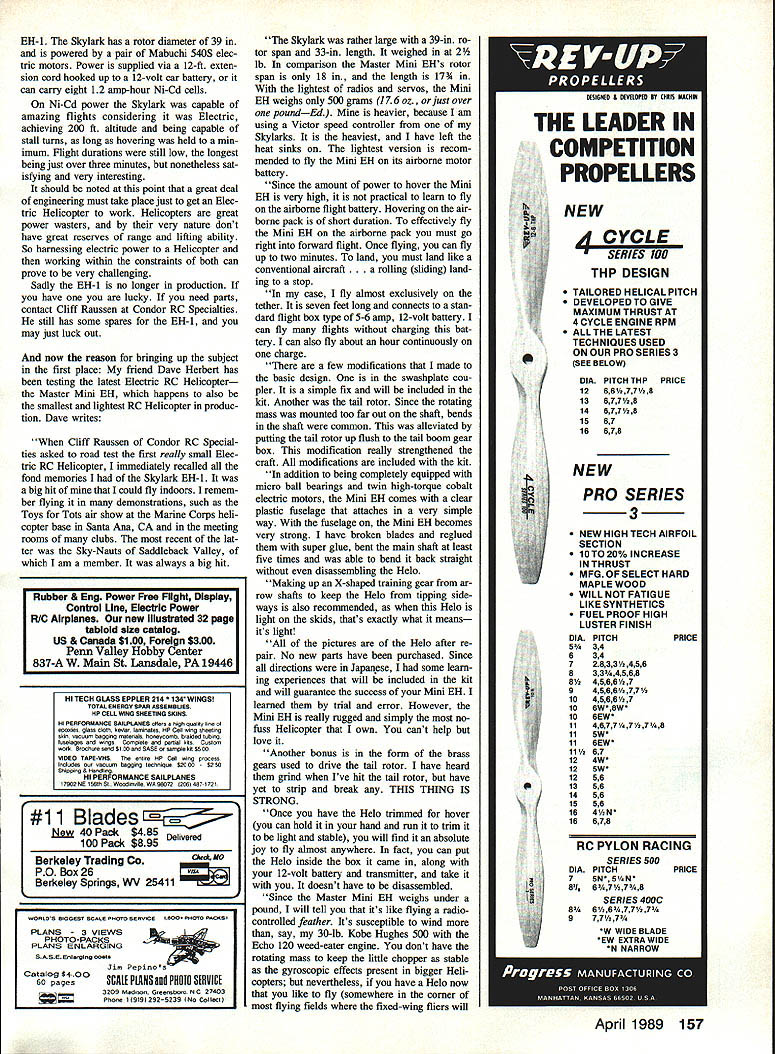
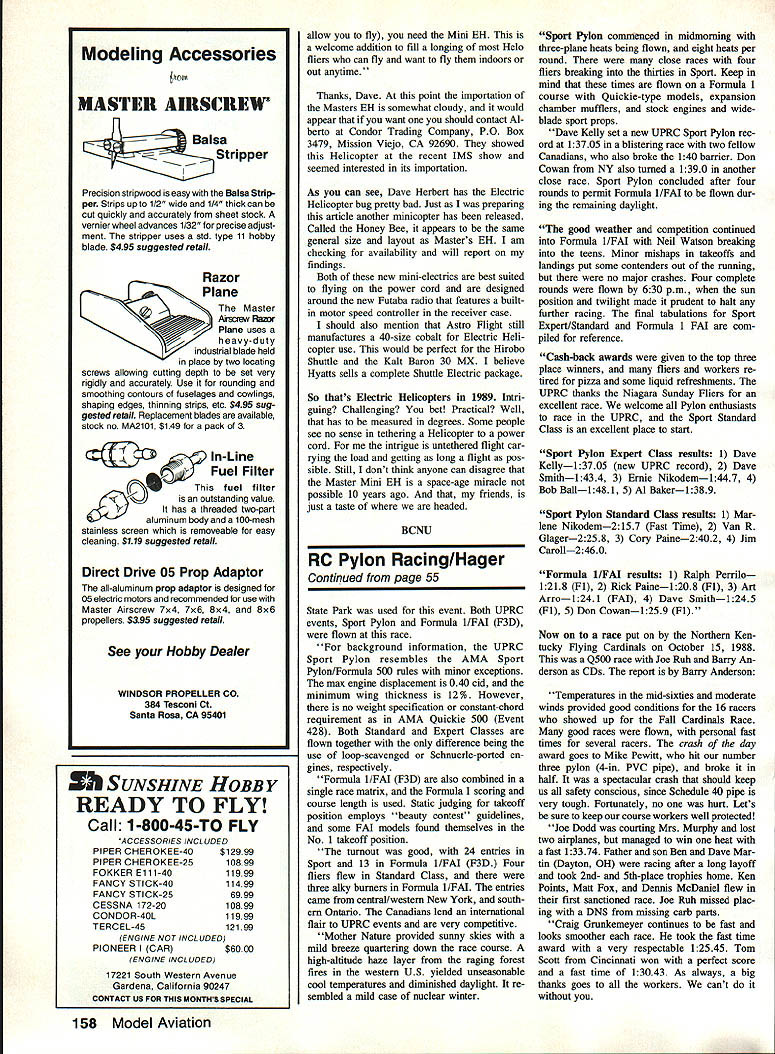
The reason for bringing up this history is that my friend Dave Herbert has been testing the latest electric RC helicopter — the Master Mini EH, which is also the smallest and lightest RC helicopter in production. Dave writes:
"When Cliff Raussen of Condor RC Specialties asked me to test the first really small electric RC helicopter, I immediately recalled all the fond memories I had of the Skylark EH-1. It was a big hit that I could fly indoors. I remember flying it in many demonstrations, such as the Toys for Tots air show at the Marine Corps helicopter base in Santa Ana, CA, and at club meetings. The most recent of these was the Sky-Nauts of Saddleback Valley, of which I am a member. It was always a big hit.
"The Skylark was rather large with a 39-inch rotor span and 33-inch length, weighing about 2.5 lb. In comparison the Master Mini EH's rotor span is only 18 in., and the length is 17.5 in. With the lightest possible radio and servos, the Mini EH weighs only about 500 grams (17.6 oz., or just over one pound). Mine is heavier because I am using a Victor speed controller from one of my Skylarks. I left the heat sinks on and recommend the lightest version to fly the Mini EH.
"Since the amount of power to hover the Mini EH is very high, it is not practical to learn to hover on the airborne flight battery. Hovering on the airborne pack is of short duration. To effectively fly the Mini EH on the airborne pack you must go right into forward flight. Once flying, you can fly up to two minutes. To land, you must land like a conventional aircraft — a rolling (sliding) landing to save the skids.
"I fly almost exclusively on the tether. It is seven ten-foot lengths long and connects to a standard flight-box type 5–6 amp, 12-volt battery. I can fly many flights without changing this battery and can fly about an hour continuously on one charge.
"There are a few modifications I made to the basic design. One is in the swashplate coupler; it's a simple fix and will be included in the kit. Another was the tail rotor: since the rotating mass was too much for the shaft, bends in the shaft were common. This was alleviated by making the tail rotor from soft aluminum sheet and bolting the rudder to the tail-boom gearbox. This modification really stiffened up the tail. All modifications are included with the kit.
"In addition to being completely equipped with micro ball bearings and twin high-torque cobalt motors, the Mini EH comes with a clear plastic fuselage that attaches very positively. With the fuselage on, the Mini EH becomes very strong. I have broken blades and re-glued them several times and was able to bend them back straight without disassembling the helicopter.
"Making up an X-shaped training gear from a pair of wire loops that came in the kit seems to be standard; it's quite a bit lighter, and when this Helo is light it's very light.
"All the pictures are of the Helo after repair. No new parts have been purchased. Since directions were in Japanese, I had some learning experiences that will be included in the instructions to guarantee success with your Mini EH. I learned them by trial and error. However, the Mini EH is really rugged and simply the most no-fuss helicopter I own. You can't help but love it.
"Another bonus is the brass gears used to drive the tail rotor. I have had them grind when I hit the tail rotor, but have yet to strip or break any. THIS THING IS STRONG.
"Once you have the Helo trimmed for hover (you can hold it in your hand and run it to trim it), it flies well. If trimmed, it is an absolute joy to fly almost anywhere. In fact, you can park the Helo inside the box it came in and take it with you; it doesn't have to be disassembled.
"Since the Master Mini EH weighs under a pound, it's like flying a radio-controlled feather. It's susceptible to wind more than, say, my 30-lb. K&B Hughes 500 with the Echo 1200 two-stroke engine. You don't have the payload to keep the chopper's nose down as the gyro is essential in bigger helis; however, if you have a Helo you like to fly (somewhere in the corner of most flying fields where the fixed-wing fliers will not mind), the Mini EH will give you hours of fun."
Thanks, Dave.
At the moment the importation of the Master Mini EH is somewhat uncertain. If you want one, contact Alberto at Condor Trading Company, P.O. Box 3479, Mission Viejo, CA 92690. They showed this helicopter at the recent IMS show and appeared interested in importing it.
As I was preparing this article another mini-copter was released: the Honey Bee. It appears to be the same general size and layout as the Master Mini EH. I am checking availability and will report my findings.
Both of these new mini-electrics are best suited to flying on the power cord and are designed around the new Futaba radio that features a built-in motor speed controller in the receiver case. I should also mention that Astro Flight still manufactures a 40-size collector for electric helicopter use. This would be perfect for the Hirobo Shuttle and the Kalt Baron 30 MX. I believe Hays sells a complete Shuttle electric package.
Practical considerations and outlook (1989)
It should be noted that a great deal of engineering must take place just to get an electric helicopter to work. Helicopters are great power wasters and by their very nature don't have great reserves of range and lifting ability. So harnessing electric power to a helicopter and working within the constraints of both can be very challenging.
Are electric helicopters intriguing? Challenging? You bet. Practical? That must be measured in degrees. Some people see no sense in tethering a helicopter to a power cord. For me the intrigue is untethered flight — trying the load and getting as long a flight as possible. Still, I don't think anyone can disagree that the Master Mini EH is a space-age miracle not possible ten years earlier. And that, my friends, is just a taste of what we are headed for.
Transcribed from original scans by AI. Minor OCR errors may remain.

