
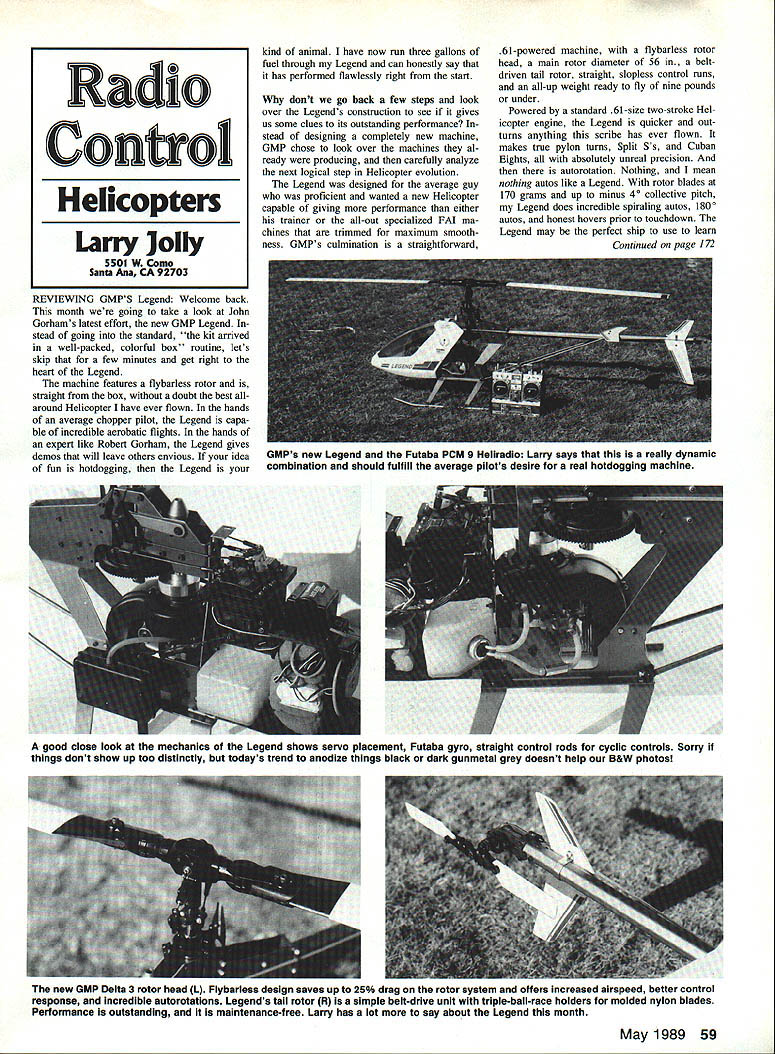
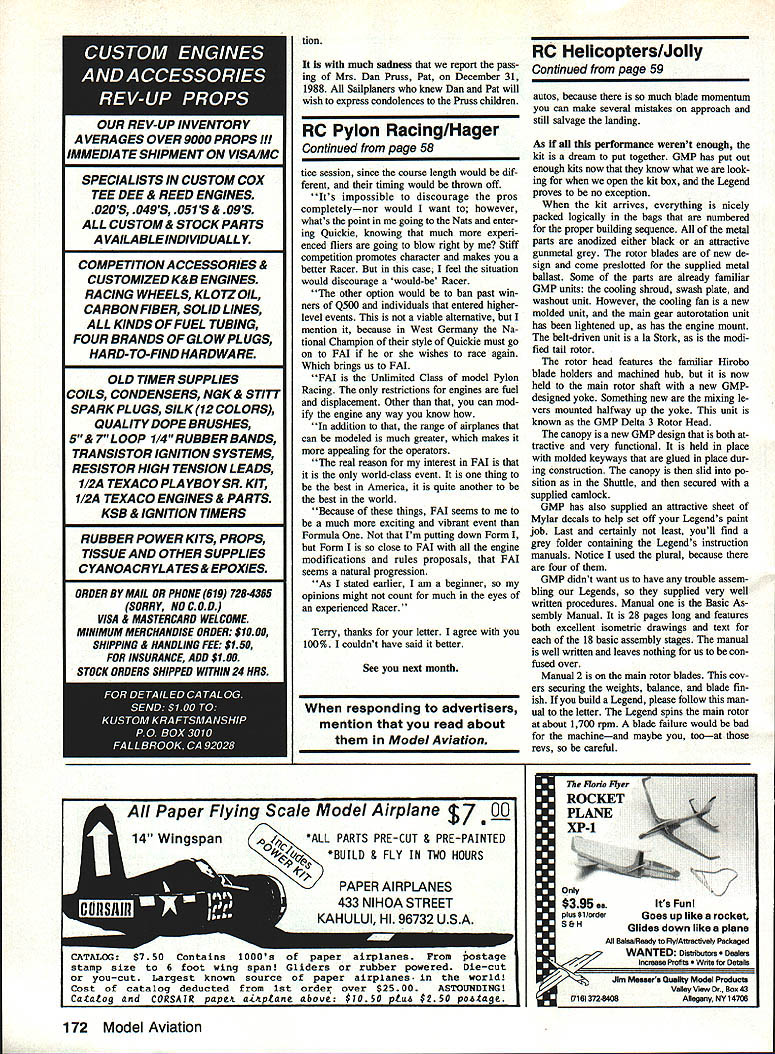
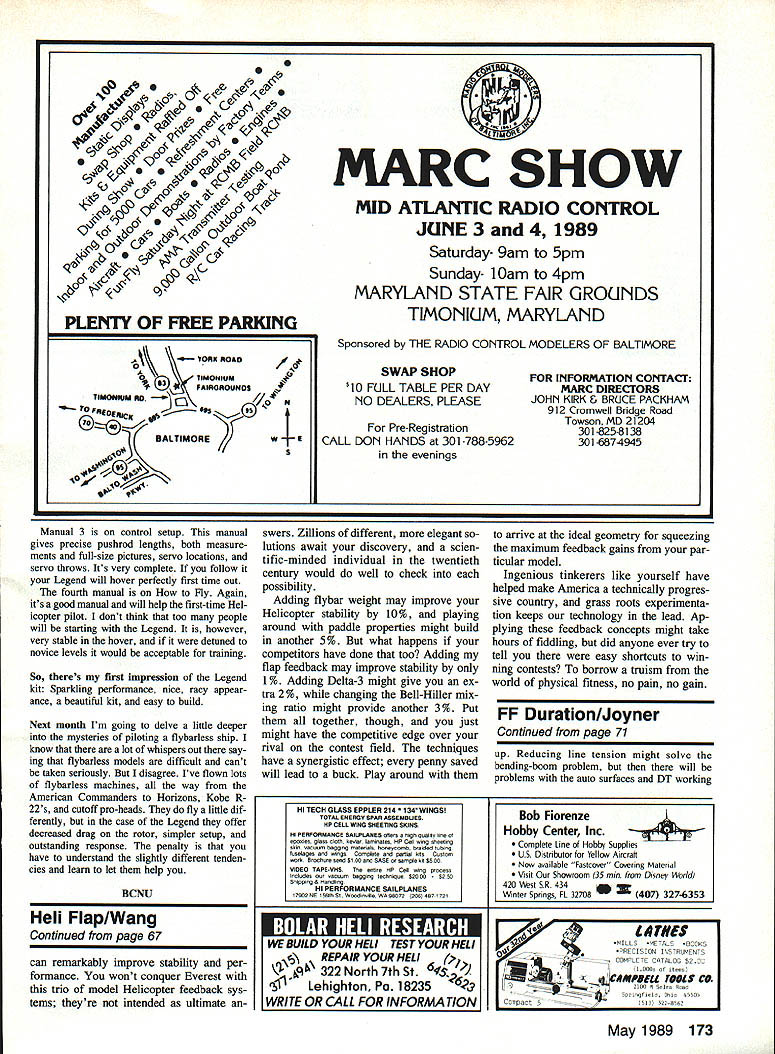
Radio Control: Helicopters
By Larry Jolly
5501 W. Como Santa Ana, CA 92703
Reviewing GMP's Legend
Welcome back. This month we're going to take a look at John Gorham's latest effort, the new GMP Legend. Instead of the standard "the kit arrived in a well-packed, colorful box" routine, let's skip that for a few minutes and get right to the heart of the Legend.
The machine features a flybarless rotor and is, straight from the box, without a doubt the best all-around helicopter I have ever flown. In the hands of an average chopper pilot, the Legend is capable of incredible aerobatic flights. In the hands of an expert like Robert Gorham, the Legend gives demos that will leave others envious. If your idea of fun is hotdogging, then the Legend is your kind of animal. I have now run three gallons of fuel through my Legend and can honestly say that it has performed flawlessly right from the start.
Design and Performance
Why don't we go back a few steps and look over the Legend's construction to see if it gives us some clues to its outstanding performance? Instead of designing a completely new machine, GMP chose to examine the machines they already were producing and then carefully analyze the next logical step in helicopter evolution.
The Legend was designed for the average pilot who was proficient and wanted a new helicopter capable of giving more performance than either his trainer or the all-out specialized FAI machines that are trimmed for maximum smoothness. GMP's culmination is a straightforward .61-powered machine with these features:
- Flybarless rotor head
- Main rotor diameter: 56 inches
- Belt-driven tail rotor
- Straight, slopless control runs
- All-up weight ready to fly: nine pounds or under
Powered by a standard .61-size two-stroke helicopter engine, the Legend is quicker and outturns anything this scribe has ever flown. It makes true pylon turns, Split S's, and Cuban Eights, all with absolute, unrivaled precision. And then there is autorotation—nothing, and I mean nothing, autos like a Legend.
With rotor blades balanced to 170 grams and collective pitch down to minus 40°, my Legend does incredible spiraling autos, 1,800-foot autos, and honest hovers prior to touchdown. The Legend may be the perfect ship to use to learn autorotations, because there is so much blade momentum you can make several mistakes on approach and still salvage the landing.
Construction and Kit Contents
As if all this performance weren't enough, the kit is a dream to put together. GMP has put out enough kits now that they know what we are looking for when we open the box, and the Legend proves to be no exception.
When the kit arrives, everything is nicely packed, logically bagged and numbered for the proper building sequence. All of the metal parts are anodized either black or an attractive gunmetal gray. The rotor blades are of a new design and come preslotted for the supplied metal ballast. Some of the parts are already familiar GMP units: the cowling shroud, swash plate, and washout unit. However, the cowling fan is a new molded unit, and the main gear autorotation unit has been lightened up, as has the engine mount. The belt-driven unit is a Stork, as is the modified tail rotor.
The rotor head features the familiar Hirobo blade holders and machined hub, but it is now bolted to the main rotor shaft with a new GMP Delta-3 rotor head. The canopy is a new GMP design that is both attractive and very functional. It is held in place with molded keyways that are glued in place during construction. The canopy is then slid into position on the shuttle and secured with a manual camlock.
GMP has also supplied an attractive sheet of Mylar beads to help set off your Legend's paint job. Last, and certainly not least, you'll find a goodly folder containing the Legend's instruction manuals—four of them.
Manuals
GMP didn't want us to have any trouble assembling our Legends, so they supplied very well-written, easy-to-follow procedures.
- Manual One — Basic Assembly Manual
- 28 pages
- Excellent exploded drawings and text for each of the 18 basic assembly stages
- Well written; leaves nothing to be confused over
- Manual Two — Main Rotor Blades
- Covers securing the weights, balancing, and blade finish
- Follow this manual to the letter: the Legend spins the main rotors at about 1,700 rpm. A blade failure would be serious at those revs.
- Manual Three — Control Setup
- Gives precise pushrod lengths (measurements and full-size pictures), servo locations, and servo throws
- Very complete; follow it and your Legend will hover perfectly first time out
- Manual Four — How to Fly
- A good manual to help the first-time helicopter pilot
- While I don't think many people will start with the Legend, it is very stable in the hover, and if detuned to novice levels it would be acceptable for training
So, there's my first impression of the Legend kit: sparkling performance, a racy appearance, a beautiful kit, and easy to build.
Flybarless Discussion and Tuning
Next month I'm going to delve a little deeper into the mysteries of piloting a flybarless ship. I know there are a lot of whispers saying flybarless models are more difficult and can't be taken seriously. But I disagree. I've flown lots of flybarless machines, from the American Commanders to Horizons, Kobre-22s, and cutoff pro-heads. They do fly a little differently, but in the case of the Legend they offer decreased drag on the rotor, simpler setup, and outstanding response. The penalty is that you have to understand the slightly different tendencies and learn to let them help you.
Adding flybar weight may improve your helicopter stability by about 10%, and changing paddle properties might build in another 5%. But what happens if your competitors have done that too? Adding flap feedback may improve stability by only 1%. Adding Delta-3 might give you an extra 2%, while changing the Bell-Hiller mixing ratio might provide another 3%. Put them all together, though, and you just might have the competitive edge over your rival on the contest field. The techniques have a synergistic effect; every penny saved will lead to a buck. Play around with them to arrive at the ideal geometry for squeezing the maximum feedback gains from your particular model.
Ingenious tinkerers like yourself have helped make America a technically progressive country, and grass-roots experimentation keeps our technology in the lead. Applying these feedback concepts might take hours of fiddling, but did anyone ever try to tell you there are easy shortcuts to winning contests? To borrow a truism from physical fitness: no pain, no gain.
BCNU
Transcribed from original scans by AI. Minor OCR errors may remain.

