
Radio Control: Helicopters
Larry Jolly
5501 W. Como Santa Ana, CA 92703
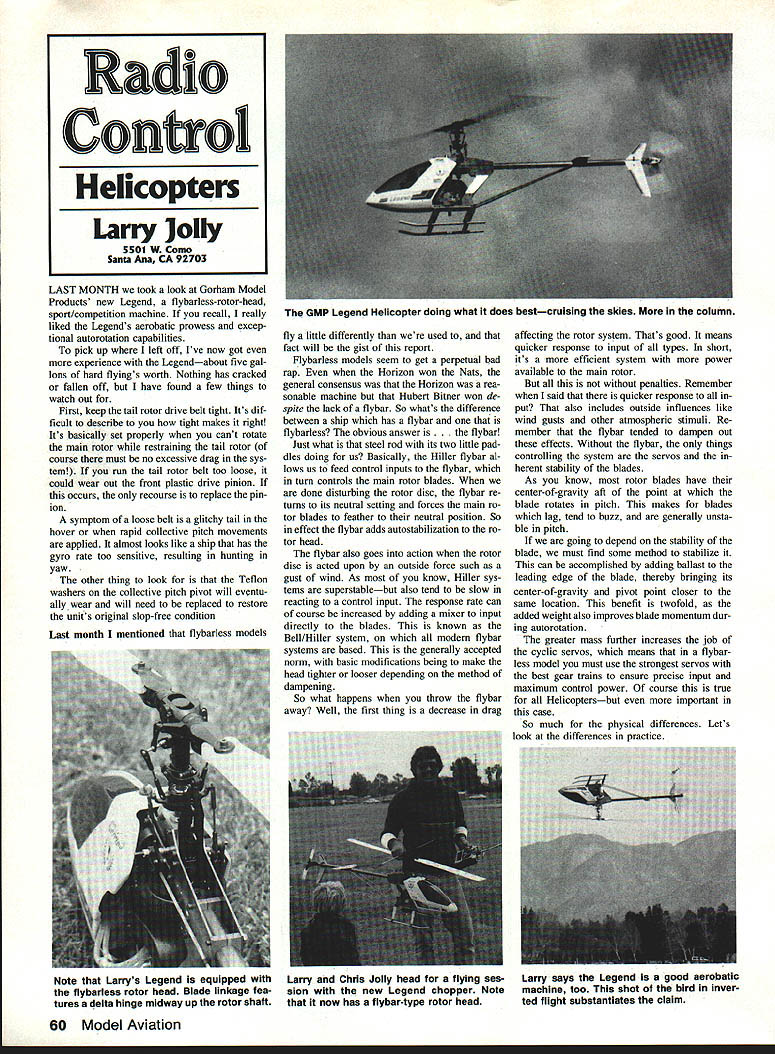
LAST MONTH we took a look at Gorham Model Products' new Legend, a flybarless-rotor-head sport/competition machine. If you recall, I really liked the Legend's aerobatic prowess and exceptional autorotation capabilities.
To pick up where I left off, I've now got even more experience with the Legend—about five gallons of hard flying's worth. Nothing has cracked or fallen off, but I have found a few things to watch out for.
Maintenance and things to watch
- Keep the tail rotor drive belt tight. It's difficult to describe, but tight makes it right. The belt is basically set properly when you can't rotate the main rotor while restraining the tail rotor (of course there must be no excessive drag in the system). If you run the tail rotor belt too loose, it could wear out the front plastic drive pinion. If this occurs, the only recourse is to replace the pinion.
- A symptom of a loose belt is a glitchy tail in the hover or when rapid collective pitch movements are applied. It almost looks like a ship that has the gyro rate too sensitive, resulting in hunting yaw.
- The Teflon washers on the collective pitch pivot will eventually wear and will need to be replaced to restore the unit's original slop-free condition.
Flybar vs. flybarless
Last month I mentioned that flybarless models fly a little differently than we're used to, and that fact will be the gist of this report.
Flybarless models seem to get a perpetual bad rap. Even when the Horizon won the Nats, the general consensus was that the Horizon was a reasonable machine but that Hubert Bitner won despite the lack of a flybar. So what's the difference between a ship which has a flybar and one that is flybarless? The obvious answer is... the flybar!
What is that steel rod with its two little paddles doing for us? Basically, the Hiller flybar allows us to feed control inputs to the flybar, which in turn controls the main rotor blades. When we are done disturbing the rotor disc, the flybar returns to its neutral setting and forces the main rotor blades to feather to their neutral position. In effect, the flybar adds autostabilization to the rotor head. The flybar also goes into action when the rotor disc is acted upon by an outside force such as a gust of wind. As most of you know, Hiller systems are superstable—but also tend to be slow reacting to control input. The response rate can of course be increased by adding a mixer to input directly to the blades. This is known as the Bell/Hiller system, on which all modern flybar systems are based. Basic modifications are used to make the head tighter or looser depending on the method of dampening.
So what happens when you throw the flybar away? The first thing is a decrease in drag affecting the rotor system. That's good. It means quicker response to input of all types. In short, it's a more efficient system with more power available to the main rotor.
But all this is not without penalties. The quicker response to all input also includes outside influences like wind gusts and other atmospheric stimuli. The flybar tended to dampen out these effects. Without the flybar, the only things controlling the system are the servos and the inherent stability of the blades.
As you know, most rotor blades have their center of gravity aft of the pivot at which the blade rotates in pitch. This makes for blades which lag, tend to buzz, and are generally unstable in pitch.
If we are going to depend on the stability of the blade, we must find some method to stabilize it. This can be accomplished by adding ballast to the leading edge of the blade, thereby bringing its center of gravity and pivot point closer to the same location. This benefit is twofold, as the added weight also improves blade momentum during autorotation. Greater mass further increases the job of the cyclic servos, which means the flybarless model must use the strongest servos with the best gear trains to ensure precise input and maximum control power. Of course this is true for all helicopters—but even more important in this case.
Differences in practice
First, a blanket statement: the GMP Legend is the most stable, natural-feeling flybarless model I have ever flown. The first thing you will notice when you lift off a flybarless machine is that you will not need to hold the stick in some position and wait to see the model respond. The following rate is extremely fast, making control response instantaneous. This means you will learn that the flybarless machine is best controlled with small, numerous control applications rather than a single, heavy one held for a long time.
In the Legend's case, it is very difficult to tell that it is not equipped with a flybar while it's hovering. The Legend has only one peculiarity in hover—the tail tends to want to drop when fast pirouettes are performed. It is not a major problem and is easily controlled with a little bit of forward cyclic. This is typical behavior of most rotor heads having minimal dampening.
Once in forward flight you will notice that the Legend requires forward cyclic to maintain level flight. This is because the Legend exhibits a coupling of fore-and-aft cyclic and collective input. When in fast forward flight, a high power input will show up as a tendency to climb—as in a loop. Conversely, a sudden negative collective pitch command will cause a tendency for the nose to drop. This is not bad and can in fact enhance the aerobatic capabilities of positive maneuvers. For instance, when executing a Split-S the ship will tend to want to tighten the radius of the loop due to this phenomenon.
Autorotation and tuck
The maneuver which really bears watching is autorotation with up to 5° of negative pitch. With this much negative pitch and low-rate fore-and-aft cyclic you could land yourself with a sloppy entry into autorotation. If you yank the power quickly by going to full negative collective pitch, the ship will nose down and may give the impression of wanting to tuck under without showing any response to "up elevator." The way out of this position is to come up slightly on the collective pitch and use aft cyclic. Utilizing collective pitch will give instantaneous recovery.
I have found the Legend not to be capable of the flybarless tuck unless high degrees of negative pitch are used and a rash entry is attempted. That's it. That's the difference.
Conclusion
The Legend is a flybarless machine of clean design and low weight with high power. This combination is tough to beat for aerobatic excellence. The Legend is also at home with either high or low revs, but it obviously performs better when wound up a little.
GMP now has many options available to fine-tune your Legend's capabilities. When time permits I'll test the Legend with a conventional rotor head and report on its characteristics. In the meantime, have fun tearing up the sky with your Legend. There's nothing like it!
BCNU
Transcribed from original scans by AI. Minor OCR errors may remain.

