
Radio Control: Helicopters
Larry Jolly 5501 W. Coma Santa Ana, CA 92703
Report: Toledo
I'm sorry to say work kept me too busy to travel to Toledo for the annual trade show. However, friends Jerry Hicks and Dan Melnick did attend and provided a mini-report. There's always something new at Toledo, and this year was no different — it seems everyone works hard after Christmas to get prototypes ready for customer inspection in April.
Highlights and new products
- Miniature Aircraft — X-Cell 30
- A scaled-down X-Cell 60 acrobat.
- Weight: 6.5 lb; main rotor diameter: 48 in.
- Uses RotorSport-style blades with nylon root ends and the same rotor head as the X-Cell 60 (proportions look correct).
- Display model flew with an OS .32 engine fitted with Miniature's new Peacemaker tuned exhaust.
- Excellent in-flight characteristics: good autorotations and clean hovering touchdowns.
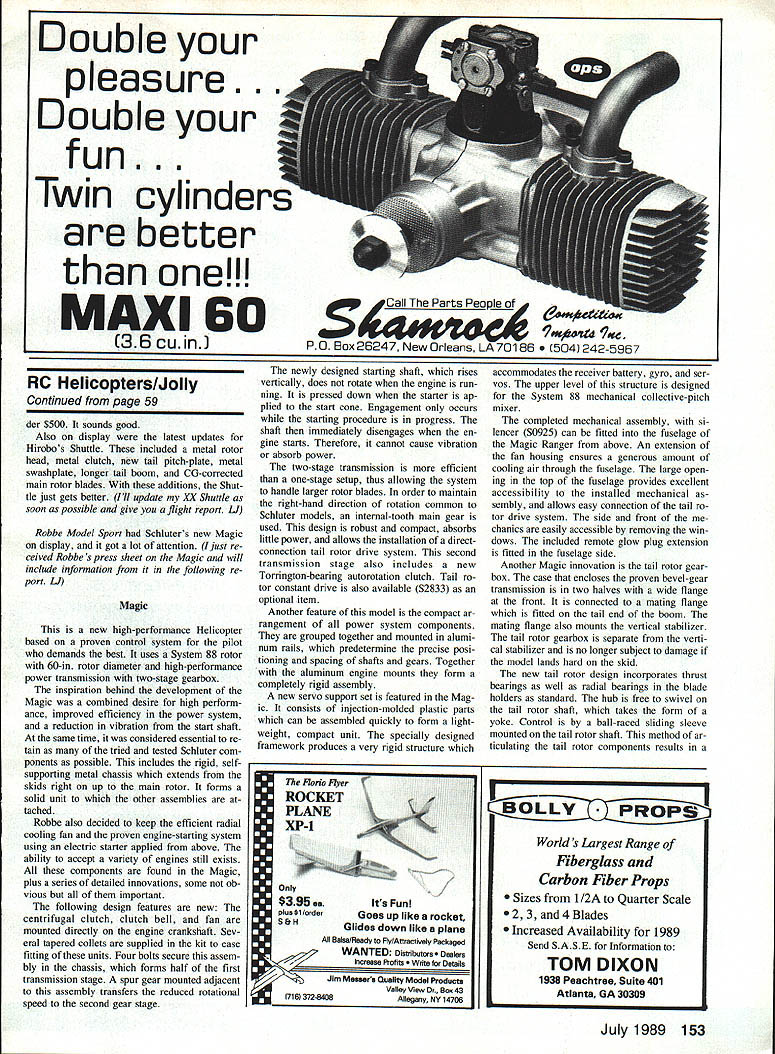
- Small Augusta 109 and Hughes 500F fiberglass fuselages available to fit the X-Cell 30 mechanics.
- Availability: early June.
- Hobbico / Kyosho — Concept 30
- New for Concept 30: wood rotor blades and a lightweight Jet Ranger fuselage.
- Previously the Concept 30 used plastic, CG-corrected main blades; wood rotors are an interesting change.
- Rumor: Taya and Kyosho may team again on a Concept 60 (more information expected in the fall).
- RC Systems
- Now producing the Rotary Wing Concept line of scale fuselages and accessories.
- New 1/4-scale Jet Ranger and fiberglass replacement canopies for many models.
- Hobby Dynamics
- Kalt Excalibur (.60-size aerobat)
- K-S composite rotor head, 470 cc fuel tank, omega-machined main reduction gear.
- Main rotor ratio: 8.8:1; tail rotor ratio: 4.5:1.
- 57-in. main rotor disc spinning ~1,700 rpm.
- Omega tail rotor gearbox included.
- Weight: ~10 lb; price around $650. Availability at dealers: June 1.
- Cyclone II
- New canopy, autorotation gear, standard-toothed belt drive, K-S rotor head.
- Priced at $389.
- Heli-Tech
- Showing Wiks products, including OF-4 and OF-3 scale rotor heads.
- Gorham Model Products
- Rebel (.40-size fixed-pitch)
- Essentially a .40-size Cricket; marketed as an ideal first machine.
- Can be purchased with a four-channel radio and a .40-size airplane engine for under $500.
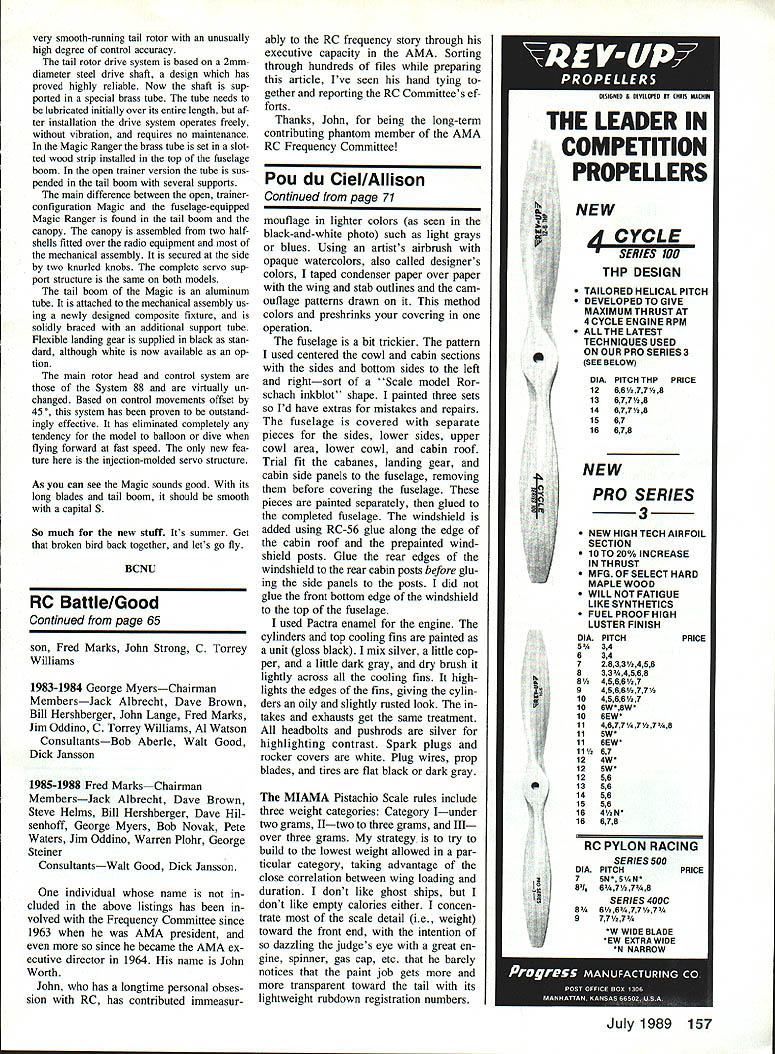
- Hirobo Shuttle updates on display:
- Metal rotor head and clutch, new tail pitch plate, metal swashplate, longer tail boom, and CG-corrected main rotor blades.
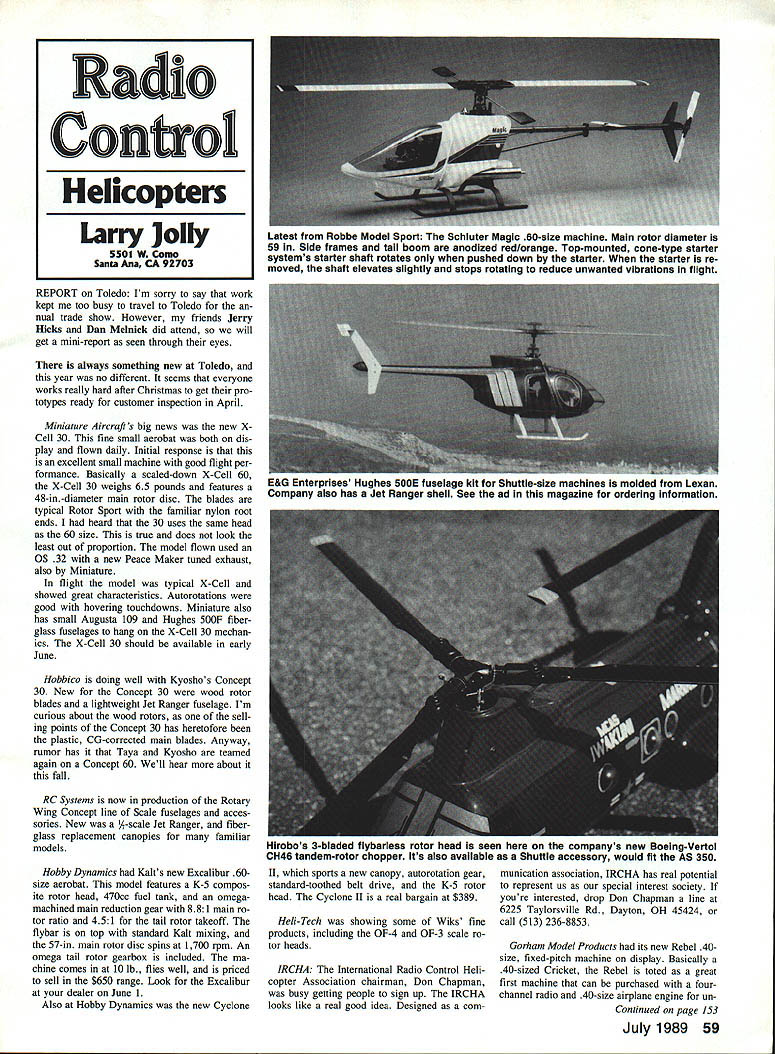
- Robbe Model Sport — Schluter Magic (.60-size)
- Received a lot of attention; designed for high performance, efficiency, reduced vibration, and to retain proven Schluter components.
- Key features:
- System 88 rotor system with 60-in. rotor diameter.
- High-performance power transmission with a two-stage gearbox for greater efficiency and ability to handle larger rotor blades.
- Centrifugal clutch, clutch bell, and fan mounted directly on the engine crankshaft; kit includes tapered collars for fitting the clutch bell to different crankshafts.
- Newly designed starting shaft: rises vertically, engages only during starting, and does not rotate with the engine, eliminating starter-induced vibration.
- Internal-tooth main gear maintains the conventional right-hand rotation; design is compact, robust, and absorbs little power.
- Second transmission stage includes a Torrington-bearing autorotation clutch. Tail-rotor constant drive (S2833) available as an option.
- Compact, rigid assembly: power components grouped on aluminum rails with aluminum engine mounts.
- Servo-support set: injection-molded parts form a lightweight, rigid framework that accommodates receiver battery, gyro, and servos; upper level designed for the System 88 mechanical collective-pitch mixer.
- Assembly can be fitted into the Magic Ranger fuselage from above; extended fan housing provides generous cooling airflow.
- Fuselage access: large top opening and removable windows for side and front access; remote glow-plug extension fitted in fuselage side.
- Tail-rotor gearbox: two-piece case with wide front flange mating to boom flange; gearbox is separate from the vertical stabilizer to reduce damage risk on hard landings.
- Tail-rotor design: thrust and radial bearings in blade holders; hub swivels on a yoke-shaped shaft; control via a ball-raced sliding sleeve for low friction, reduced backlash, and lower drive power requirements — results in a smooth-running tail rotor with high control accuracy.
- Tail rotor drive: 2 mm steel drive shaft supported in a special brass tube; lubricate initially, then operates freely without vibration and requires no maintenance.
- Magic Ranger vs open trainer:
- Canopy assembled from two half-shells secured by knurled knobs; same servo support structure on both models.
- Tail boom is aluminum, attached with a composite fixture and braced with an additional support tube.
- Flexible landing gear supplied in black standard; white optional.
- Main rotor head and control system are System 88, virtually unchanged — proven to eliminate ballooning or diving during high-speed forward flight; only new feature is the injection-molded servo structure.
- Overall: long blades and tail boom should result in very smooth flight characteristics.
IRCHA (International Radio Control Helicopter Association)
- Chairman Don Chapman was signing members up at the show.
- IRCHA is designed as a communication association with potential to represent hobbyists as a special interest society.
- Contact: Don Chapman, 6225 Taylorsville Rd., Dayton, OH 45424. Phone: (513) 236-8853.
Miscellany and closing
- Robbe's Schluter Magic display included press information and emphasized retention of proven Schluter components (rigid metal chassis, radial cooling fan, top-applied electric starter, and engine flexibility) alongside the new innovations described above.
- The general tenor at Toledo: lots of prototype work and incremental improvements — new rotor heads, fuselages, gearboxes, and accessory items.
- Final note: it's summer — repair the broken bird and get out to fly.
Transcribed from original scans by AI. Minor OCR errors may remain.

