
Radio Control: Helicopters
Larry Jolly 5501 W. Como Santa Ana, CA 92703
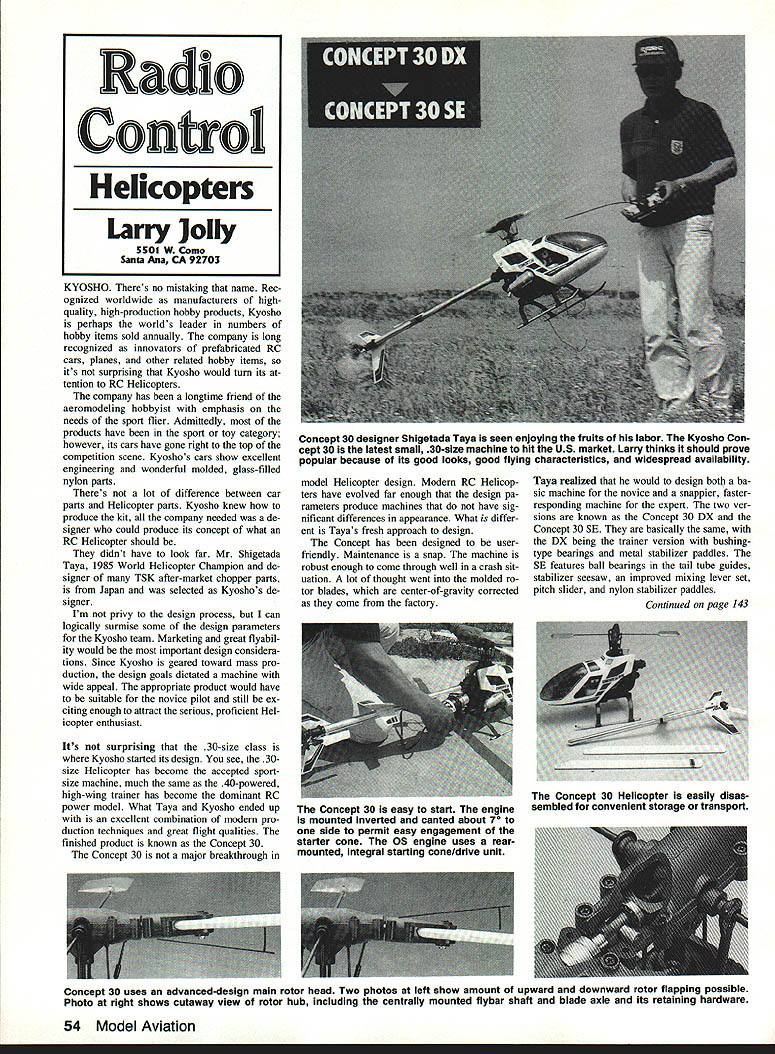
Kyosho and the Concept 30
Kyosho. There's no mistaking that name. Recognized worldwide as a manufacturer of high-quality, high-production hobby products, Kyosho is perhaps the world's leader in numbers of hobby items sold annually. The company is long recognized as an innovator of prefabricated RC cars, planes, and other related hobby items, so it is not surprising that Kyosho would turn its attention to RC helicopters.
The company has been a longtime friend of the aeromodeling hobbyist, with emphasis on the needs of the sport flier. Admittedly, most of the products have been in the sport or toy category; however, its cars have gone right to the top of the competition scene. Kyosho's cars show excellent engineering and wonderfully molded, glass-filled nylon parts.
There's not a lot of difference between car parts and helicopter parts. Kyosho knew how to produce the kit; all the company needed was a designer who could produce its concept of what an RC helicopter should be.
They didn't have to look far. Mr. Shigetada Taya, 1985 World Helicopter Champion and designer of many TSK after-market chopper parts, is from Japan and was selected as Kyosho's designer.
I'm privy to the design process, but I can logically surmise some of the design parameters for the Kyosho team. Marketing and great flyability would be the most important design considerations. Since Kyosho is geared toward mass production, the design goals dictated a machine with wide appeal. The appropriate product would have to be suitable for the novice pilot and still be exciting enough to attract the serious, proficient helicopter enthusiast.
It's not surprising that the .30-size class is where Kyosho started its design. The .30-size helicopter has become the accepted sport-size machine, much the same as the .40-powered, high-wing trainer has become the dominant RC power model. What Taya and Kyosho ended up with is an excellent combination of modern production techniques and great flight qualities. The finished product is known as the Concept 30.
The Concept 30 is not a major breakthrough in model helicopter design. Modern RC helicopters have evolved far enough that design parameters produce machines that do not have significant differences in appearance. What is different is Taya's fresh approach to design.
The Concept has been designed to be user friendly. Maintenance is a snap. The machine is robust enough to come through well in a crash situation. A lot of thought went into the molded rotor blades, which are center-of-gravity corrected as they come from the factory.
Versions: DX and SE
Taya realized that he would have to design both a machine for the novice and a snappier, faster-responding machine for the expert. The two versions are known as the Concept 30 DX and the Concept 30 SE. They are basically the same, with differences aimed at training versus performance:
- Concept 30 DX (trainer):
- Bushing-type bearings
- Metal stabilizer paddles
- Concept 30 SE (performance):
- Ball bearings in the tail tube guides and stabilizer seesaw
- Improved mixing lever set
- Pitch slider
- Nylon stabilizer paddles
Distribution and First Impressions
The Concept 30 is distributed in America by Great Planes Model Distributors, which also handles the OS Max engines. So, unlike the Hirobo Shuttle, the Concept 30 is distributed with the OS 32 FSRH or the OS .28 FSRH engines that Kyosho selected as the design engines for the Concept. Great Planes has done an excellent job promoting its new little helicopter. Because of the diligent work and its excellent reputation as a distributor, Great Planes has ensured that the Concept 30 will be very successful and available at most model shops.
Great Planes supplied me with a Concept 30 kit for testing. I received it yesterday and have not yet had time to assemble it (a task which should take about four hours). I did open the box and checked out the contents, though. The Concept comes packed in a foam shipping container, in much the same condition as Hirobo's Shuttle; that is, about 80% assembled. Looking over the Concept 30 reveals that it is pure Kyosho, with beautifully molded parts that fit well. Kyosho has prepared an excellent instruction manual obviously aimed at the novice. This in itself will go a long way toward flying success.
Since I haven't assembled my Concept yet, I'd like to save any more comments until next month. However, Kyosho and Taya should be congratulated for their efforts in the highly competitive .30-size class. The Concept 30 is a very viable machine showing great strides in design and production techniques. I'd also like to thank Great Planes for making the Concept 30 available to both you and me. When you're ready, tune in next month and we'll see what the Concept 30 is like to assemble and fly.
Transcribed from original scans by AI. Minor OCR errors may remain.

