
Radio Control: Helicopters
Larry Jolly
15781 Empire Ln. Westminster, CA 92683
Welcome back. If you caught last month's column, I was discussing Gorham Model Products' new Rebel fixed-pitch helicopter. At the conclusion of that article I had not completely flight-evaluated the Rebel and consequently decided to dedicate this column to setting up the Rebel and flying fixed-pitch machines in general.
As a review, GMP's new Rebel is a fixed-pitch, .40-size model helicopter aimed at the entry-level helicopter pilot, particularly those who are fixed-wing fliers and are likely to have access to a .40-size engine and a four-channel radio.
GMP's instruction manual is 40 pages long and is well written. The Rebel went together very easily, with construction time held to a minimum. As it turns out, the Rebel is very much like a super-Cricket. Flying my Rebel was as easy as putting the machine together had been. It is a great trainer. The chopper hovered well on its first tank of fuel, with minimum blade trimming necessary for proper tracking. I was impressed with the instruction manual, particularly the setup and flying procedures. With the combination of the Rebel's great stability and comprehensive instructions, a first-time helicopter pilot should do very well with this helicopter.
One point I'd like to make is that although the blade holders come pre-bent, there is a real possibility that additional trimming will be necessary to achieve proper blade tracking. This means you must not only determine which blade is high or low, but also decide if you want to increase the lift of the system or decrease it. The description for doing this, as given by GMP, is good and should be followed.
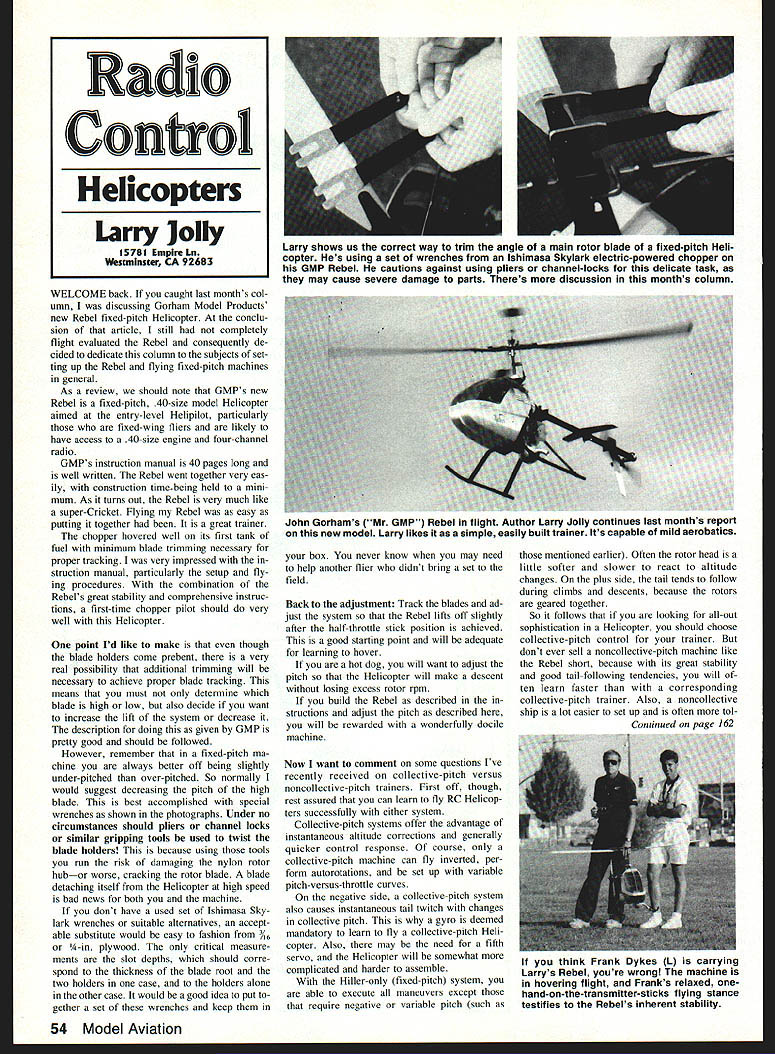
However, remember that in a fixed-pitch machine you are always better off being slightly under-pitched than over-pitched. Normally I suggest decreasing the pitch of the high blade. This is best accomplished with special wrenches as shown in the photographs. Under no circumstances should pliers, channel locks, or similar gripping tools be used to twist the blade holders. Using those tools risks damaging the nylon rotor hub—or worse, cracking the rotor blade. A blade detaching itself from the helicopter at high speed is very dangerous for both you and the machine.
If you don't have a set of Ishimasa Skylark wrenches or suitable alternatives, an acceptable substitute can be fashioned from 3/16- or 1/4-inch plywood. The only critical measurements are the slot depths, which should correspond to the thickness of the blade root and the two holders in one case, and the other holders in the other case. It would be a good idea to put together a set of these wrenches and keep them in your box. You never know when you may need to help another flier who didn't bring a set to the field.
Back to the adjustment: track the blades and adjust the system so that the Rebel lifts off slightly after the half-throttle stick position is achieved. This is a good starting point and will be adequate for learning to hover.
If you are a hot-dogger, you will want to adjust the pitch so that the helicopter will make a descent without losing excess rotor rpm.
If you build the Rebel as described in the instructions and adjust the pitch as described here, you will be rewarded with a wonderfully docile machine.
Collective-pitch versus fixed-pitch trainers
First, rest assured that you can learn to fly RC helicopters successfully with either system.
Collective-pitch systems:
- Offer instantaneous altitude corrections and generally quicker control response.
- Are the only type that can fly inverted, perform autorotations, and be set up with variable pitch-versus-throttle curves.
- Can cause instantaneous tail twitch with changes in collective pitch; for this reason a gyro is considered mandatory to learn a collective-pitch helicopter.
- May require a fifth servo and are somewhat more complicated and harder to assemble.
Fixed-pitch (Hiller-only) systems:
- Allow you to execute all maneuvers except those requiring negative or variable pitch.
- Often have a slightly softer rotor head that is slower to react to altitude changes.
- Tend to have better tail-following during climbs and descents because the rotors are geared together.
- Are easier to set up and often more tolerant.
If you want the most sophisticated capabilities, choose a collective-pitch trainer. But don't sell a noncollective-pitch machine like the Rebel short—because of its great stability and good tail-following tendencies, you may actually learn faster with a well-set-up fixed-pitch trainer.
Flight characteristics and aerobatics
So what will the Rebel do? In the hover it's a dream. You can fly pirouettes all day without having to back into the turn. In forward (or fast) flight, the Rebel handles forward, backward, or sideways equally well. Most helicopters are biased toward forward and sideways flight, but the Rebel flies neutrally in any direction. In fact, the Rebel would be the perfect trainer for practicing circuits in reverse.
As far as aerobatics are concerned, the Rebel loops tightly and does a slow roll. Spinning stall turns are easy as well.
For many of us the Rebel is the kind of machine that brings back the good old days when we learned to fly. There is something very relaxing about this kind of flying machine.
Either with a gyro or without, with a helicopter engine or with a standard .40, with a heli-radio system or with a standard four-channel stick box, the Rebel from GMP offers a lot of fun. It's a product of today's technology with an eye back to where we came from.
BCNU
Transcribed from original scans by AI. Minor OCR errors may remain.

