
Radio Control: Helicopters
Walt Schoonard
UPON ARRIVING at Toledo each year, one is usually greeted by unbelievable cold and windy weather. This is a real shock, especially for me, being a tenderfoot from Florida, but this year was different. Oh, it was a little cold Saturday morning, but the sun was shining and a little wind was blowing. By mid-afternoon it actually got up in the high seventies and then cooled off by late evening.
This year's Toledo show was more of a business trip for me so I did not have as much time to see the displays as in years before. However, I did get to all the helicopter booths and that is where my interest lies and yours, too, or you wouldn't be reading this.
Kavan had their long-awaited Alouette 2 on display, and typical of Kavan thoroughness, they are already making improvements that will be in the very first kits. Many should be flying, including mine, by the time that you read this column.
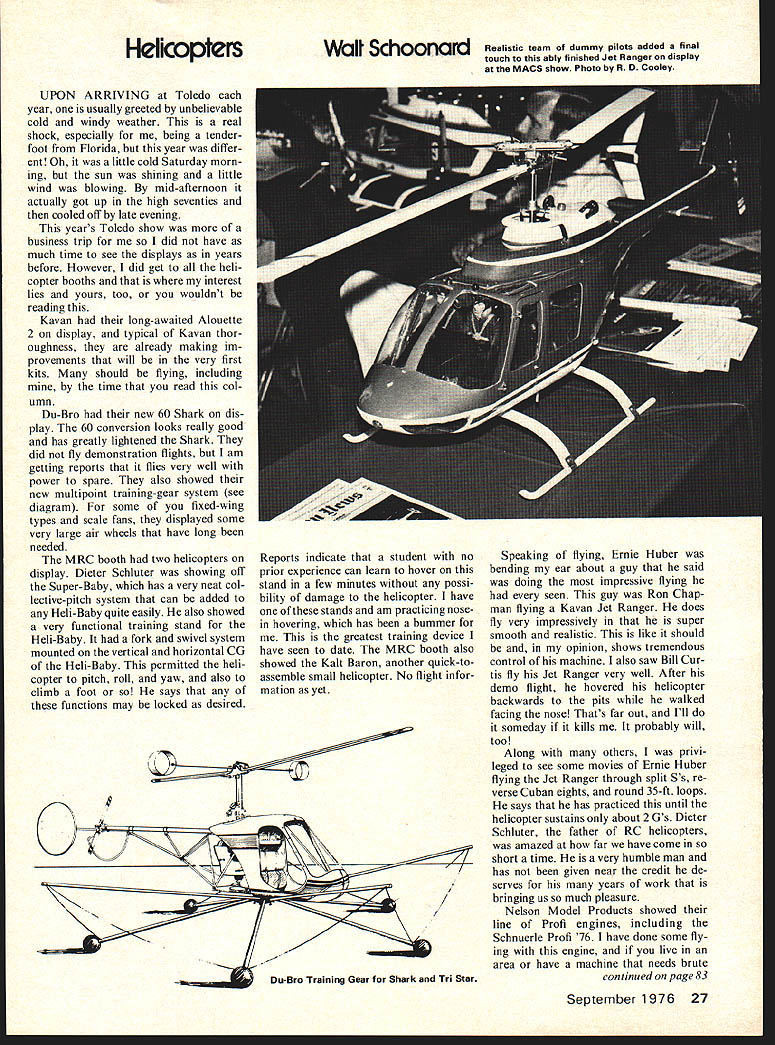
Du-Bro had their new 60 Shark on display. The 60 conversion looks really good and has greatly lightened the Shark. They did not fly demonstration flights, but I am getting reports that it flies very well with power to spare. They also showed their new multipoint training-gear system (see diagram). For some of you fixed-wing types and scale fans, they displayed some very large air wheels that have long been needed.
The MRC booth had two helicopters on display. Dieter Schluter was showing off the Super-Baby, which has a very neat collective-pitch system that can be added to any Heli-Baby quite easily. He also showed a very functional training stand for the Heli-Baby. It had a fork and swivel system mounted on the vertical and horizontal CG of the Heli-Baby. This permitted the helicopter to pitch, roll, and yaw, and also to climb a foot or so! He says that any of these functions may be locked as desired.
Reports indicate that a student with no prior experience can learn to hover on this stand in a few minutes without any possibility of damage to the helicopter. I have one of these stands and am practicing nose-in hovering, which has been a bummer for me. This is the greatest training device I have seen to date. The MRC booth also showed the Kalt Baron, another quick-to-assemble small helicopter. No flight information as yet.
Speaking of flying, Ernie Huber was bending my ear about a guy that he said was doing the most impressive flying he had ever seen. This guy was Ron Chapman flying a Kavan Jet Ranger. He does fly very impressively in that he is super smooth and realistic. This is like it should be and, in my opinion, shows tremendous control of his machine. I also saw Bill Curtis fly his Jet Ranger very well. After his demo flight, he hovered his helicopter backwards to the pits while he walked facing the nose! That's far out, and I'll do it someday if it kills me. It probably will, too!
Along with many others, I was privileged to see some movies of Ernie Huber flying the Jet Ranger through split S's, reverse Cuban eights, and round 35-ft. loops. He says that he has practiced this until the helicopter sustains only about 2 G's. Dieter Schluter, the father of RC helicopters, was amazed at how far we have come in so short a time. He is a very humble man and has not been given near the credit he deserves for his many years of work that is bringing us so much pleasure.
Nelson Model Products showed their line of Profi engines, including the Schnuerle Profi 76. I have done some flying with this engine, and if you live in an area or have a machine that needs brute. power, this is the one. It runs smooth, has a very linear carburetor, and idles well. It will not fit into a Jet Ranger in its present form; however, I understand that the manufacturer is working on this problem.
Al Erwin had his Tach-Tron governor on display, along with a unique electronic device showing how it works to maintain constant rotor speed. This unit has a counter that reads rotor-shaft speed and delays the slightest change to the throttle servo, which reacts on motor power to compensate. Designed for helicopters with collective, it is being marketed by Royal Electronics, Denver, CO. I am going to write an article later about my findings with this governor. I have been experimenting with two types, one of which has constant rotor speed all the way to landing; and the other that can be adjusted so that, after a given collective down, the rotor speed follows the collective down. More about this later. Al Erwin has also produced a very clever bit of installing a Webra 61 speed FR in his Graupner 212 mechanic Haubenbosch that weighs 15½ pounds. If you need some more power in your 212, write to him; he will be glad to help, I'm sure. Al Erwin, 1312 W. Hill, Champaign, IL 61820.
Robart Manufacturing Company had two items of interest to helicopter pilots. One was an in-line fuel pump about the size of a small cigarette. This pump is activated by backplate crankcase pressure and does not need a special carburetor. It will permit fuel location to suit your special needs. It should be available now at $12.95. They also had a wing-incidence gauge that can be adapted to check rotor pitch. It works like a plumber's bob in reverse.
I had the privilege of being one of the helicopter judges this year along with Steve Mintz and Dave Keats. This is a difficult job, to say the least, and not everyone can be pleased with the outcome. However, we tried to be fair. In the float races the show committee stipulated that first prize was awarded to R. L. Catt of Magadore, OH, for his super neat match of a du-Baby Hugs 500 fuse to a Heli-Baby. Excellent workmanship and eye appeal. Second place went to Walt George of Lincoln Park, MI, for his Bienz Falcon Bell 212. It had a great deal of detail. Third place went to Gene Rock of Media, PA, for his scratch-built, very small 33" Veco 19-powered Baby Jays. I understand that it lives very fast and well. Fourth place went to Pete Niles' Enstrom Policejet, and fifth place went to Tom Wells' highly detailed Jet Ranger.
(My address is: 2080 Sharon Rd., Winter Park, FL 32789.)
Transcribed from original scans by AI. Minor OCR errors may remain.

