
Radio Control: Helicopters
Larry Jolly 15781 Empire Ln. Westminster, CA 92683
We're going to cover several subjects this month that seem to have come our way all at once. I hope you're getting lots of flying in now that the great summer weather is here. As always, I'm constantly looking for new material for the column. If you've got a picture of your favorite whirlybird, why not send me a copy and include a few words about you, your ship, and your club. I could really use the help, as it's difficult to keep up the column on my own.
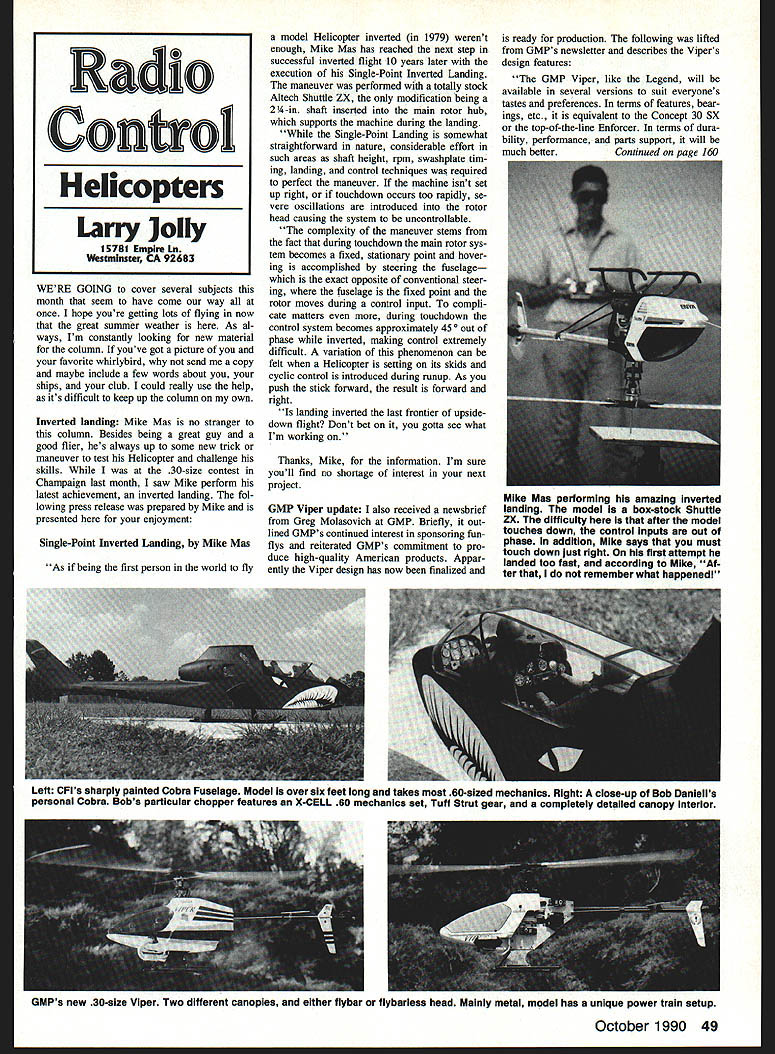
Inverted landing: Mike Mas is no stranger to this column. Besides being a great guy and a good flier, he's always up to some new trick or maneuver to test his helicopter and challenge his skills. While I was at the .30-size contest in Champaign last month, I saw Mike perform his latest achievement, an inverted landing. The following press release was prepared by Mike and is presented here for your enjoyment:
Single-Point Inverted Landing, by Mike Mas
"As if being the first person in the world to fly a model helicopter inverted (in 1979) weren't enough, Mike Mas has reached the next step in successful inverted flight 10 years later with the execution of his Single-Point Inverted Landing. The maneuver was performed with a totally stock Altech Shuttle ZX, the only modification being a 2-1/4-in. shaft inserted into the main rotor hub, which supports the machine during the landing.
"While the Single-Point Landing is somewhat straightforward in nature, considerable effort in such areas as shaft height, rpm, swashplate timing, landing, and control techniques was required to perfect the maneuver. If the machine isn't set up right, or if touchdown occurs too rapidly, severe oscillations are introduced into the rotor head causing the system to be uncontrollable.
"The complexity of the maneuver stems from the fact that during touchdown the main rotor system becomes a fixed, stationary point and hovering is accomplished by steering the fuselage — which is the exact opposite of conventional steering, where the fuselage is the fixed point and the rotor moves during a control input. To complicate matters even more, during touchdown the control system becomes approximately 45° out of phase while inverted, making control extremely difficult. A variation of this phenomenon can be felt when a helicopter is setting its skids and a cyclic control is introduced during runup. As you push the stick forward, the result is forward and right.
"'Is landing inverted the last frontier of upside-down flight? Don't bet on it, you gotta see what I'm working on.'"
Thanks, Mike, for the information. I'm sure you'll find no shortage of interest in your next project.
GMP Viper update
I also received a newsbrief from Greg Molasovich at GMP. Briefly, it outlined GMP's continued interest in sponsoring fun flys and reiterated GMP's commitment to producing high-quality American products. Apparently the Viper design has now been finalized and is ready for production. The following was lifted from GMP's newsletter and describes the Viper's design features:
"The GMP Viper, like the Legend, will be available in several versions to suit everyone's tastes and preferences. In terms of features, bearings, etc., it is equivalent to the Concept 30 SX or the top-of-the-line Enforcer. In terms of durability, performance, and parts support, it will be much better."
A lightweight pod-and-boom Viper will be available first, equipped with a Mini-Elite rotorhead. Soon to follow will be a semi-fuselage version and a new Mustang Delta 3 rotorhead, which will be used on both the pod-and-boom and semi-fuselage versions of the Viper and other .30-powered helicopters for spectacular hot-dog performance. The Viper will fit into nearly all of the many scale fuselages for .30-sized helicopters available today.
Viper specifications:
- Main rotor diameter: 44 in.
- Tail rotor diameter: 8 in.
- Engine size: .28–.35 cu. in.
- Weight: 5.75–6.25 lb.
- Radio: four- to five-channel
- Tail rotor drive: belt driven
- Main rotor head: Mini-Elite (all metal, preassembled)
- Collective pitch: standard
- Autorotation: standard
- Construction: aluminum/steel
- Fuselages: will fit most .30-size fuselages
- Suggested retail price: $445
- Availability: end of August 1990
New GMP rotor head—Mini-Elite (standard on Viper)
With the incredible growth of the .30-size market, GMP is producing an all-metal, preassembled two-thirds-size version of the world-famous Elite rotor system. You will be able to buy Mini-Elite rotor heads because they fit any .30-size helicopter on the market, such as the Concept 30, Shuttle, and Enforcer, to provide much-improved FAI Expert-level aerobatic performance and hovering stability. Mini-Elite suggested retail price: $169.
Sounds like the Viper is going to be real interesting. As soon as GMP has one available I'll give you a full report, and I'll test-fly the new Mini-Elite head on one of my other .30-size machines. The GMP newsletter also describes the company's product lineup for 1990. Apparently, Cricket, Hughes 300, and Competition production has been suspended for the time being, but parts will still be available. GMP is looking at improvements in the Cricket and Hughes 300 and may reintroduce them at a later time.
I recently received a letter and some pictures from Bob Daniel (CFI RC Supply, 9180 Hill Road, Lakeland, FL 33809; tel. 1-813-855-2658). Bob is producing a large, six-foot-long Cobra fuselage. The fuselage is made from polyester glass and is large enough for most .60-size mechanics. This is a big one, similar in size to the old Heli Cobra.
Bob's Cobra features X-Cell mechanics and Tuff Strut landing gear. I've included photos of his nearly complete machine. Check with Bob for prices and availability.
This is going to be a short month. Next week I'll be traveling to Illinois to cover the Nats. I'm looking forward to visiting and watching some great flying. Anyway, look for a full Nats report in the next issue.
Great Planes just sent me one of the brand-new Concept SX helicopters for a review. This Concept looks real neat and should be a superb machine. Kyosho has put a lot of effort into the evolution of its Concept and the SX typifies that thoroughness. I'll start playing with the Concept SX when I get back from the Nats and see if I can get it done for an article in the following issue.
Keep the skids down on touchdown—unless you are Mike Mas—and keep those photos coming.
Transcribed from original scans by AI. Minor OCR errors may remain.

