
Radio Control: Helicopters
Larry Jolly 15781 Empire Ln. Westminster, CA 92683
Welcome back. This month we're going to take a look at Kyosho's latest offering, the new Concept 30 SX.
By now everyone is familiar with Kyosho's Concept 30. I think it's fair to say that never before has a model helicopter been as widely accepted and successfully marketed as Kyosho's initial offering. From coast to coast at fields across America, Concepts are flying and flying well.
Since the Concept 30 was Kyosho's first helicopter, it is not surprising that modelers could find a few things they wanted to see done differently. As a result, there have been a great many after-market parts made available for the Concept—more, in fact, than any other machine I can remember.
Accepting the fact that the Concept 30 is very successful, great-flying, easy to build and readily available, why would Kyosho bring forth the SX? The obvious answer is that the SX is a refined concept. Taking the experience gained over the last two years and aiming at a slightly higher caliber of heli pilot, Kyosho engineers have added to the Concept's naturally good flight characteristics and have rewarded us with a machine that is optimized for aerobatics. Thinking about it, that's not such a bad idea. Thousands of modelers have learned to fly on the Concept and as they have improved, it is only natural that they'll want to make a step up.
The Concept 30 SX
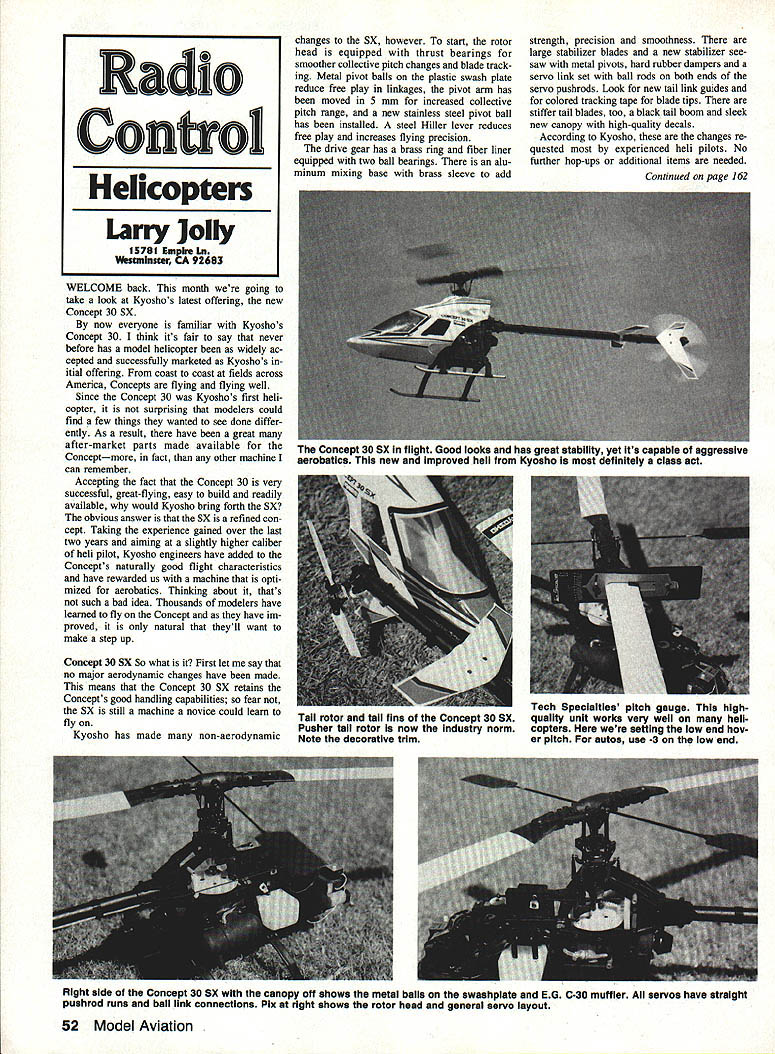
So what is it? First let me say that no major aerodynamic changes have been made. This means that the Concept 30 SX retains the Concept's good handling capabilities; so fear not, the SX is still a machine a novice could learn to fly on.
Kyosho has made many non-aerodynamic changes to the SX, however. According to Kyosho, these are the changes requested most by experienced heli pilots. No further hop-ups or additional items are needed.
Key changes and improvements include:
- Rotor head equipped with thrust bearings for smoother collective pitch changes and blade tracking.
- Metal pivot balls on the plastic swashplate to reduce free play in linkages.
- Pivot arm moved 5 mm for increased collective pitch range and a new stainless steel pivot ball installed.
- Steel Hiller lever to reduce free play and increase flying precision.
- Drive gear with a brass ring and fiber liner, supported by two ball bearings.
- Aluminum mixing base with brass sleeve for added strength, precision, and smoothness.
- Larger stabilizer blades and a new stabilizer seesaw with metal pivots and hard rubber dampers.
- Servo link set with ball rods on both ends of the servo pushrods.
- New tail link guides and colored tracking tape for blade tips.
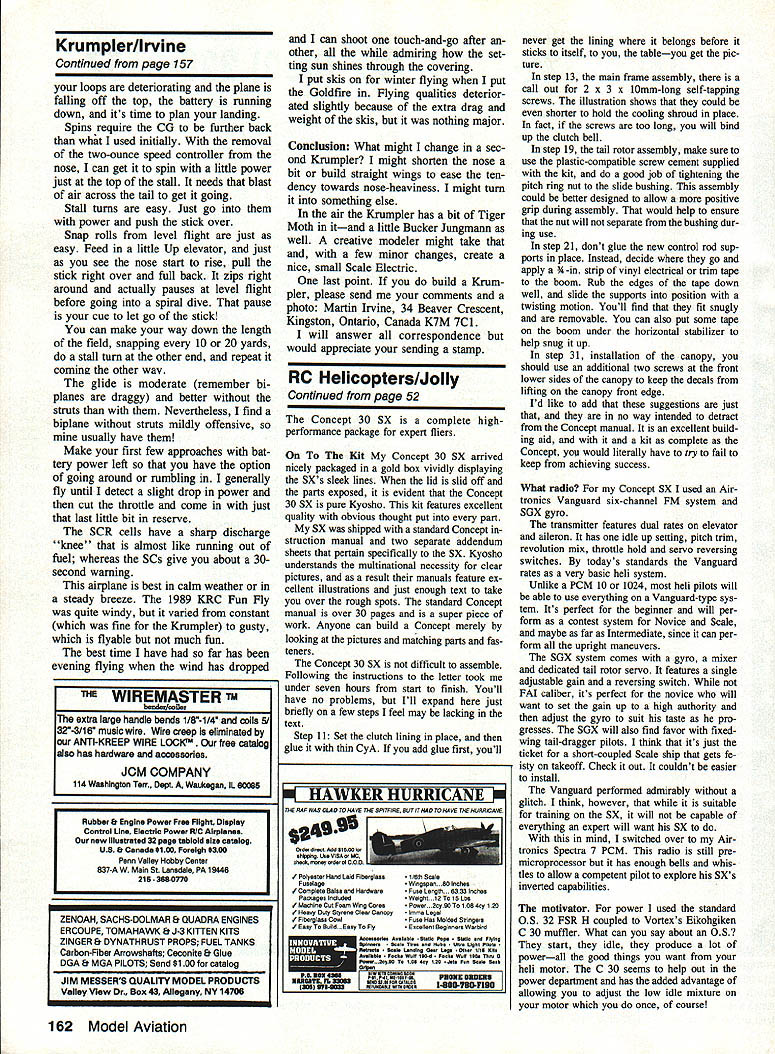
- Stiffer tail blades, a black tail boom, and a sleek new canopy with high-quality decals.
RC Helicopters
The Concept 30 SX is a complete high-performance package for expert fliers.
On to the kit
My Concept 30 SX arrived nicely packaged in a gold box vividly displaying the SX's sleek lines. When the lid is slid off and the parts are exposed, it is evident that the Concept 30 SX is pure Kyosho. This kit features excellent quality with obvious thought put into every part.
My SX was shipped with a standard Concept instruction manual and two separate addendum sheets that pertain specifically to the SX. Kyosho understands the international necessity for clear pictures and, as a result, their manuals feature excellent illustrations and just enough text to take you over the rough spots. The standard Concept manual is over 30 pages and is a super piece of work. Anyone can build a Concept merely by looking at the pictures and matching parts and fasteners.
The Concept 30 SX is not difficult to assemble. Following the instructions to the letter took me under seven hours from start to finish. You'll have no problems, but I'll expand here briefly on a few steps I feel may be lacking in the text.
Assembly notes and tips
- Step 11: Set the clutch lining in place, and then glue it with thin CA. If you add glue first, you'll never get the lining where it belongs before it sticks to itself, to you, or to the table.
- Step 13 (main frame assembly): The manual calls out 2 x 3 x 10 mm self-tapping screws. The illustration shows they could be even shorter to hold the cooling shroud in place. If the screws are too long, you will bind up the clutch bell.
- Step 19 (tail rotor assembly): Use the plastic-compatible screw cement supplied with the kit, and do a good job of tightening the pitch ring nut to the slide bushing. This assembly could be better designed to allow a more positive grip during assembly to ensure the nut will not separate from the bushing during use.
- Step 21: Don't glue the new control rod supports in place. Instead, decide where they go and apply a 3M strip of vinyl electrical or trim tape to hold them in place. Bend the edges of the tape down well and slide the supports into position with a twisting motion. You'll find that they fit snug and are removable. You can also put some tape around the boom under the horizontal stabilizer to help snug it up.
- Step 31 (canopy installation): Use an additional two screws at the front lower sides of the canopy to keep the decals from lifting on the canopy front edge.
I'd like to add that these suggestions are just that, and they are in no way intended to detract from the Concept manual. It is an excellent building aid, and with it and a kit as complete as the Concept, you would literally have to try to fail to keep from achieving success.
What radio?
For my Concept 30 SX I used an Airtronics Vanguard six-channel FM system and an SGX gyro.
The transmitter features dual rates on elevator and aileron. It has one idle-up setting, pitch trim, revolution mix, throttle hold and servo reversing switches. For most fliers the Vanguard provides a very basic, usable heli system.
Unlike PCM 10 or 1024 systems, most heli pilots will be able to use everything on a Vanguard-type system. It's a perfect fit for the beginner and will perform as a contest system for novice and Scale, and maybe as far as Intermediate, since it can perform all the upright maneuvers.
The SGX system comes with a gyro, a mixer and a dedicated tail rotor servo. It features a single adjustable gain and a reversing switch. With the Vanguard, it's perfect for the novice. You will want to set the gain up to a high authority and then adjust the gyro to suit its rate as the pilot progresses. The SGX will also find favor with fixed-wing tail-dragger pilots. It's simple and reliable to install.
The motivator
For power I used the standard O.S. 32 FSR-H. It started, ran and idled very well and provided ample power for all maneuvers. The Concept 30 SX is a quality unit and, with the improvements Kyosho has made, it is a definite class act.
Flight impressions — Does it fly?
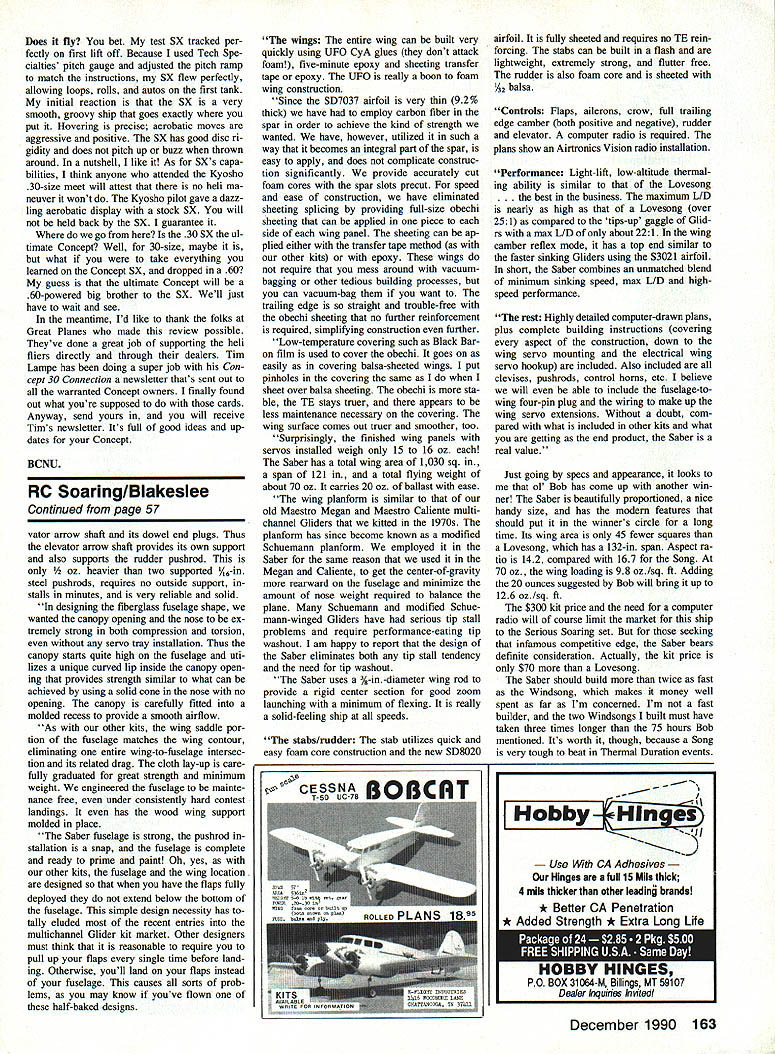
You bet. My test SX tracked perfectly on first lift-off. Because I used a Tech Specialties pitch gauge and adjusted the pitch ramp to match the instructions, my SX flew perfectly, allowing loops, rolls, and autos on the first tank.
My initial reaction is that the SX is a very smooth, groovy ship that goes exactly where you put it. Hovering is precise; aerobatic moves are aggressive and positive. The SX has good disc rigidity and does not pitch up or buzz when thrown around. In a nutshell, I like it!
As for the SX's capabilities, I think anyone who attended the Kyosho .30-size meet will attest that there is no heli maneuver it won't do. The Kyosho pilot gave a dazzling aerobatic display with a stock SX. You would not be held back by the SX. I guarantee it.
Where do we go from here?
Is the .30 SX the ultimate Concept? Well, for .30-size, maybe it is, but what if you were to take everything you learned on the Concept SX and drop in a .60? My guess is that the ultimate Concept will be a .60-powered big brother to the SX. We'll just have to wait and see.
In the meantime, I'd like to thank the folks at Great Planes who made this review possible. They've done a great job of supporting the heli fliers directly and through their dealers. Tim Lampe has been doing a super job with his Concept 30 Connection, a newsletter that's sent out to all the warranted Concept owners. I finally found out what you're supposed to do with those cards. Anyway, send yours in, and you will receive Tim's newsletter. It's full of good ideas and updates for your Concept.
BCNU.
Transcribed from original scans by AI. Minor OCR errors may remain.

