
Radio Control: Helicopters
Larry Jolly 15781 Empire Ln. Westminster, CA 92683
Introduction
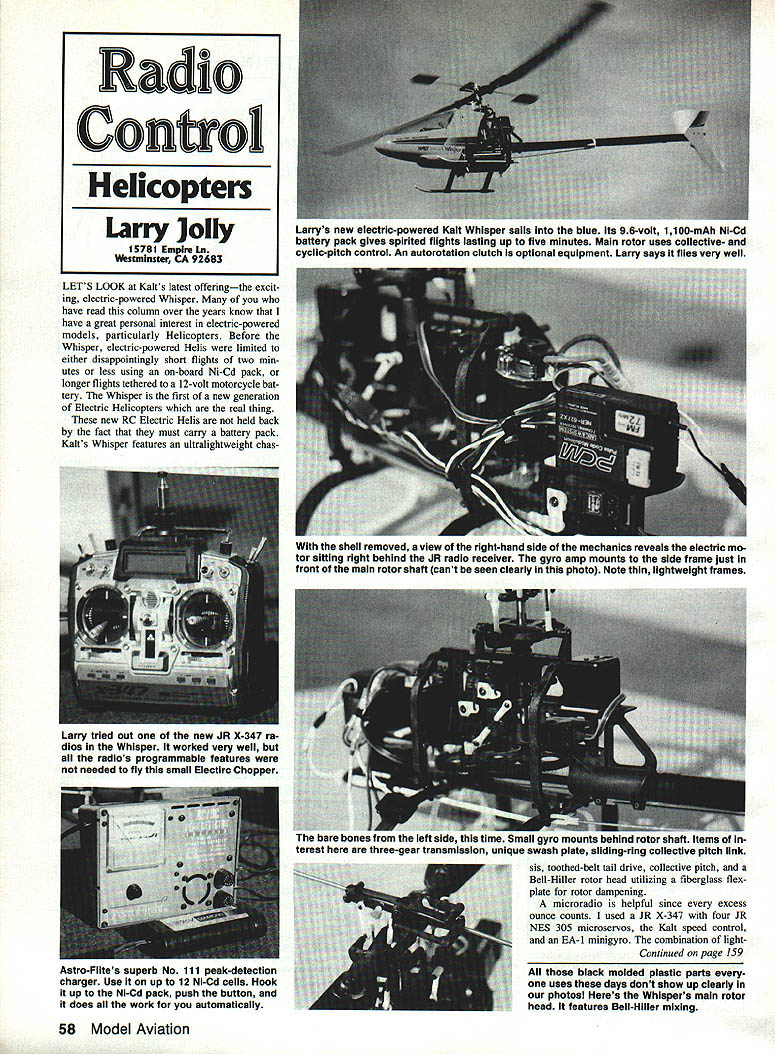
Let's look at Kalt's latest offering—the electric-powered Whisper. Many readers know I have a strong interest in electric-powered models, particularly helicopters. Before the Whisper, electric helis were limited to very short flights with on-board Ni-Cd packs or tethered operation. The Whisper represents the first of a new generation of electric helicopters that are the real thing.
Specifications and Performance
- Power: electric motor with an eight-cell, 1,100 mAh Ni-Cd flight pack (supplied with the kit)
- Ready-to-fly weight (with pack): 1,195 grams (42 oz)
- Flight time: typically 4–5 minutes depending on how aggressively you fly
- Flight characteristics: climbs aggressively, performs loops and rolls, executes super-stall turns; small, nimble, and quiet—ideal for indoor and front-yard flying (a good-neighbor machine)
Availability and Options
The Whisper is distributed by Hobby Dynamics and is available at hobby shops either semi-assembled or as a you-assemble kit. As shipped, it includes the electric motor and the eight-cell, 1,100 mAh Ni-Cd pack. Optional items include:
- Kalt EA-1 minigyro
- Kalt speed control
- Autorotation clutch
- 12-volt DC Kalt charger
Assembly
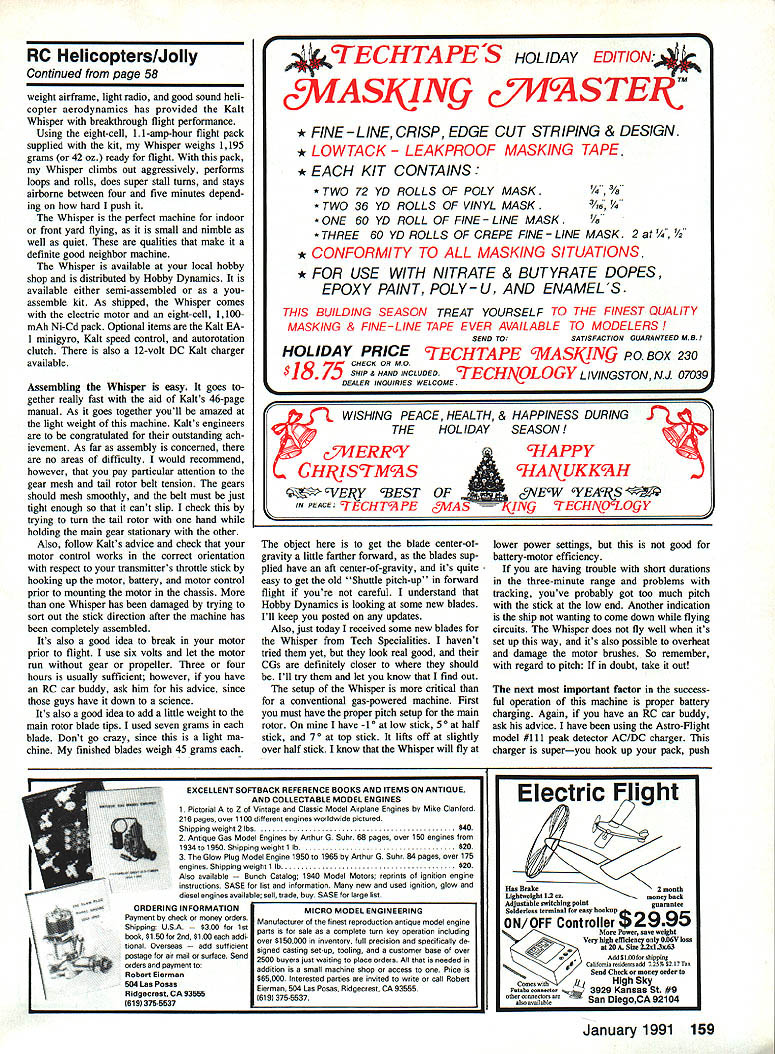
Assembling the Whisper is straightforward and fast with Kalt's 46-page manual. The ultralight chassis is impressive—credit to Kalt's engineers. There are no major assembly difficulties, but pay particular attention to:
- Gear mesh: gears should mesh smoothly.
- Tail-rotor belt tension: the belt must be just tight enough so it won't slip. Check by trying to turn the tail rotor by hand while holding the main gear stationary.
Also, verify motor-control orientation with respect to the transmitter throttle stick before mounting the motor and connecting the motor battery. Several Whispers have been damaged trying to sort stick direction after complete assembly.
Motor Break-In and Blade Tip Weight
- Break in the motor prior to flight: run the motor at 6 volts for approximately 3–4 hours. You can do this without the gear/propeller attached; some recommend doing it with gear/propeller. Ask an RC car friend for tips—they often have the know-how.
- Add a small amount of weight to each main-rotor blade tip (about 7 grams per blade). Do not overdo it—the finished blades weigh about 45 grams each. The goal is to move the blade center of gravity slightly forward because the supplied blades have an aft CG. Too much aft CG can cause a pitch-up in forward flight.
Hobby Dynamics is evaluating new blades; Tech Specialties recently sent sample blades with better CGs that look promising.
Blade and Rotor Notes
- Keep the main rotor blades fairly loose. Starting up too abruptly can produce blade lag; too tight and the blades may stray out of track.
- Blade CG and tracking are important to avoid pitch-up tendencies and to maintain smooth flight.
Setup and Trim
The Whisper's setup is more critical than for a conventional gas-powered heli. Collective pitch must be matched to the motor:
- Example setup: 1° collective at low stick, 5° at half stick, and 7° at top stick. Lift-off occurs slightly over half stick.
- Running with excessive low-end pitch can produce short flight durations (around 3 minutes), thrusting problems, failure to descend on circuits, and motor brush overheating. Rule of thumb: if in doubt, reduce pitch.
Use idle-up to help maintain rotor speed in wind and improve wind capability.
Battery Charging
Proper battery charging is crucial. I use Astro-Flite No. 111 peak-detection Ni-Cd charger:
- Charges at 450 mA, senses full charge, then switches to trickle charge.
- Can use AC wall power at home or 12 V at the field.
Ask experienced RC car friends for charger and charging-rate advice if needed.
Radio / Transmitter
I used the JR X-347 in the Whisper. It's programmed for aerobatics, helicopters, or sailplanes in one transmitter and includes a microprocessor for mixing and adjustments. Notable helicopter features:
- Three five-point main-rotor pitch curves
- Three five-point throttle curves
- Throttle hold with separate pitch curve
- Two revo-mix settings (hover and aerobatics)
- ACC mixing, inverted-flight switch, free mixer
- Hovering pitch and throttle adjustment, collective pitch trim
- Two- or three-servo CCPM mixing
The X-347 is more radio than the Whisper strictly needs but is easy to program and works very well. I plan a future how-to article on setting it up for helicopters.
Flying Tips and Safety
Here are some important reminders:
- The Whisper likes to run, but watch for overspeed. After about four minutes of flying, stay close to the ship—power from the 1,100 mAh pack drops off quickly and you can lose sufficient power to land safely (especially in wind).
- Consider investing in an autorotation clutch to allow longer, smoother flights and safer landings.
- Break in the motor before flight (6 V for 3–4 hours).
- Add small weights to blade tips (about 7 g per blade) to move blade CG forward and avoid pitch-up tendencies.
- Ensure gear mesh and tail belt tension are correct.
- Keep rotor blades loose enough to avoid blade lag and out-of-track problems.
- If flight durations are very short or the ship is "thrusting," check pitch at the low end—too much low-end pitch causes inefficiency and motor strain.
Industry Developments
Electric helicopter activity is growing:
- Great Planes will begin delivering the Concept EP soon.
- Futaba and Airtronics are working on electric-helicopter systems.
- Bob Boucher of Astro-Flight is developing hop-up power plants.
All this indicates electric helicopters have arrived—and if follow-on products approach the Whisper's quality, electric heli flying will get even more exciting.
Summary
The Whisper performed exactly as advertised. It assembles well and flies without a hitch. It is stable and capable of mild aerobatics. At about 2½ lb (1,195 g) it is not ideal in strong wind but is wind-capable with proper rotor-speed management (idle-up). Parts are reasonable and available. In a nutshell, Kalt has a winner in the Whisper.
BCNU
Transcribed from original scans by AI. Minor OCR errors may remain.

