
Radio Control: Helicopters
Larry Jolly 15781 Empire Ln. Westminster, CA 92683
Welcome back. It is with the greatest of sadness that I report the passing of Walt Schoonard on November 17, 1990. Walt was most famous for founding Miniature Aircraft Supply and producing the X-Cell series of helicopters.
What many of you may not know is that Walt spent the better part of his last 20 years promoting RC helicopters, serving at various times as columnist (he was MA's first "RC Helicopters" columnist), contest director, and, of course, importer. Walt loved RC helicopters.
Many of us had not seen Walt these last few years—this was because of his declining health due to the ravages of diabetes. Our thoughts now are with the Schoonard family who run Miniature Aircraft Supply. Tim and Ted are now officially in charge and have vowed to keep MAS at the forefront of helicopter technology.
Kyosho E.P. Concept
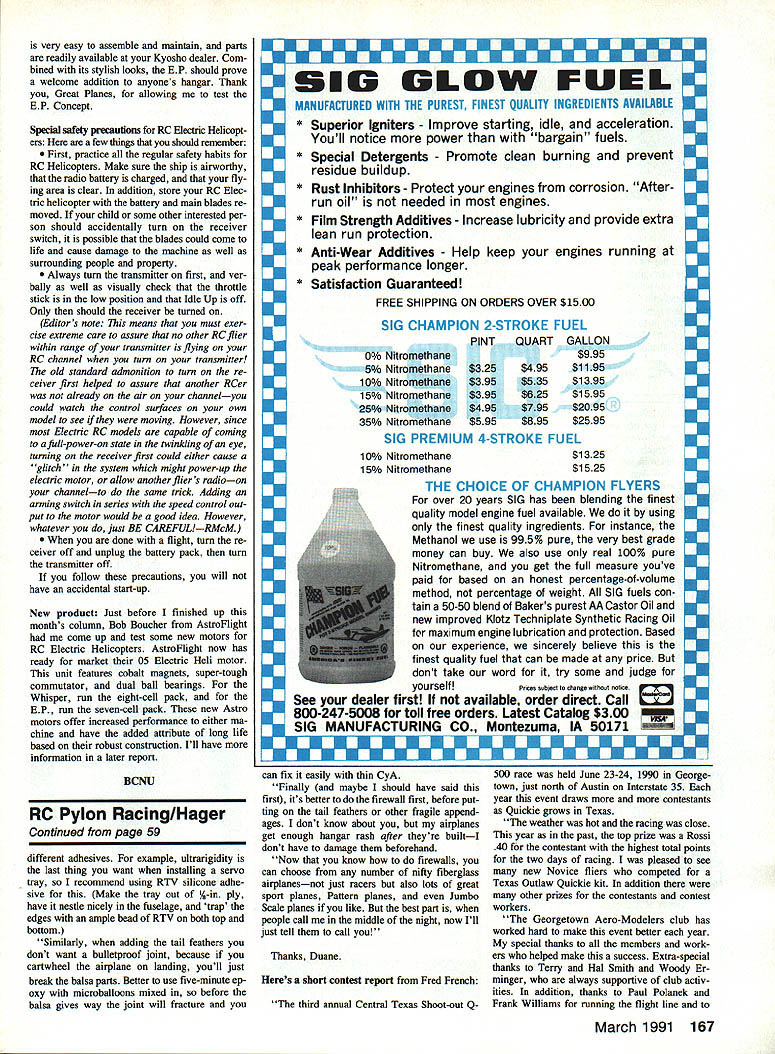
The electric-powered Concept is Kyosho's latest offering through Great Planes Model Distributors. First, let me say that the E.P. is of typical Kyosho quality. The airframe features molded side frames and a bottom plate, an aluminum tail boom, a swash plate with metal pivot balls, an enclosed gear train, a combination metal/plastic head, autorotation as standard, weighted OHS foam blades, and over 20 ball bearings.
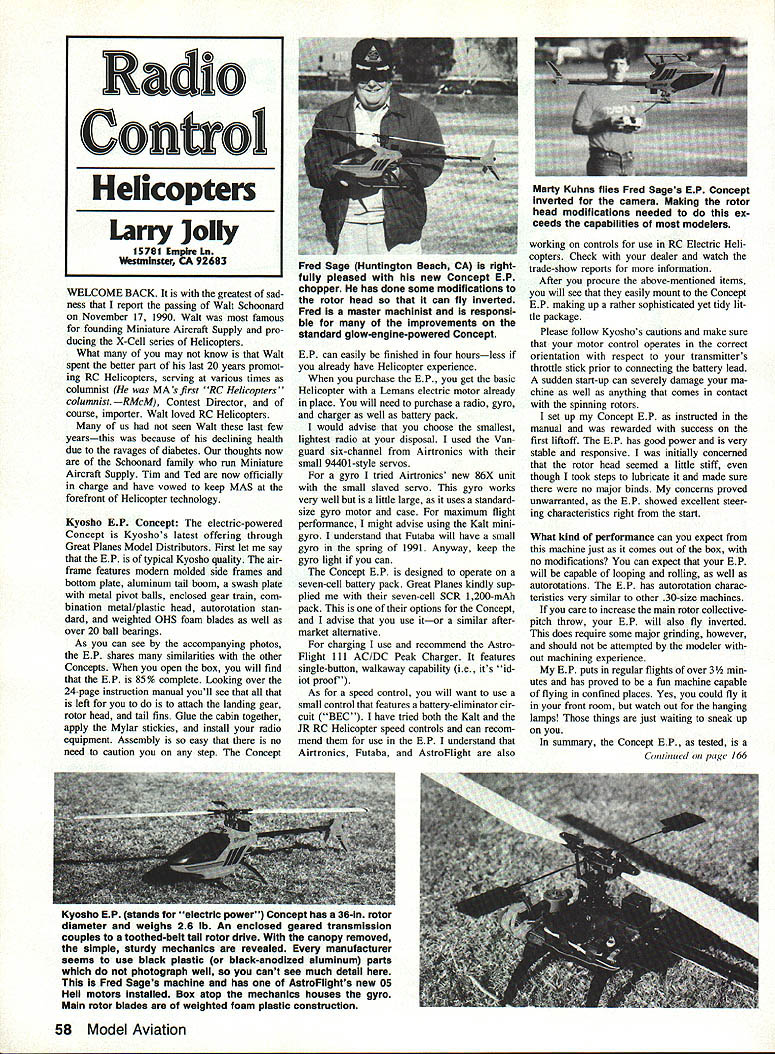
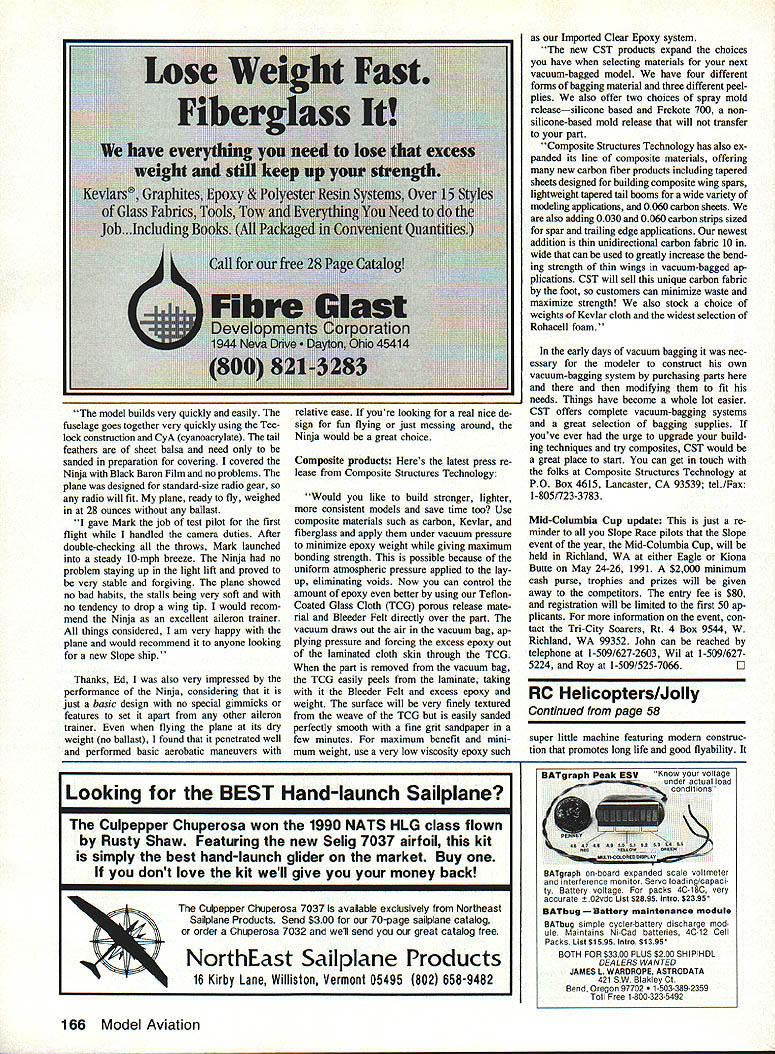
As you can see by the accompanying photos, the E.P. shares many similarities with the other Concepts. When you open the box, you will find that the E.P. is about 85% complete. Looking over the 24-page instruction manual you'll see that all that is left for you to do is attach the landing gear, rotor head, and tail fins; glue the cabin together; apply the Mylar stick-ons; and install your radio equipment. Assembly is so easy that there is no need to caution you on any step. The Concept E.P. can easily be finished in four hours—less if you already have helicopter experience. When you purchase the E.P., you get the basic helicopter with a LeMans electric motor already in place. You will need to purchase a radio, gyro, charger, and a battery pack.
I would advise that you choose the smallest, lightest radio at your disposal. I used the Vanguard six-channel from Airtronics with their small 94401-style servos.
For a gyro I tried Airtronics' new 86X unit with the small slaved servo. This gyro works very well but is a little large, as it uses a standard-size gyro motor case. For maximum flight performance, I might advise using the Kalt minigyro. I understand that Futaba will have a small gyro in the spring of 1991. Anyway, keep the gyro light if you can.
The Concept E.P. is designed to operate on a seven-cell battery pack. Great Planes kindly supplied me with their seven-cell SCR 1,200 mAh pack. This is one of their options for the Concept, and I advise that you use it—or a similar aftermarket alternative.
For charging I use and recommend the AstroFlight 111 AC/DC Peak Charger. It features single-button, walkaway capability (i.e., it's "idiot proof").
As for a speed control, you will want to use a small control that features a battery-eliminator circuit (BEC). I have tried both the Kalt and the JR RC Helicopter speed controls and can recommend them for use in the E.P. I understand that Airtronics, Futaba, and AstroFlight are also working on controls for use in RC electric helicopters. Check with your dealer and watch the trade-show reports for more information.
After you procure the above-mentioned items, you will see that they easily mount to the Concept E.P., making up a rather sophisticated yet tidy little package.
Please follow Kyosho's cautions and make sure that your motor control operates in the correct orientation with respect to your transmitter's throttle stick prior to connecting the battery lead. A sudden start-up can severely damage your machine as well as anything that comes in contact with the spinning rotors.
I set up my Concept E.P. as instructed in the manual and was rewarded with success on the first liftoff. The E.P. has good power and is very stable and responsive. I was initially concerned that the rotor head seemed a little stiff, even though I took steps to lubricate it and made sure there were no major binding concerns. My concerns proved unwarranted, as the E.P. showed excellent steering characteristics right from the start.
What kind of performance can you expect from this machine just as it comes out of the box, with no modifications? You can expect that your E.P. will be capable of looping and rolling as well as autorotations. The E.P. has autorotation characteristics very similar to other 30-size machines. If you care to increase the main rotor collective pitch throw, your E.P. will also fly inverted, but this does require some minor grinding and should not be attempted by the modeler without machining experience.
The E.P. puts in regular flights of over 3½ minutes and has proved to be a fun machine capable of flying in confined places. Yes, you could fly it in your front room, but watch out for the hanging lamps! Those things are just waiting to sneak up on you.
In summary, the Concept E.P., as tested, is a super little machine featuring modern construction that promotes long life and good flyability.
Special safety precautions for RC Electric Helicopters
Here are a few things that you should remember:
- First, practice all the normal safety habits for RC helicopters. Make sure the ship is airworthy, that the radio battery is charged, and that your flying area is clear. In addition, store your RC electric helicopter with the battery and main blades removed. If your child or some other interested person should accidentally turn on the receiver switch, it is possible that the blades could come to life and cause damage to the machine as well as surrounding people and property.
- Always turn the transmitter on first, and verbally as well as visually check that the throttle stick is in the low position and that Idle Up is off. Only then should the receiver be turned on. (Editor's note: This means that you must exercise extreme care to assure that no other R/C flier within range of your transmitter is flying on your R/C channel when you turn on your transmitter! The old standard admonition to turn on the receiver first helped to assure that another R/Cer was not already on the air on your channel—you could watch the control surfaces on your own model to see if they were moving. However, since most electric R/C models are capable of coming to a full-power-on state in the twinkling of an eye, turning on the receiver first could either cause a "glitch" in the system which might power up the electric motor, or allow another flier's radio—on your channel—to do the same trick. Adding an arming switch in series with the speed control to the motor would be a good idea. However, whatever you do, just BE CAREFUL.—RMcM.)
- When you are done with a flight, turn the receiver off and unplug the battery pack, then turn the transmitter off.
If you follow these precautions, you will not have an accidental start-up.
New product
Just before I finished up this month's column, Bob Boucher from AstroFlight had me come up and test some new motors for RC electric helicopters. AstroFlight now has ready for market their 05 Electric Heli motor. This unit features cobalt magnets, a super-tough commutator, and dual ball bearings. For the Whisper, run the eight-cell pack, and for the E.P., run the seven-cell pack. These new Astro motors offer increased performance to the electric and have the added attribute of long life based on their robust construction. I'll have more information in a later report.
Transcribed from original scans by AI. Minor OCR errors may remain.

