
Helicopters
Walt Schoonard
Unique Helicopter Configurations
I have received quite a few pictures of unusual helicopter designs so this month's column will deal with a few and will give credit to their designers. It is a good idea to keep a good sense of humor when working with RC helicopters, and as you see, these people have, and their efforts also help others to do the same!
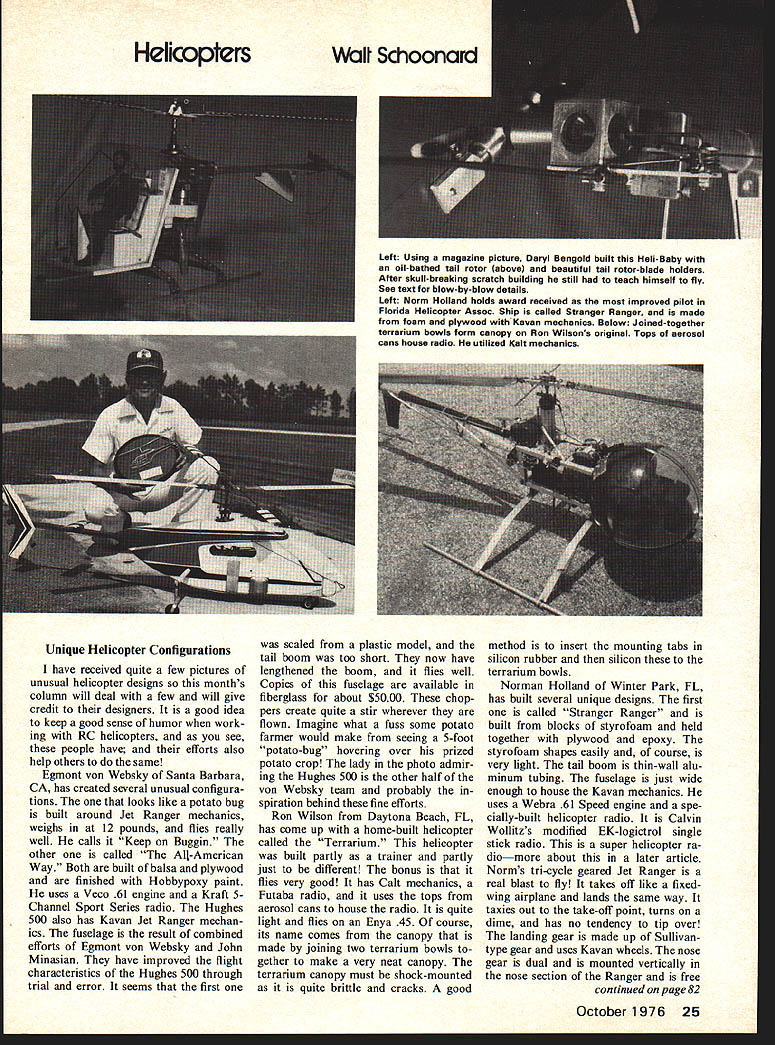
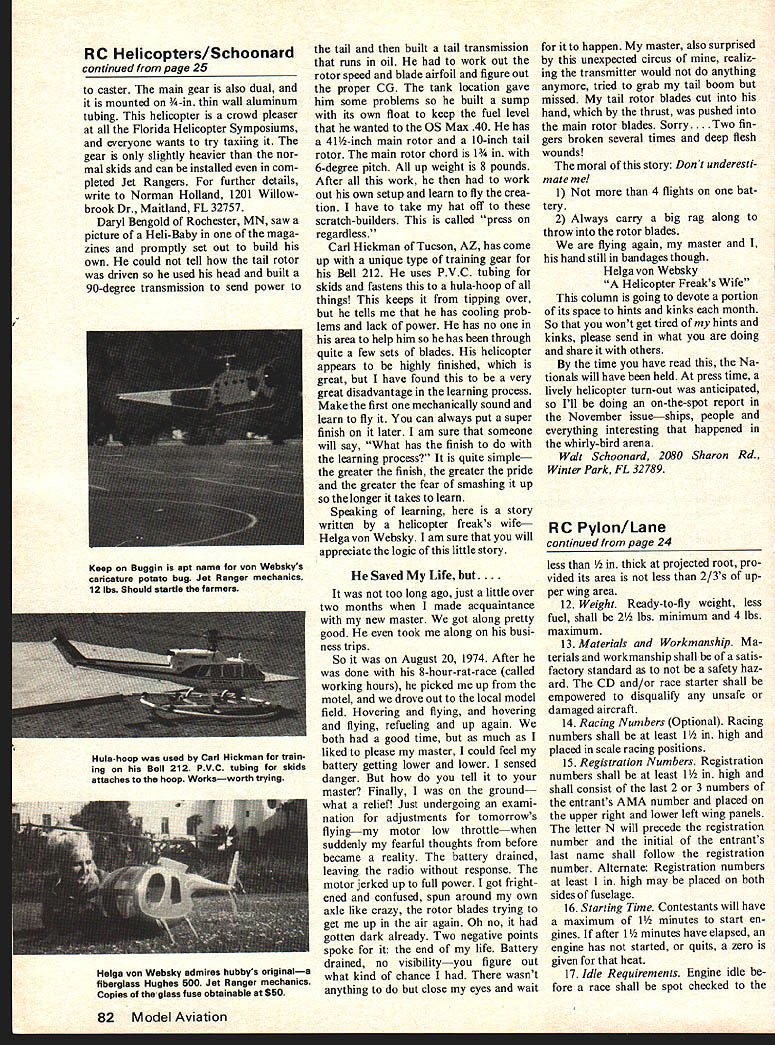
Egmont von Websky of Santa Barbara, CA, has created several unusual configurations. The one that looks like a potato bug is built around Jet Ranger mechanics, weighs in at 12 pounds, and flies really well. He calls it "Keep on Buggin'." The other one is called "The All-American Way." Both are built of balsa and plywood and are finished with Hobbypoxy paint. He uses a Veco .61 engine and a Kraft 5-Channel Sport Series radio. The Hughes 500 also has Kavan Jet Ranger mechanics. The fuselage is the result of combined efforts of Egmont von Websky and John Minasian. They have improved the flight characteristics of the Hughes 500 through trial and error. It seems that the first one was scaled from a plastic model, and the tail boom was too short. They now have lengthened the boom, and it flies well. Copies of this fuselage are available in fiberglass for about $50.00. These choppers create quite a stir wherever they are flown. Imagine what a fuss some potato farmer would make from seeing a 5-foot "potato-bug" hovering over his prized potato crop! The lady in the photo admiring the Hughes 500 is the other half of the von Websky team and probably the inspiration behind these efforts.
Ron Wilson from Daytona Beach, FL, has come up with a home-built helicopter called the "Terrarium." This helicopter was built partly as a trainer and partly just to be different! The bonus is that it flies very good! It has Kalt mechanics, a Futaba radio, and it uses the tops from aerosol cans to house the radio. It is quite light and flies on an Enya .45. Of course, its name comes from the canopy that is made by joining two terrarium bowls together to make a very neat canopy. The terrarium canopy must be shock-mounted as it is quite brittle and cracks. A good method is to insert the mounting tabs in silicon rubber and then silicon these to the terrarium bowls.
Norman Holland of Winter Park, FL, has built several unique designs. The first one is called "Stranger Ranger" and is built from blocks of styrofoam and held together with plywood and epoxy. It is very light. The tail boom is thin-wall aluminum tubing. The fuselage is just wide enough to house the Kavan mechanics. He uses a Webra .61 Speed engine and a specially-built helicopter radio. It is Calvin Wollitz's modified EK-Logictrol single stick radio—more about this in a later article. Norman's tri-cycle geared Jet Ranger is a real blast to fly! It takes off like a fixed-wing airplane and lands the same way. It taxies out to the take-off point, turns on a dime, and has no tendency to tip over! The landing gear is made up of Sullivan-type gear and uses Kavan wheels. The nose gear is dual and is mounted vertically in the nose section of the Ranger and is free to caster. The main gear is also dual, and it is mounted on 3/4-in. thin wall aluminum tubing. This helicopter is a crowd pleaser at all the Florida Helicopter Symposiums, and everyone wants to try taxiing it. The gear is only slightly heavier than the normal skids and can be installed even in completed Jet Rangers. For further details, write to Norman Holland, 1201 Willowbrook Dr., Maitland, FL 32757.
Daryl Bengold of Rochester, MN, saw a picture of a Heli-Baby in one of the magazines and promptly set out to build his own. He could not tell how the tail rotor was driven so he used his head and built a 90-degree transmission to send power to the tail and then built a tail transmission that runs in oil. He had to work out the rotor speed and blade airfoil and figure out the proper CG. The tank location gave him some problems so he built a sump with its own float to keep the fuel level even. He wanted to use the OS Max .40. He has a 41-1/2-inch main rotor and a 10-inch tail rotor. The main rotor chord is 1-3/4 in. with 6-degree pitch. All up weight is 8 pounds. After all this work, he then had to work out his own setup and learn to fly the creation. I have to take my hat off to these scratch-builders. This is called "press on regardless."
Carl Hickman of Tucson, AZ, has come up with a unique type of training gear for his Bell 212. He uses P.V.C. tubing for skids and fastens them to a hula-hoop. This keeps it from tipping over, but he tells me that he has cooling problems and lack of power. He has no one in his area to help him so he has been through quite a few sets of blades. This helicopter appears to be highly finished, which is great, but I have found this to be a very great disadvantage in the learning process. Make the first one mechanically sound and learn to fly it. You can always put a super finish on it later. I am sure that someone will say, "What has the finish to do with the learning process?" It is quite simple — the greater the finish, the greater the pride and the greater the fear of smashing it up so the longer it takes to learn.
Speaking of learning, here is a story written by a helicopter freak's wife — Helga von Websky. I am sure that you will appreciate the logic of this little story.
He Saved My Life, but . . .
It was not too long ago, just a little over two months when I made acquaintance with my new master. We got along pretty good. He even took me along on his business trips.
So it was on August 20, 1974. After he was done with his 8-hour art-race (called working hours), he picked me up from the motel, and we drove out to the local model field. Hovering and flying, and hovering and flying, refueling and up again. We both had a good time, but as much as I liked to please my master, I could feel my battery getting lower and lower. I sensed danger. But how do you tell it to your master? Finally, I was on the ground — what a relief! Just undergoing an examination for adjustments for tomorrow's flying — my motor (or throttle) — when suddenly my fearful thoughts from before became a reality. The battery drained, leaving the radio without reception. The motor jerked up to full power. I got frightened and confused, spun around my own axle like crazy, the rotor blades trying to get me up in the air again. Oh no, it had gotten dark already. Two negative points spoke for it: the end of my life. Battery drained, no visibility — you figure out what kind of chance I had. There wasn't anything to do but close my eyes and wait for it to happen. My master, also surprised by this unexpected circus of mine, realizing the transmitter would not do anything anymore, tried to grab my tail boom but missed. My tail rotor blades cut into his hand, which by the thrust, was pushed into the main rotor blades. Sorry . . . Two fingers broken several times and deep flesh wounds!
The moral of this story: Don't underestimate me!
1) Not more than 4 flights on one battery.
2) Always carry a big rag along to throw into the rotor blades.
We are flying again, my master and I, his hand still in bandages though.
Helga von Websky "A Helicopter Freak's Wife"
This column is going to devote a portion of its space to hints and kinks each month. So that you won't get tired of my hints and kinks, please send in what you are doing and share it with others.
By the time you have read this, the Nationals will have been held. At press time a lively helicopter turn-out was anticipated, so I'll be doing an on-the-spot report in the November issue — ships, people and everything interesting that happened in the whirly-bird arena.
Walt Schoonard, 2080 Sharon Rd., Winter Park, FL 32789.
Transcribed from original scans by AI. Minor OCR errors may remain.

