
Radio Control: Helicopters
Larry Jolly 15781 Empire Ln. Westminster, CA 92683
Welcome back
Since the Kalt Whisper and Concept EPs became available, I've had many people ask about learning to fly RC helicopters on one of these smaller machines. With the right attitude and a good instructor, you can learn to fly almost anything, but most RC heli pilots today train on one of the many excellent 30-size machines. Recently I've followed George Myers' accounts of his Whisper experiences and discovered that many new RC heli pilots are trying their wings on Kalt's new little cutie.
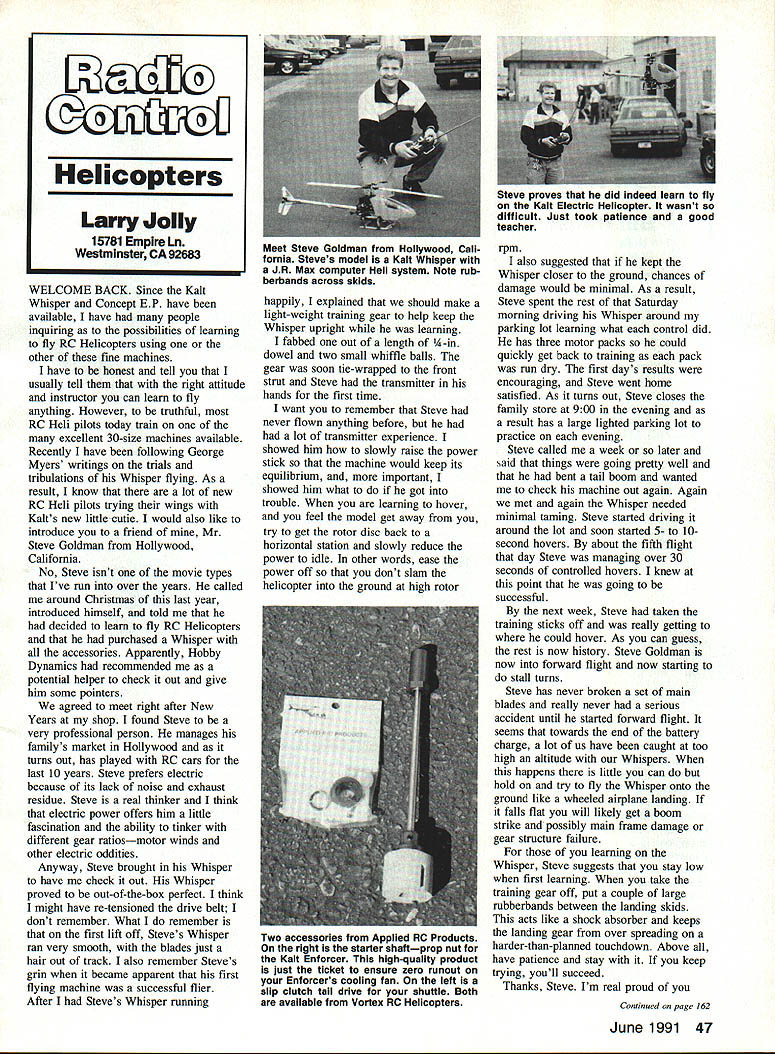
I'd like to introduce a friend, Steve Goldman of Hollywood, California. Steve isn't one of the movie types — he manages his family's market in Hollywood and has been playing with RC cars for the last ten years. He prefers electric power for its lack of noise and exhaust residue, and he enjoys tinkering with gear ratios, motor winds and other electric oddities.
Steve called around Christmas, said he'd decided to learn heli flying, and that he'd purchased a Whisper with accessories. Hobby Dynamics recommended me as someone who could help check out the machine and give a few pointers. We agreed to meet at my shop right after New Year's.
First flights and training gear
Steve's Whisper was essentially perfect out of the box. I may have re-tensioned the drive belt, but I remember that on first lift-off the Whisper ran very smoothly; the blades were only a hair out of track. Steve's grin told the rest — his first flying machine was a successful flier.
To help him learn, I made a lightweight training gear from a length of 4-inch dowel and two small whiffle balls, then tie-wrapped it to the front strut. Steve had never flown anything before (though he had plenty of transmitter experience), so I showed him how to slowly raise the power stick to keep the machine in equilibrium and what to do if he got into trouble.
Hovering basics
- If the model starts to get away from you, try to bring the rotor disc back to a horizontal position and slowly reduce power to idle. Ease the power off — don't slam the helicopter into the ground at high rotor RPM.
- Keep the Whisper close to the ground when learning; chances of damage are much lower.
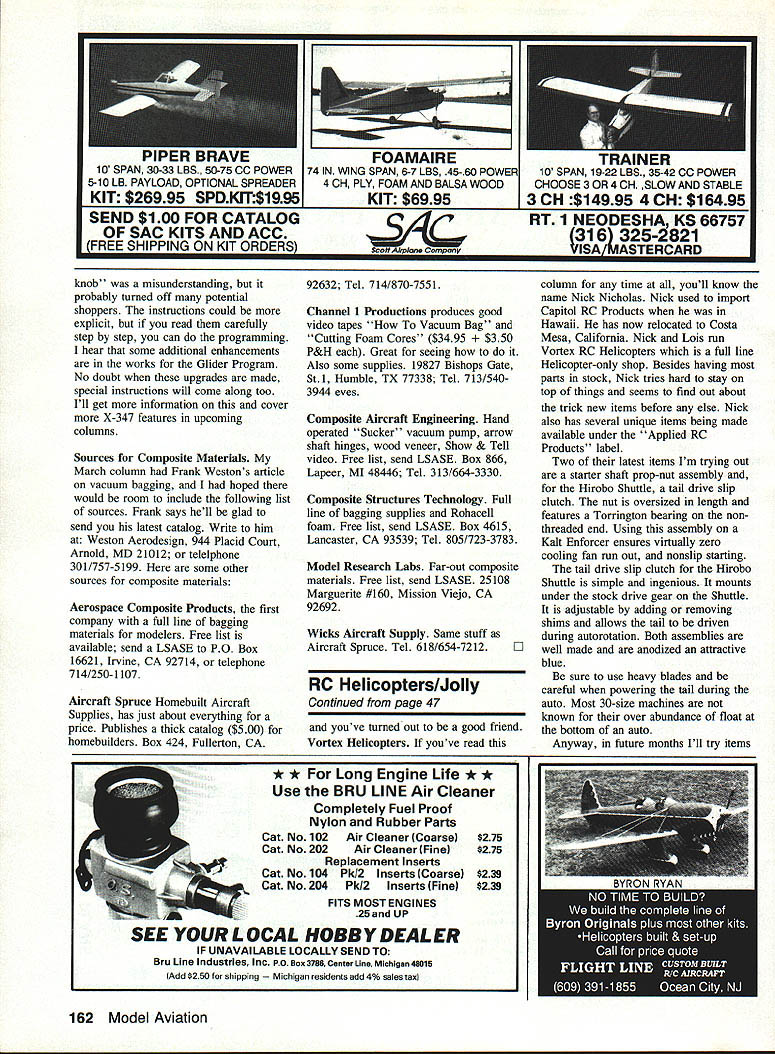
Steve spent that Saturday morning driving his Whisper around my parking lot, learning each control. He had three motor packs, so he could get back into the air quickly as each pack ran dry. The first day's results were encouraging.
Progress and common pitfalls
Steve closes the family store at 9:00 p.m., which gave him a large lighted parking lot to practice in each evening. A week later he called because he'd bent a tail boom and wanted another checkup. Again the Whisper needed minimal taming. He started with short 5–10 second hovers and, by about his fifth flight that day, was holding controlled hovers for over 30 seconds.
Within another week he removed the training sticks and was reliably hovering. He moved into forward flight shortly afterward and began practicing stall turns. Up to that point Steve had never broken a set of main blades and had no serious accidents. His first significant trouble came during forward flight: toward the end of a battery charge it's common to find yourself too high with little rotor power left. In those circumstances you must try to fly the Whisper onto the ground like a wheeled airplane landing. If it falls flat you risk a boom strike and possible main-frame or gear structure damage.
Practical tips from Steve
- Stay low while learning.
- When you remove the training gear, put a couple of large rubber bands between the landing skids to act as shock absorbers and prevent the skids from splaying on harder-than-planned touchdowns.
- Above all, have patience and keep practicing — persistence pays off.
Thanks, Steve — I'm proud of you, and you've turned out to be a good friend.
Vortex Helicopters
If you've read this column you know Nick Nicholas. Nick used to import Capitol RC Products while in Hawaii and has relocated to Costa Mesa, California. Nick and Lois run Vortex RC Helicopters, a full-line, helicopter-only shop. They keep most parts in stock and work hard to stay on top of new items. Nick also offers several unique products under the "Applied RC Products" label.
Items I'm testing
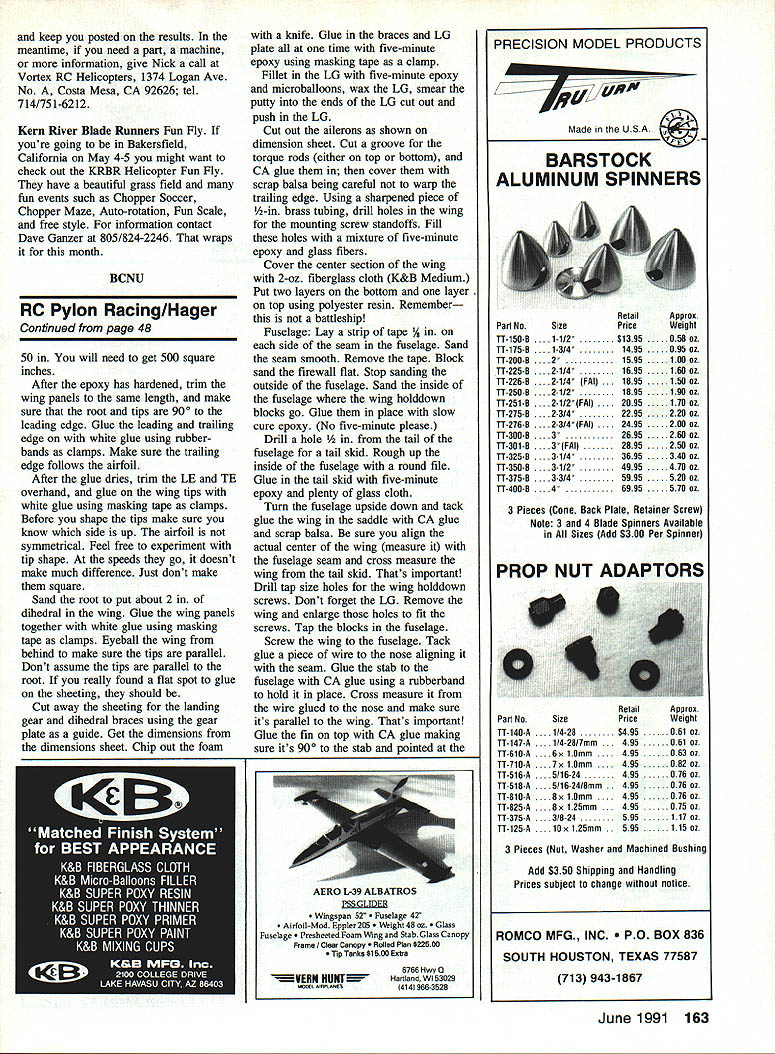
Two items I'm trying from Vortex:
- A starter shaft/prop-nut assembly.
- A Hirobo Shuttle tail-drive slip clutch.
The starter shaft/prop-nut assembly is oversized in length and features a Torrington bearing on the non-threaded end. Used on a Kalt Enforcer, it helps ensure virtually zero cooling-fan runout and a non‑slipping start.
The Hirobo Shuttle tail-drive slip clutch mounts under the stock drive gear on the Shuttle. It's simple and ingenious, adjustable by adding or removing shims, and allows the tail to be driven during autorotation. Both assemblies are well made and anodized an attractive blue.
Be sure to use heavy blades and be careful when powering the tail during autorotation. Most 30-size machines don't have a lot of low-end float, and you can easily get into trouble if you overdrive the tail.
Closing
I'll be trying and reporting on more items in future months. In the meantime, remember to stay low, practice patiently, and use simple protective measures (like rubber bands between skids) when learning on small electrics like the Whisper.
Transcribed from original scans by AI. Minor OCR errors may remain.

