

Radio Control: Helicopters
Larry Jolly 15781 Empire Ln. Westminster, CA 92683
I'm sorry I missed last month, but I've recently started work on a new major film project—and what can I say? There are only so many hours in a day. I will try to stay current and help keep you informed with what's new in our world of rotary-winged models.
Toledo show — What to expect in 1991
Toledo has passed, and now we know what we can expect to find in the hobby shops in 1991:
- Airtronics will have the Infinity 1000 RC system late this year. I saw some prototypes recently and I will fill you in next month. Suffice to say the Infinity will be an incredible system.
- Futaba has a new mini-electric helicopter system complete with a one-piece minigyro.
- Altech has all the pieces to make a Gold Shuttle. While it is a superb .30-size all-metal machine, one wonders where the cost for a chopper this size is really going.
- Miniature Aircraft had its new .30-size Hughes 500 E fuselage. The Triumph is still being developed, but the prototypes are flying now, so it should be available soon.
- Tech Specialties' Bill Curtis had the Phoenix on display. This is the reworked Legend I've discussed recently. The ship looked good and should be available soon.
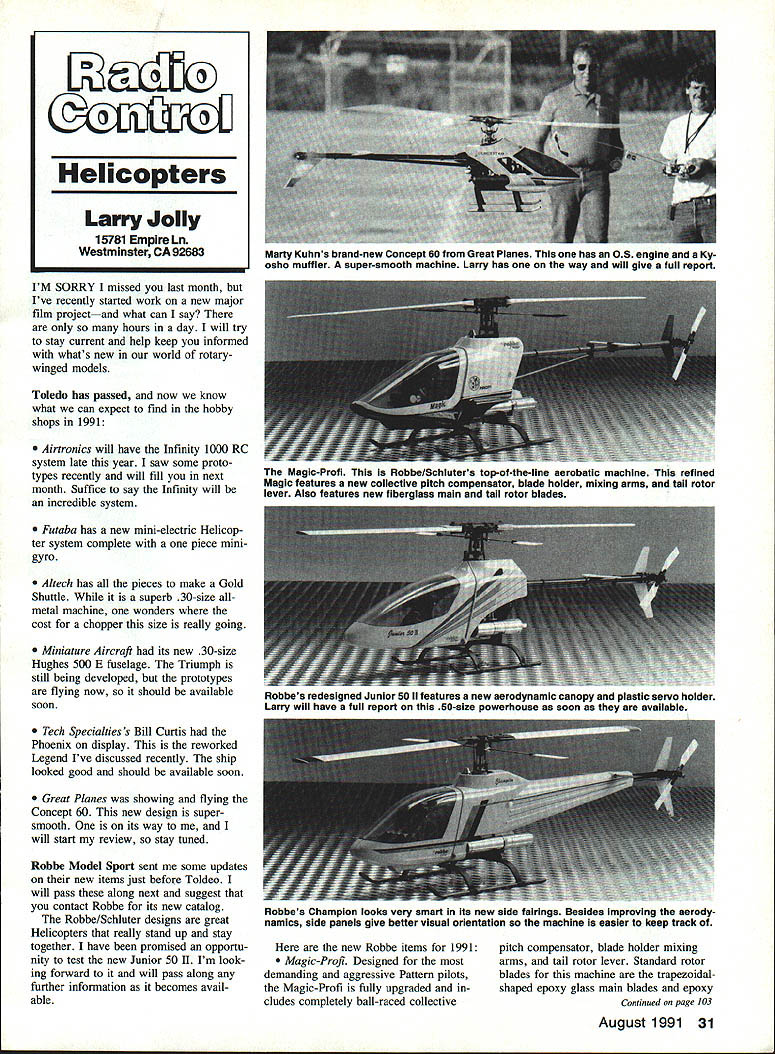
- Great Planes was showing and flying the Concept 60. This new design is super-smooth. One is on its way to me, and I will start my review, so stay tuned.
- Robbe Model Sport sent me some updates on their new items just before Toledo. I will pass these along next and suggest that you contact Robbe for its new catalog.
- The Robbe/Schluter designs are great helicopters that really stand up and stay together. I have been promised an opportunity to test the new Junior 50 II. I'm looking forward to it and will pass along any further information as it becomes available.
New Robbe items for 1991
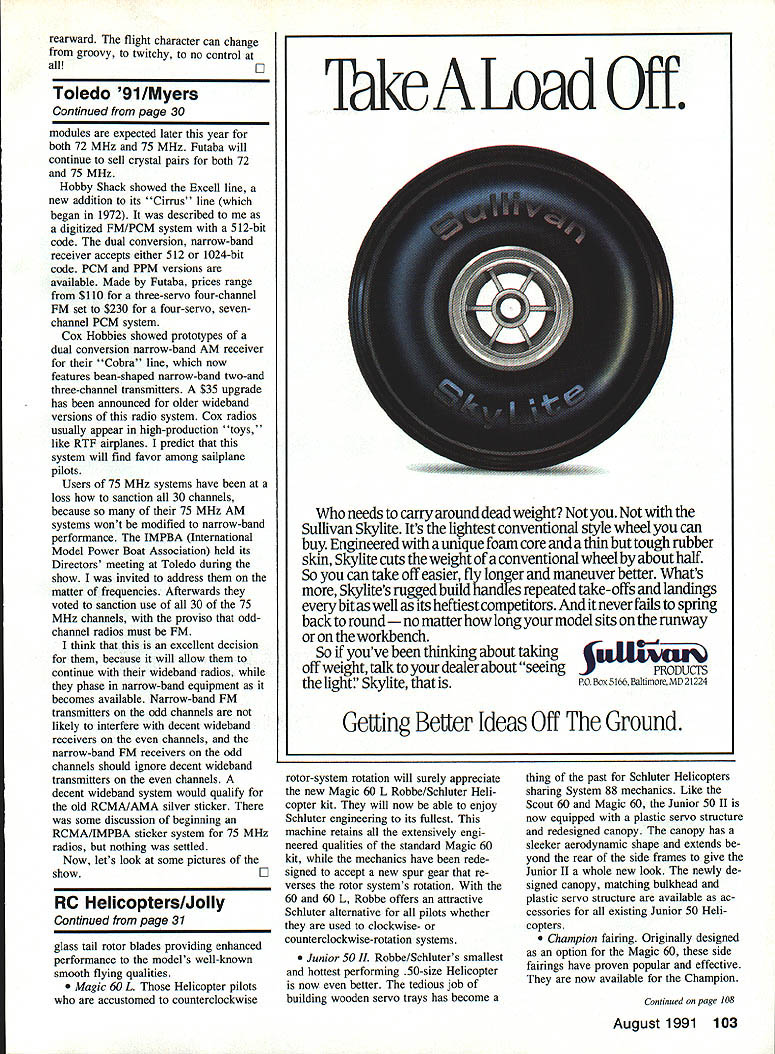
- Magic-Profi
Designed for the most demanding and aggressive pattern pilots, the Magic-Profi is fully upgraded and includes completely ball-raced collective pitch compensator, blade holder, mixing arms, and tail rotor lever. It also features new fiberglass main and tail rotor blades. Standard rotor blades for this machine are trapezoidal-shaped epoxy-glass main blades and epoxy-glass tail rotor blades, providing enhanced performance to the model's well-known smooth flying qualities.
- Magic 60 L
Pilots who are accustomed to counterclockwise rotor-system rotation will appreciate the new Magic 60 L Robbe/Schluter helicopter kit. It retains all the extensively engineered qualities of the standard Magic 60 kit, while the mechanics have been re-designed to accept a new spur gear that reverses rotor-system rotation. With the 60 and 60 L, Robbe offers an attractive alternative for pilots whether they are used to clockwise- or counterclockwise-rotation systems.
- Junior 50 II
Robbe/Schluter's smallest and hottest-performing .50-size helicopter is now even better. The tedious job of building wooden servo trays has become a thing of the past for Schluter helicopters sharing System 88 mechanics. Like the Scout 60 and Magic 60, the Junior 50 II is now equipped with a plastic servo structure and redesigned canopy. The canopy has a sleeker aerodynamic shape and extends beyond the rear of the side frames to give the Junior II a whole new look. The newly designed canopy, matching bulkhead and plastic servo structure are available as accessories for all existing Junior 50 helicopters.
- Champion fairing
Originally designed as an option for the Magic 60, these side fairings have proven popular and effective. They are now available for the Champion. The side fairing set dramatically improves the helicopter's aerodynamics and provides a visual aid for flight orientation. The side fairings are molded in two pieces for hang-on attachment and include mounting hardware and instructions.
- Hughes 500 E scale fuselage for Magic and Junior mechanics
The McDonnell-Douglas Hughes 500 E represents one of the most unique designs in full-size helicopters today. Its functionally radial design makes it extremely well suited for installation of pod-and-boom RC helicopter mechanics. Each kit includes a white gel-coated, high-gloss epoxy-glass fuselage, including vertical and horizontal stabilizers. Also included are vacuum-formed cabin windows, prefabricated wooden parts, landing gear, fittings, decals, and detailed plans and instructions.
- Scout 60 II
This new machine will be in the hands of dealers as you read this. It comes with an increased rotor diameter (59.6 in.) and a longer rotor boom. It also includes a plastic servo structure for ease of construction and less building time. The new-style Magic 60 tail boom support is standard to help support the longer tail boom. It will receive the tail rotor pitch-change mechanism from the Magic 60, and the plastic bearing blocks have been replaced by a set of aluminum ones. The mixing levers have been modified to improve handling and stability when lower rotor speeds are preferred.
- Junior 50 II ARF
The Junior 50 II is also coming out in an "almost ready to fly" version. With all of its main components preassembled and neatly packaged, it is ready to be assembled and flown. The subassemblies are as follows: main mechanics with plastic servo structure, bellcranks, swashplate, and pitch compensator in place; tail rotor system, stabilizers, and control linkages attached to the tail boom; main rotor head completely assembled; main rotor blades covered; landing gear ready-built; canopy glued and trimmed. All this reduces building time to a minimum and will attract many new pilots. Buying today and flying tomorrow is a reality now. It's about time a quality ARF helicopter finally became available.
- Magic 60 1:1 tail rotor gear set
For pilots who demand the highest level of response from their helicopters. This gear ratio is designed to replace the stock gears in the Magic 60 gearbox. The kit includes two 20-tooth gears and a pre-measured spacer for proper gear mesh. No gearbox changes are required to complete the installation.
- Junior 50 plastic servo structure
A new plastic servo structure is now available to fit all existing models of the Junior 50. This assembly is made from injection-molded plastic parts and can be assembled rather quickly. It provides plenty of space for all radio system components, and its sturdy construction contributes to durability. This structure requires the use of the new cabin bulkhead as well as the new canopy.
- Magic 60 ARF
As the Magic 60 has become so popular, Robbe/Schluter decided to make it easier for consumers to purchase and fly one with minimum building time required. With all of its main components preassembled and neatly packaged, it is ready to be assembled and flown. It comes with factory-built subassemblies: main mechanics complete with full tanks, bellcranks, swashplate and collective pitch compensator; tail rotor system with tail boom completely assembled with control system, stabilizers and tail strut; main rotor head completely assembled; main rotor blades covered; landing gear assembled; canopy glued, trimmed, and ready for paint.
- Constant-speed control (CSC 4)
This new microprocessor-controlled speed regulator is specifically produced with the helicopter enthusiast in mind. The CSC 4 provides constant main rotor rotational speed, which makes overall control of the helicopter considerably easier. It maintains the correct relationship between the collective pitch and throttle curve due to the constant rotor speed. The CSC 4 can be switched on and off by means of an auxiliary channel. The speed selection is infinitely variable, with the regulating action taking effect rather softly. Setting up the CSC 4 is simplified by a test mode which indicates the direction of regulation and the travel of the throttle servo.
Robbe Performance Accessories — Torque-tube drive system
Robbe's torque-tube drive system is the first product in the new Robbe Performance Accessory (RPA) line. These performance accessories have been designed, tested and produced with one thought in mind: quality.
This new drive system features precision ball bearings pressed directly onto the tube, eliminating the need for a bushing. Bearings are placed at precise locations, not necessarily evenly spaced, to ensure smooth, vibration-free operation. Each bearing is suspended in exact alignment in the tail boom by a single "O"-ringed retainer that snaps in place over the bearing, preventing a retainer from slipping off and eliminating the extra weight and clumsiness of typical double-"O"-ring retainers.
The torque-tube itself is eight millimeters in diameter and is made of an epoxy-glass combination that allows the fibers to be radially wound in both directions, thereby preventing the tube from distorting in either direction. Typically, a tail rotor's operating capacity is measured in inch-ounces. When the Robbe torque-tube was load tested we were able to impose five foot-pounds of torque before the tube started to show signs of stress. Tests performed on a standard two-millimeter shaft resulted in repeated failure at the two foot-pound mark.
Additional features include:
- Quick connect/disconnect of the tail boom and gearbox
- Elimination of drive-wire whip and reduced maintenance
- Minimal drag resulting in less power required to drive the tail rotor
- Highest torsional rigidity available in the industry
For more information on this and other Robbe Performance Accessories, see your local dealer first. If not available, contact Robbe direct:
Robbe Model Sport 180 Township Line Rd. Belle Mead, NJ 08502
Thanks for all the club newsletters I've been receiving. They contain some great ideas that I'll be passing along soon.
If you have a large contest coming up and want me to pass that information along, I need to receive your information at least two months in advance in order to get it published in time. Thanks.
BCNU
Transcribed from original scans by AI. Minor OCR errors may remain.

