
Radio Control: Helicopters
Larry Jolly 15781 Empire Ln. Westminster, CA 92683
WELCOME BACK. Before I start this month's ramblings, I'd like to take this opportunity to thank all of you for the tremendous support given this year's F3B Soaring Team. I know that this is the Helicopter column, but I have to confess that this is my best chance to reach all the super AMA members who have contributed to our fund-raising activities. As you read this, Joe, Daryl, and I are finishing up last-minute details and will be departing for Holland during the third week in August. Because of your generous efforts, we have been able to concentrate more on building and flying than on raising the money to get to the champs. Thank you again. If we attain what we are capable of, you will hear cheers all the way across the Atlantic. Thank you.
1991 Helicopter Selections
Early in June, the 1991 US World Helicopter selections were completed. First place, Curtis Youngblood, flew a pod-and-boom X-Cell 60. Evidently Curtis was in first-class form and left no doubt of his abilities. Second place finisher was Wayne Mann, flying an X-Cell 60 in a Triumph fuselage. I have had the opportunity to follow Wayne's progress. He is dedicated and well trained, and there is no doubt that he will be a strong contender at the Worlds. Third place finisher was Robert Gorham, flying his TSK Black Star with a Miniature Aircraft Long Ranger fuselage. Robert, of course, is a veteran and a top contender. The World Championships will be held in October of this year in Australia.
Remember the team has to pay for a lot of additional expenses in order to compete. Basically, AMA pays for the air fare, the contest entry fee, and the lodging while at the Worlds. The team pays for all additional expenses like model box excess baggage fees, their ground transportation, and lodging before the champs. Please look for their fundraising announcements — time is short and they will appreciate the help. We have got a great team. Let's help them out so they can do what they do best. Congratulations, guys. Go get 'em!
Kern River Blade Runners Second Annual Fun Fly
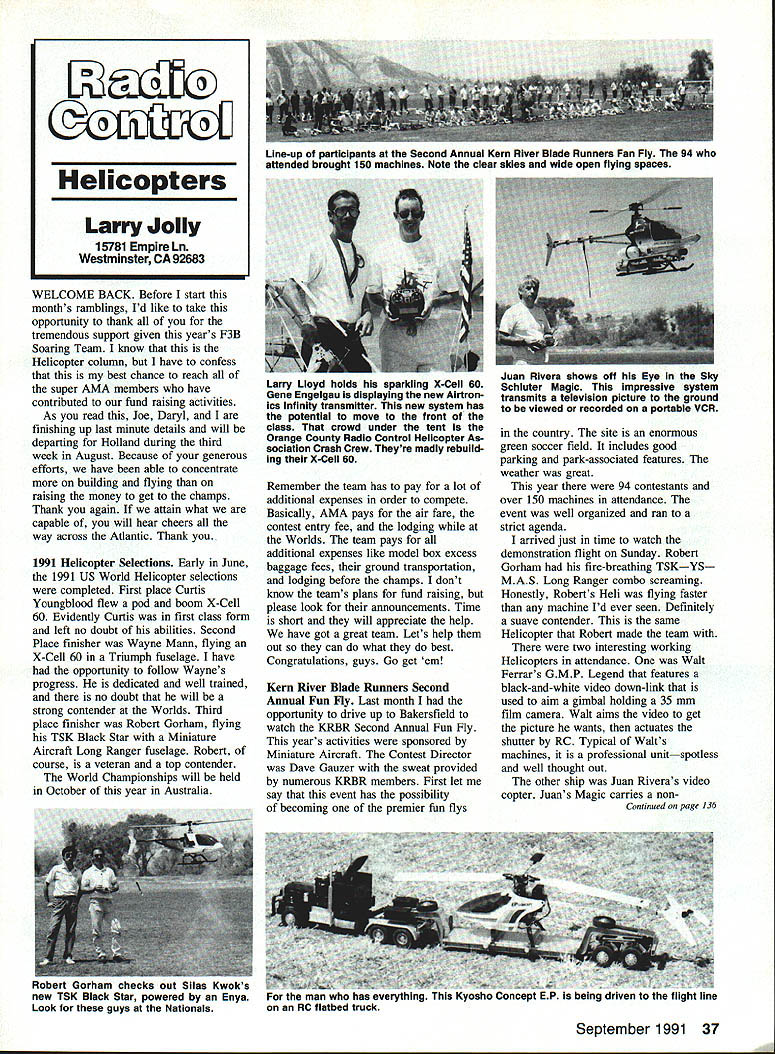
Last month I had the opportunity to drive up to Bakersfield to watch the KRBR Second Annual Fun Fly. This year's activities were sponsored by Miniature Aircraft. The Contest Director was Dave Gauzer with the sweat provided by numerous KRBR members. First, let me say that this event has the possibility of becoming one of the premier fun flies in the country. The site is an enormous green soccer field. It includes good parking and park-associated features. The weather was great.
This year there were 94 contestants and over 150 machines in attendance. The event was well organized and ran to a strict agenda. I arrived just in time to watch the demonstration flight on Sunday. Robert Gorham had his fire-breathing TSK—YS M.A.S. Long Ranger combo screaming. Honestly, Robert's helicopter was flying faster than any machine I'd ever seen — definitely a suave contender. This is the same helicopter that Robert made the team with.
There were two interesting video-equipped helicopters in attendance. One was Walt Ferrar's G.M.P. Legend that features a black-and-white video down-link used to aim a gimbal holding a 35 mm film camera. Walt aims the video to get the picture he wants, then actuates the shutter by RC. Typical of Walt's machines, it is a professional unit—spotless and well thought out.
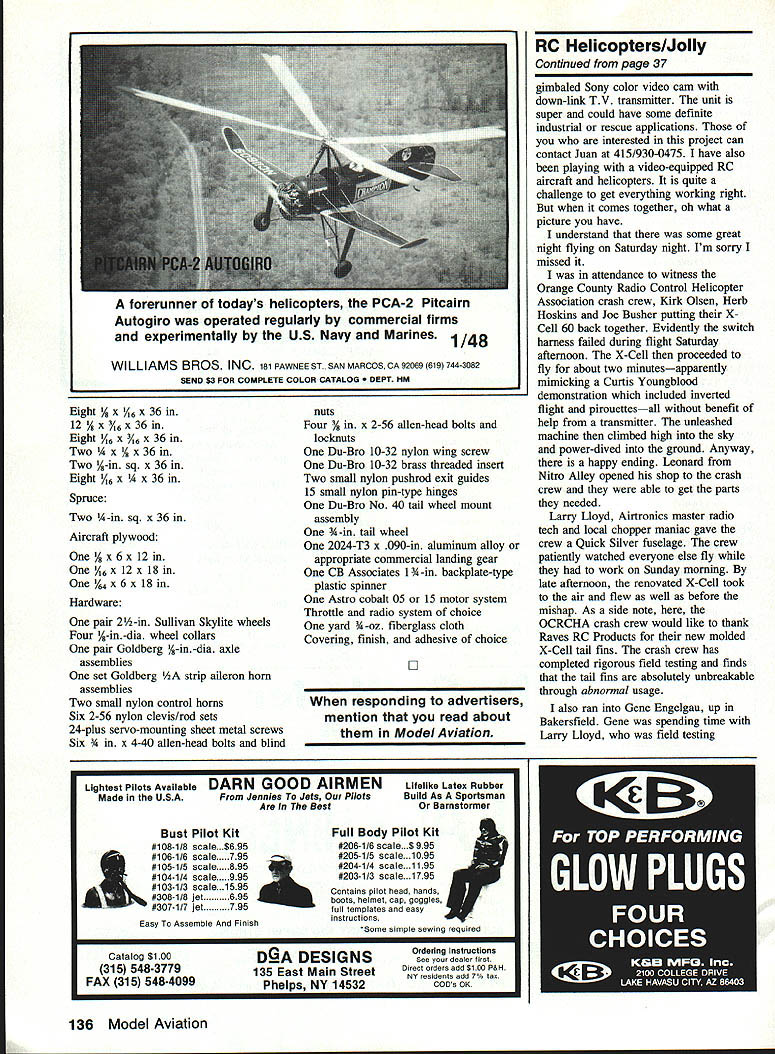
The other ship was Juan Rivera's video copter. Juan's Magic carries a non-gimbaled Sony color video cam with a down-link TV transmitter. The unit is super and could have some definite industrial or rescue applications. Those of you who are interested in this project can contact Juan at 415-930-0475. I have also been playing with a video-equipped RC aircraft and helicopters. It is quite a challenge to get everything working right. But when it comes together, oh what a picture you have.
I understand that there was some great night flying on Saturday night. I'm sorry I missed it.
I was in attendance to witness the Orange County Radio Control Helicopter Association crash crew — Kirk Olsen, Herb Hoskins, and Joe Busher — putting their X-Cell 60 back together. Evidently the switch harness failed during flight Saturday afternoon. The X-Cell then proceeded to fly for about two minutes — apparently mimicking a Curtis Youngblood demonstration which included inverted flight and pirouettes — all without benefit of help from a transmitter. The unleashed machine then climbed high into the sky and power-dived into the ground. Anyway, there is a happy ending. Leonard from Nitro Alley opened his shop to the crash crew and they were able to get the parts they needed.
Larry Lloyd, Airtronics' master radio tech and local chopper maniac, gave the crew a Quick Silver fuselage. The crew patiently watched everyone else while they had to work on Sunday morning. By late afternoon, the renovated X-Cell took to the air and flew as before the mishap. As a side note, the OCRCHA crash crew would like to thank Raves RC Products for their new molded X-Cell tail fins. The crash crew has completed rigorous field testing and finds that the tail fins are absolutely unbreakable through abnormal usage.
I also ran into Gene Engelgau up in Bakersfield. Gene was spending time with Larry Lloyd, who was field-testing Airtronics' new Infinity system. For those of you who don't know Gene, he is the software genius who developed the Atracs system used by all the top U.S. and Japanese glider fliers. Yes, Gene happens to be a top glider flier who also got infected by the chopper virus.
Airtronics Infinity System
Gene has completed the software package for the new heli system, and all I can say is that you should really take a look at the new Airtronics Infinity. It should be available in the fall. I would expect to see it on display at Chicago.
The radio features all the normal 1024 PCM, 10 tricks, plus a few thrown in for good measure. Some notable features include:
- Five separate throttle curves and five separate pitch curves.
- Separate aileron, rudder, and elevator offsets.
- Fully synthesized system: the transmitter will act as a frequency scanner for a particular band.
- Ability to decide the specific frequency you want to fly and program that frequency into the receiver (i.e., the receiver will be on the 72 MHz or the 50 MHz band, and you decide what individual frequency you want to use).
My hat's off to both Airtronics and Gene Engelgau. I can't wait to see the finished product.
Let's wrap. I'd like to thank Ray Stacy of the Pittsburgh Area Rotor Runners, Mark Murdock of the Atlanta Helicopter Club, and Randy Miller from the Orange County Radio Control Helicopter Association for answering my pleas for help and graciously sending me their club newsletters. This really helps me to keep in touch with what's happening around the U.S. and as a result, I can make the column just that much better. Remember, I'm always thankful for newsletters and pictures of you and your favorite helicopter.
BCNU
Transcribed from original scans by AI. Minor OCR errors may remain.

