
Radio Control: Helicopters
Larry Jolly 15781 Empire Ln. Westminster, CA 92683
WELCOME back, and a happy 1992 to all you chopper fans. If you caught last month's column you may have seen the announcement for the 1992 Top Gun Scale Helicopter Tournament. I just heard from A. E. Stanley that the Top Gun Helicopter contest is now officially a go! The competition will take place May 7–10, 1992, in West Palm Beach, Florida (not Mesa, Arizona, as I mistakenly mentioned last month).
Plans are already well under way, with many confirmed competitors and judges. Preliminary rules are standard AMA Scale judging with modified flying rules. Look for a five- to seven-minute flight and possibly 10 maneuvers. Official rules will be available in November.
If you are interested in being a competitor or helper, contact A. E. Stanley, 686 Violet Rd., Warminster, PA 18974. Mr. Stanley is also trying to line up prize donations from all segments of the RC helicopter industry. I’m sure this tournament will be a big step forward for RC scale helicopters and attract a lot of attention to our sport. I hope Mr. Stanley gets all the support he needs to make this contest a success. If you can help, please drop him a line.
1991 World RC Helicopter Championships
As I'm writing this month's column, the U.S. helicopter team is taking on the rest of the world in Australia. I don't have any results yet, but I'll have a report for you next month.
I understand Wayne Mann is flying a new set of mechanics from Miniature Aircraft. The word from those who have seen the ship is that while it shares many X-Cell characteristics, the new helicopter also features longer main rotor blades, a 9.5:1 reduction gear ratio, and a new engine position. Look for these new mechanics to make their debut at the Chicago RCHTA show. When I know more I'll pass it on.
PARR Automatic Fast Field Charger
I just received the October issue of the Pittsburgh Area Rotor Runners (PARR) newsletter. It included a schematic for a neat little field charger that you can easily build at home. I'm grateful to be able to lift the following from that newsletter:
Here is a fast field charger for keeping your receiver batteries at a peak charge all day. The circuit is very easy and very cheap to build. The entire charger can be built in about one hour and will cost less than $10.
OK, here's the standard disclaimer: neither I nor PARR will accept any responsibility for anything you do with this circuit. I will tell you that a number of members recently came out flying and realized the receiver pack had been left at home during the trip to the field, causing the servos to react sluggishly. Less than 15 minutes after connecting the charger, the pack was ready to fly. What would have otherwise been a bad day was saved.
As drawn, the charger is intended to replace the normal charger. Connect the input to a 12-volt gel-cell battery and the output to the receiver pack. After a couple of flights the batteries will be brought back to full charge. When the light goes out, the charge rate drops to almost nothing and the charge is complete.
Construction is simple. The layout is not critical. To adjust the charger, connect a 12-volt battery to the input. Connect a digital voltmeter to the unloaded output and adjust the 5K pot to exactly 5.7 volts DC. The charger is now complete and ready to use.
Build the circuit exactly as shown. The #767 automotive light bulb is just an indicator to tell you when the charge is complete. Also, a current-limiter circuit can be substituted if desired. The charger is not intended to be left connected for extended periods of time.
Thanks to the PARR guys for allowing me to publish this neat little unit. Remember, it's a real good idea to carry a battery tester in your field kit. Don't wait until your servos get sluggish — recharge an airborne pack. A helicopter is its own scary critter.
By the way, the PARR newsletter now features color photos. Someone must have access to a Xerox Canon color copier.
If you have questions regarding the PARR field charger or the newsletter, contact Ray Stacy, 521 Hankey Farms Dr., Oakdale, PA 15071.
AUTOMATIC FAST FIELD CHARGER
- EASY TO BUILD!
- CHEAP!
- AUTOMATIC SHUT-OFF!
Thanks to the newsletter of the Pittsburgh Area Rotor Runners for this fast field charger schematic. There is considerably more information in the column on how to make one.
Atlanta Southern Classics Fly-In
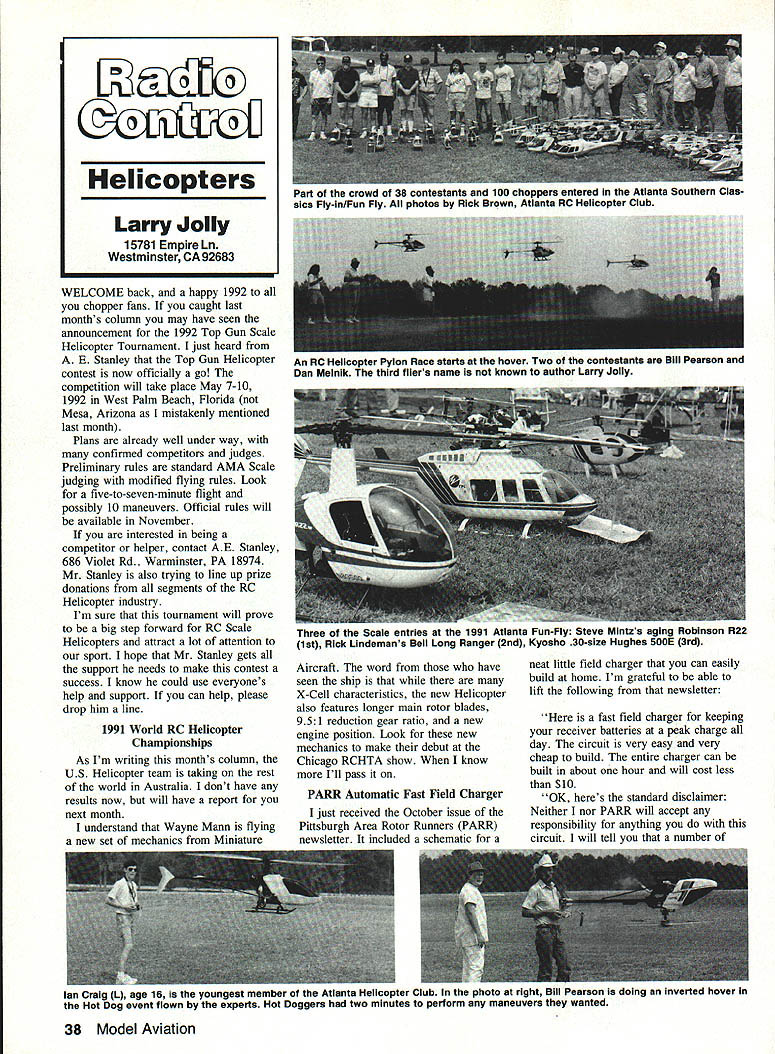
The Seventh Annual Atlanta Southern Classics Fly-In/Fun Fly, sponsored by the Atlanta Helicopter Club, was held the weekend of September 14–15, 1991, at the club's beautiful flying site on the grounds of the Atlanta Motor Speedway. This year's event drew a crowd of pilots from around the Southeast with a broad array of entrants and demonstrations, covering a range of skill levels and interests. Pilots competed in a number of different events to test their abilities in an atmosphere of light competition and fun.
Three classes of competition were flown, with two events suitable for each class:
- Novice
- Timed Hover
- Pad Hop
Each contestant got three attempts in each event; each attempt was timed. The twist was that the contestant was made aware of his/her first time and then had to try to match it on the next two attempts without the aid of a timer or stopwatch.
- Intermediate
- Heli Poker
- Two-minute precision flight
In Heli Poker, a 30-ft. circle is set up with several gates, each designated by a playing card. The object is for the competitor to maneuver a beach ball through the gates to assemble a winning five-card poker hand. Contestants could nudge the ball with the canopy, skids, or rotor blast. The two-minute precision hover was an attempt to hover precisely for two minutes without a stopwatch or timer.
- Expert
- Autorotation
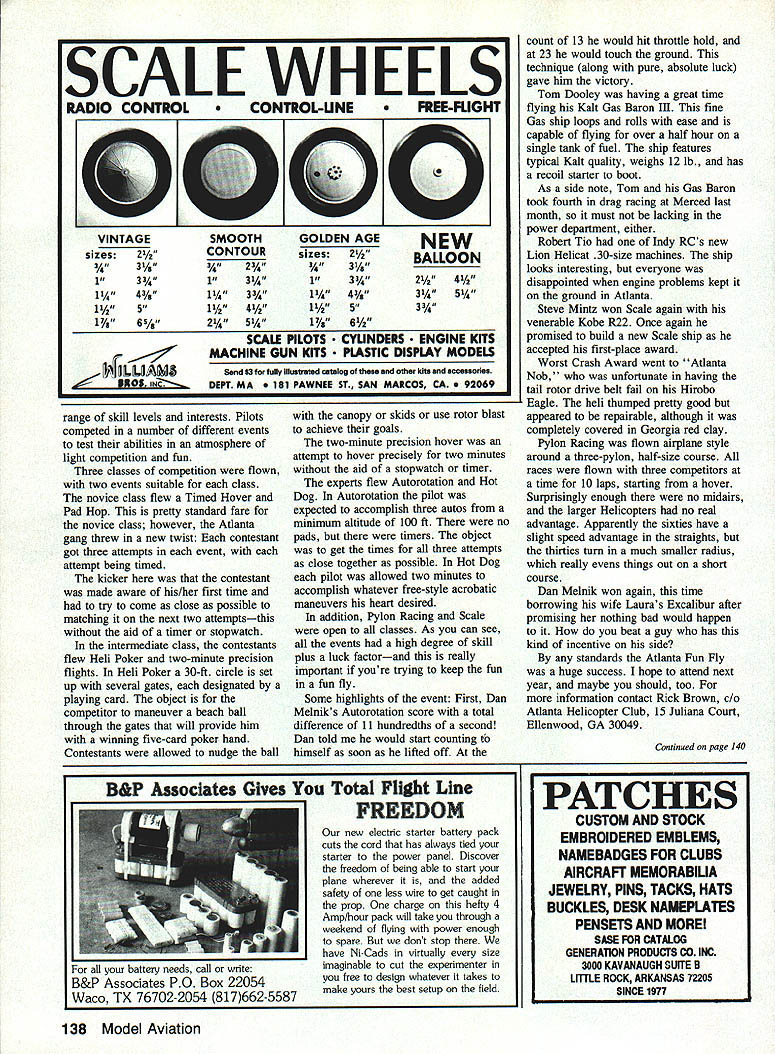
- Hot Dog
In Autorotation the pilot was expected to accomplish three autos from a minimum altitude of 100 ft. There were no pads, but there were timers; the object was to get the times for all three attempts as close together as possible. In Hot Dog each pilot was allowed two minutes to perform free-style acrobatic maneuvers.
In addition, Pylon Racing and Scale were open to all classes. All events mixed skill with luck, which helped keep the fun in the fun fly.
Some highlights of the event:
- Dan Melnik's Autorotation score had a total difference of only 0.11 seconds. Dan said he would count to himself as soon as he lifted off: at 13 he would hit throttle hold, and at 23 he would touch the ground. This technique (and some luck) gave him the victory.
- Tom Dooley had a great time flying his Kalt Gas Baron III. This fine gas ship loops and rolls with ease and can fly for over a half hour on a single tank of fuel. The ship features typical Kalt quality, weighs 12 lb., and has a recoil starter.
- Tom and his Gas Baron took fourth in drag racing at Merced last month.
- Robert Tio had one of Indy RC's new Lion Helicats (.30-size). The ship looked interesting, but engine problems kept it on the ground in Atlanta.
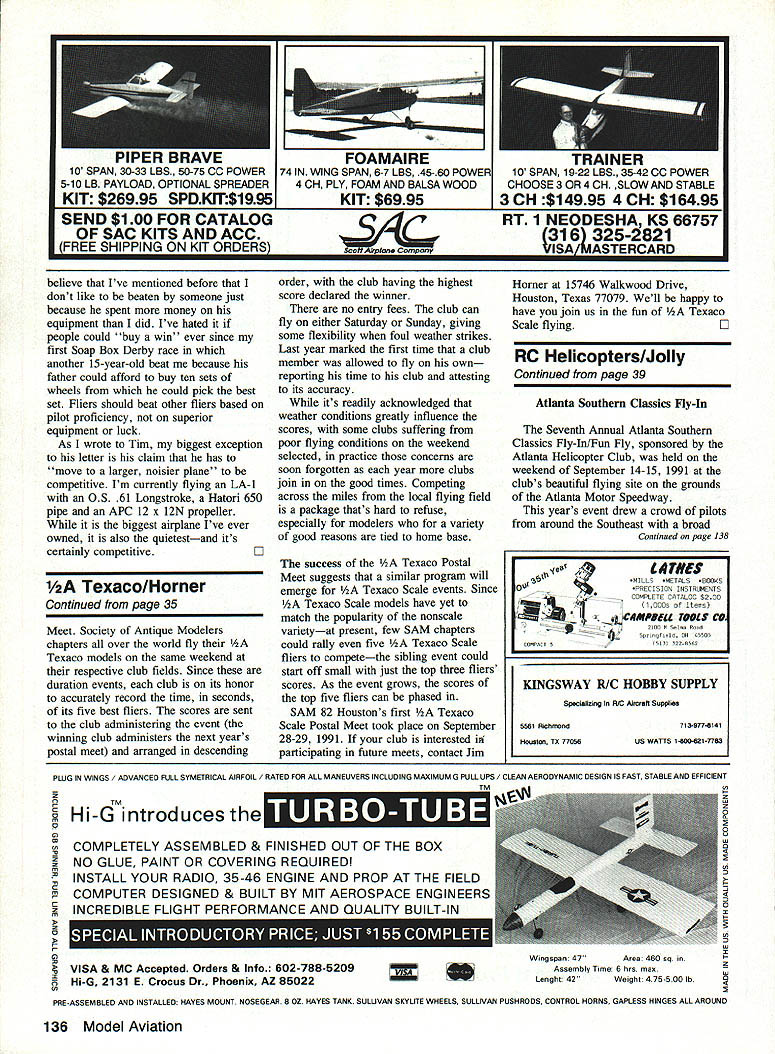
- Steve Mintz won Scale again with his venerable Kobe R22. He promised to build a new Scale ship as he accepted his first-place award.
- Worst Crash Award went to "Atlanta Nob," who suffered a tail rotor drive belt failure on his Hirobo Eagle. The heli thumped hard and was covered in Georgia red clay but appeared repairable.
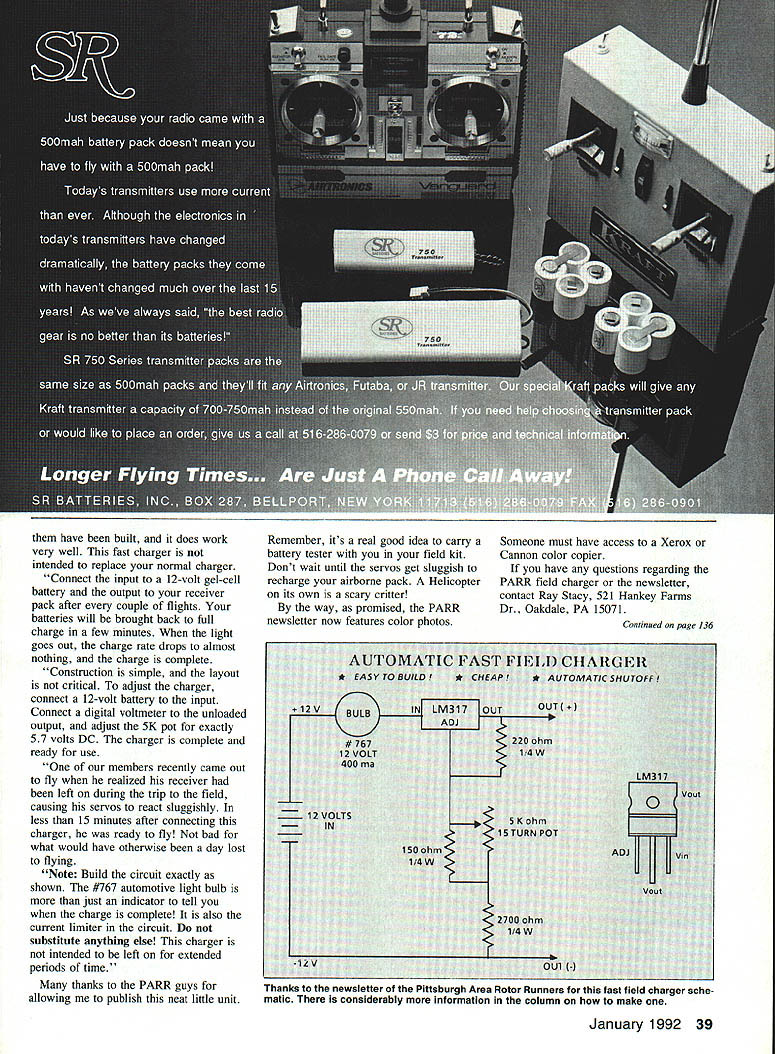
- Pylon Racing was flown airplane-style around a three-pylon half-size course. Races were three-competitor, 10-lap events starting from a hover. Surprisingly, there were no midairs. Larger helicopters had no real advantage: the sixties had a slight speed edge in the straights, but the thirties turned a much smaller radius, evening things out on the short course. Dan Melnik won again, borrowing his wife's Laura's Excalibur after promising her nothing bad would happen to it.
By any standards the Atlanta Fun Fly was a huge success. I hope to attend next year, and maybe you should, too. For more information contact Rick Brown, c/o Atlanta Helicopter Club, 15 Juliana Court, Ellenwood, GA 30049.
Longest Autorotation
When Dan Melnik and I talked about autorotations, he reminded me that his longest autorotation was one minute 45 seconds from the time he shut down the engine. This feat was accomplished with an old Kalt Cyclone. The wind was blowing pretty hard, and Dan had the Cyclone high when he started. I know I've done over one minute with my Cyclone II.
Has anyone out there been practicing long autos like Dan's? If you have, tell me about it. I'd be interested in compiling your data and presenting it to the rest of the folks.
I've also heard of others doing aerobatics while in autorotation. How about sending me some notes on your technique so I can pass it on to potential hotdoggers out there?
More Power for Your Shuttle
Anyone who might want to put an O.S. .46 in his Shuttle should contact Dick Wilke, Northern Illinois RC Helicopter Association, daytime (708) 620-5840. Dick can provide a custom-machined engine mount for the O.S. .46/Shuttle conversion.
That about wraps it up for this month. BCNU.
Uniflow Fuel Tank Construction
This type of fuel tank construction dates back to my Control Line Aerobatics days and was designed to stop the mixture of the engine from changing as the fuel level of the tank dropped (typically the mixture will lean out as the fuel level decreases). I have been using one of these tanks in my O-500 airplanes for the past three years and it has worked beautifully for me. The mixture never changes from start to finish; as a matter of fact, you can sometimes be surprised when it quits because there isn't the typical sag to indicate the end of the tank.
A Uniflow tank is very easy to construct, with only a few minor differences from standard tank construction. Basically, you will need to use all three inlets into your tank: one for fuel pick-up, one for muffler pressure, and the third as an overflow vent for filling, which will be capped off in flight.
The fuel pickup tube is of standard construction with a flexible hose attached to the brass tube that leads to a clunk in the back of the tank. The pressure tube is constructed identical to the fuel pickup with the following exception: make the pressure line (clunk assembly) 1/4 in. shorter than the fuel pick-up so that when they lie next to each other in the tank, the fuel pick-up is longer and goes farther toward the back of the tank.
With this type of vent/pressure system, the fuel mixture never changes until the vent/pressure clunk is actually no longer covered by fuel. The overflow line just goes to the standard location for your old vent/pressure line (i.e., the top of the tank). The overflow line is necessary because if you were to try to fill your tank until the vent/pressure clunk was covered, fuel would run right out of the tank.
With this amount of muffler pressure there is no problem richening the mixture as before, nor is there a problem with the engine going lean as soon as it is launched and the propeller unloads.
For those who elect not to use a one-way check valve in the muffler, pressure will be bled back through the muffler and will give you a problem with the mixture when the engine is on the ground. If you use a one-way valve, you can use as much muffler pressure as you want, which will give you positive pressure on the fuel pick-up without any concern about back pressure.
Transcribed from original scans by AI. Minor OCR errors may remain.

