
Radio Control: Helicopters
Larry Jolly 15781 Empire Ln. Westminster, CA 92683
Kalt Baron Alpha II
Welcome back. This month's column is devoted to Hobby Dynamics' new Kalt Baron Alpha II. When I was offered the chance to review Kalt's latest .60 ship I was very enthusiastic. I had both flown and watched Dan Melnik put his Excalibur through its paces and was very impressed. While the Alpha II is basically an upgraded Excalibur, it demonstrates Kalt's understanding of where the American helicopter market is going. This includes the change to a larger rotor disc, different gearing and high-quality main and tail rotor units.
When you first look at an Alpha your impression is of a long, tall machine that sits high on its skids. It's not until you begin to examine each individual part that you appreciate what an incredibly high-quality product Kalt has brought together.
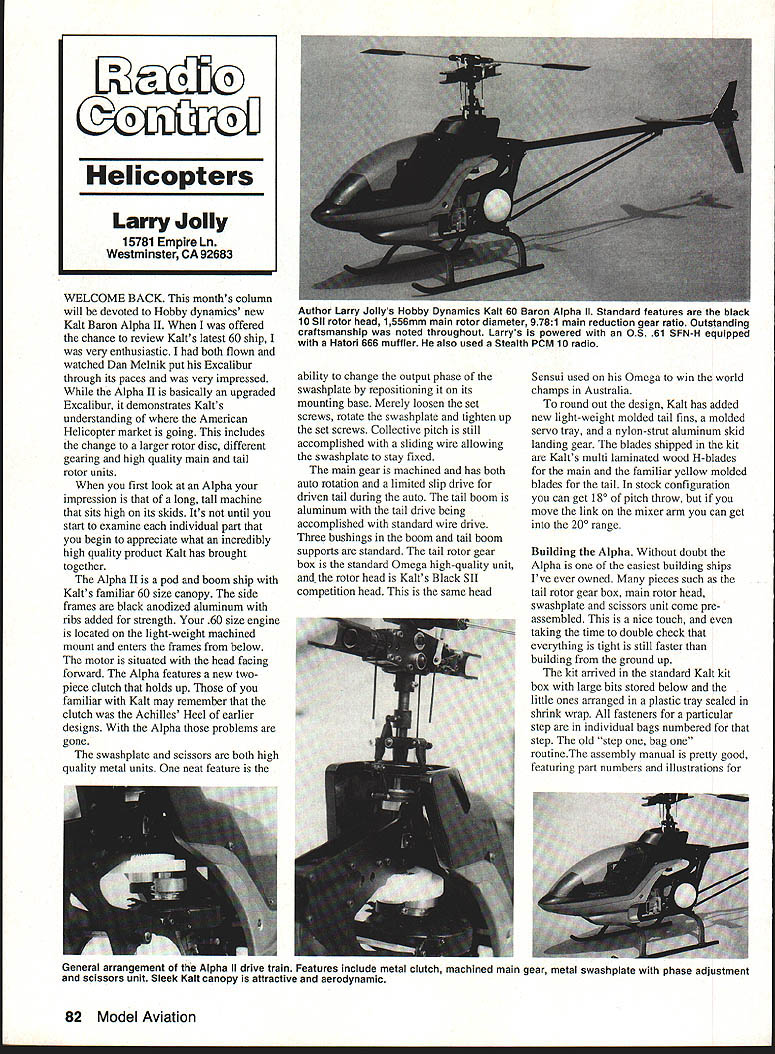
The Alpha II is a pod-and-boom ship with Kalt's familiar .60-size canopy. The side frames are black-anodized aluminum with ribs added for strength. The .60-size engine mounts on a light-weight machined mount and enters the frames from below, the motor situated with the head facing forward. The Alpha features a new two-piece clutch that holds up; those familiar with Kalt may remember that the clutch was the Achilles' heel of earlier designs. With the Alpha those problems are gone.
The swashplate and scissors are both high-quality metal units. One neat feature is the ability to change the output phase of the swashplate by repositioning it on its mounting base: merely loosen the set screws, rotate the swashplate and retighten. Collective pitch is still accomplished with a sliding wire allowing the swashplate to stay fixed.
The main gear is machined and has both autorotation capability and a limited-slip drive that allows the tail to be driven during autorotation. The tail boom is aluminum with a standard wire tail drive. Three bushings in the boom and tail-boom supports are standard. The tail rotor gearbox is the standard Omega high-quality unit and the rotor head is Kalt's Black SII competition head — the same head Sensui used on his Omega to win the world champs in Australia.
To round out the design, Kalt has added new lightweight molded tail fins, a molded servo tray, and a nylon-strut aluminum skid landing gear. The blades shipped in the kit are Kalt's multi-laminated wood H-blades for the main and the familiar yellow molded blades for the tail. In stock configuration you can get 18° of pitch throw; by moving the link on the mixer arm you can reach the 20° range.
Building the Alpha
Without doubt the Alpha is one of the easiest ships I've ever built. Many pieces — such as the tail rotor gearbox, main rotor head, swashplate and scissors unit — come preassembled. This is a nice touch; even taking the time to double-check everything is tight is still faster than building from scratch.
The kit arrived in the standard Kalt kit box with large parts stored below and the small ones arranged in a plastic tray sealed in shrink wrap. All fasteners for a particular step are in individually numbered bags — the old "step one, bag one" routine. The assembly manual is pretty good, featuring part numbers and illustrations for each step. One thing missing is a description accompanying each part number. The parts are obvious, but it would be nice to have part numbers listed with both the part name and some description such as dimension or material.
When building the Alpha, pay attention to the supplement instructions. The American Alpha II is slightly different from the Japanese version. The American version features the Excalibur starting system, the limited-slip differential (LSD) system and a different method of attachment for the foam tail fins.
Assembly is accomplished in nine basic steps; the following elaborates on the manual text.
- Main frames are assembled. Just follow the pictures and remember to use the Kalt-provided hardware.
- The clutch bell, bearing system and various standoffs are added to the main frame.
- In step 2-2 the slide ring shafts that act as the pivot for the collective arm are three brass units 30 mm in length and one 20 mm long. Also, the standoff for the bellcrank is aluminum, about 3/8 in. diameter and 1/2 in. long.
- The engine is prepared to accept the clutch and positioned in the main frames.
- The main shaft, scissors arm, swashplate, bearing and main gear are added.
- In step 4-2 the limited-slip drive is attached to the main shaft. This system uses an O-ring and metal washers to rub against the bottom bearing of the autorotation unit, allowing the tail rotor to spin during autorotation. Remember you want it to slip, so I used two washers instead of the three supplied. Also be careful when positioning the black-anodized metal cap — mine was tight and I had to polish the inside so it would slide over the main shaft.
- The cooling fan, landing gear and fuel tank are added. The fuel tank is a neat unit that features O-ring gaskets to keep the side frames from cutting the tank in two. Once you have all the plumbing hooked up to the tank, take the two small O-rings and place them in the grooves molded in the tank. Slide the tank through the right side frame, pause to position the two large O-rings around the tank, then finish sliding the tank through the left side frame. Use a small screwdriver to position the O-rings so they slide into place and finally secure the tank from rotation with the rubber spacer.
- The tail rotor gearbox gets its blade holders and the tail boom is assembled.
- In step 6-3 position the molded tail boom holder so that the end with an edge is forward.
- The servos are mounted in their preformed mounts.
- The cabin is glued together and painted.
- The head and linkage are assembled.
As you can see, the Alpha II goes together very quickly. I am very impressed with the engineering. It's not just that everything fits — Kalt has really taken the time to make sure the right materials are used in the right places. I'm amazed at how smooth the gear train is in my example. Everything is tight; there isn't any slop anywhere. This helicopter is truly one high-quality machine.
It's going to be next weekend before I can fly the Alpha II, so please come back next month and I'll report what I find. I also want to try a couple of sets of blades, and this will give me the opportunity to put a few gallons through the Alpha before I wrap it up.
Robert Teoh Goes Home
I just heard from Tom Dooley that well-known heli‑filer, collector and all-around nice guy Robert Teoh will be returning to his home country of Malaysia. I'm sure all of Robert's friends will join me in wishing him a fond farewell. Good luck, Robert, and I hope you're able to continue with your favorite hobby back home.
And You Think You Had a Bad Day
I called Dan Melnik of Vertical Flight Technologies the other night to order one of his new FAI carbon blades. He seemed a little down, so I asked what was bothering him. Well, it hasn't been a great year. It seems the Tangent Eight lost its number-one ship during practice the day before the contest. During the contest he stretched the autorotation further than his Kalt wanted to go and he had an awful boom strike. Then, last weekend he went down to Ernie Huber's Fun Fly with his very new ship. Everything was going well with a lot of swell people getting some flying in when... BOOM! Dan mid-aired a Miniature Aircraft X-Cell 40, wiping out both ships. Unbeknownst to Dan, these two weren't the only casualties: some poor guy hovering near the pits lost his ship when a piece of one of the mid-aired ships went through his rotor disc with predictable results. Some days it just doesn't pay to get up.
Hirobo Verto II
I've been working with my Hirobo Verto II tandem ship and have not been truly satisfied with it. If there is anybody out there who is really flying circuits and, in general, has a successful helicopter setup, please contact me. I'd love to publish your findings.
BCNU
Transcribed from original scans by AI. Minor OCR errors may remain.

