
Radio Control: Helicopters
Larry Jolly 15781 Empire Ln. Westminster, CA 92683
Welcome back. This month I'll cover some highlights of the recent Toledo exposition and the importance of monitoring your Ni-Cds.
Toledo Minireport
The Toledo exposition is the granddaddy of American hobby shows. Every spring, modelers from all over the U.S. make a pilgrimage to Toledo in quest of a first look at new offerings from favorite manufacturers.
Altech Altech, the American importer/distributor for Hirobo, showed the Shuttle line and the Condor–Eagle .60-size machines. New for this year were a .60-size Bell 222 and a reworked TOW Cobra. Also on display was Altech's Lama conversion for the Shuttle. I predict the Lama will be a popular little scale ship — I saw Altech pilot Mike Mas demonstrate his Lama at the IMS show in L.A., and it performed very well, simulating a full-scale Lama admirably.
Airtronics Airtronics was proudly showing the Infinity 1000. As with any new product, development and distribution take time, but the Infinity is real and will be available very shortly. I was fortunate to receive a test unit days before Toledo. The first Infinity available is the non-synthesized system; while that feature is advertised, the main attraction is the radio’s extensive mixing capabilities. Next month I will discuss the system in detail — the Airtronics Infinity 1000 helicopter system is the first of a new generation of super-radios.
Futaba Futaba was showing a new top-of-the-line radio, the 9ZAP — a nine-channel radio with 10-model memory and mixing for helicopter, power, and sailplane functions. Richard Verano of Futaba indicated the 9ZAP is more than a repackaged FC-28; in any case, it should be an exciting radio with lots of mixing capability. The 9ZAP is slated for a September release.
Great Planes / Kyosho Great Planes was showing the full line of Kyosho helicopters. New at the show were the Concept 30SR and the Concept 10.
- Concept 30SR — Still recognizable as a Concept 30, but with major improvements:
- Taller main mast
- Metal inner mixing arms
- New reinforced rotor head with one-piece blade grips
- All-metal mixing base
- Longer main blades
- Taller landing gear
- More rigid servo trays
- 24° total main rotor pitch travel in stock form
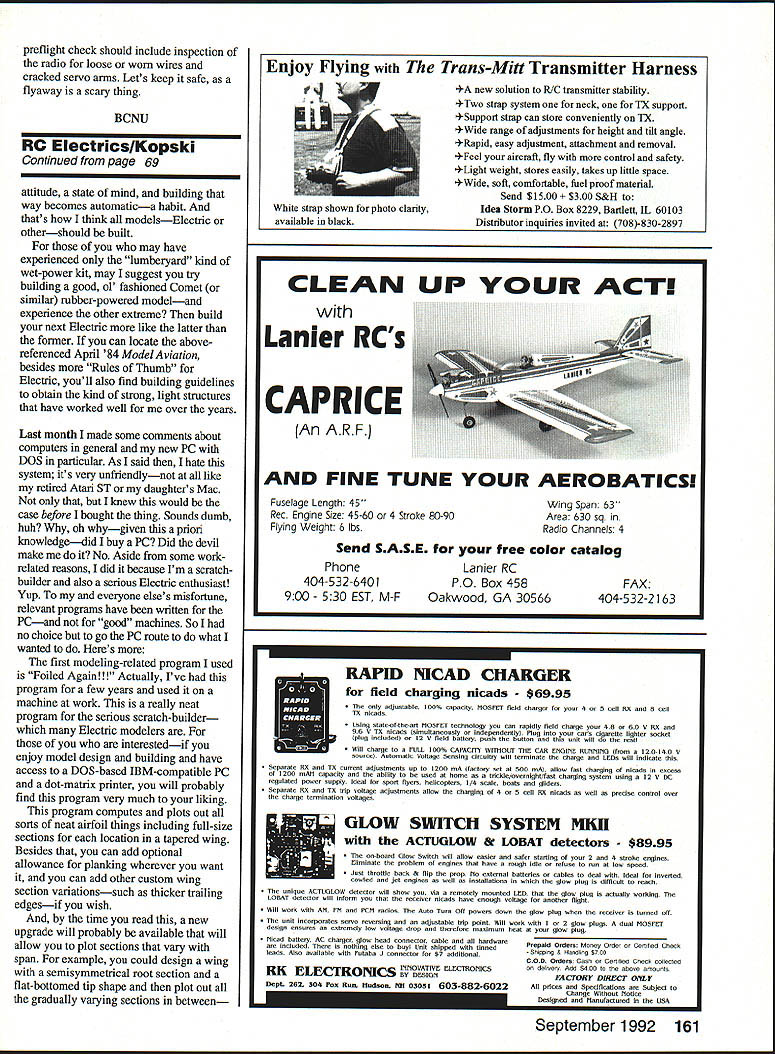
- Concept 10 — Intended to compete with the MH-10. Features major prefabrication, including an installed O.S. Max CZ-HX .15 pull-start engine, roughly 50% parts compatibility with the EP Concept, belt-driven tail rotor, and standard autorotation.
I will report in depth on the Concept 60 next month. I have since flown both the Concept 30SR and the Concept 10. The 30SR is a very impressive .30-size machine with good head rigidity and excellent tail response; it autorotates like a .60-size machine, with good glide characteristics and sufficient inertia to hover before touchdown. The Concept 10 I flew briefly: it’s a lightweight, lively little machine — pure fun and likely to be a popular sport flier.
M.A.S. (Miniature Aircraft Supply) — Continued from page 67 Tim and Ted Schoonard have been very busy; M.A.S. is moving full steam into carbon-fiber/graphite composite parts, including:
- Vertical and horizontal fins
- Elevator servo mounts
- Landing gear support plates
- Tail booms and drives
- Side frames
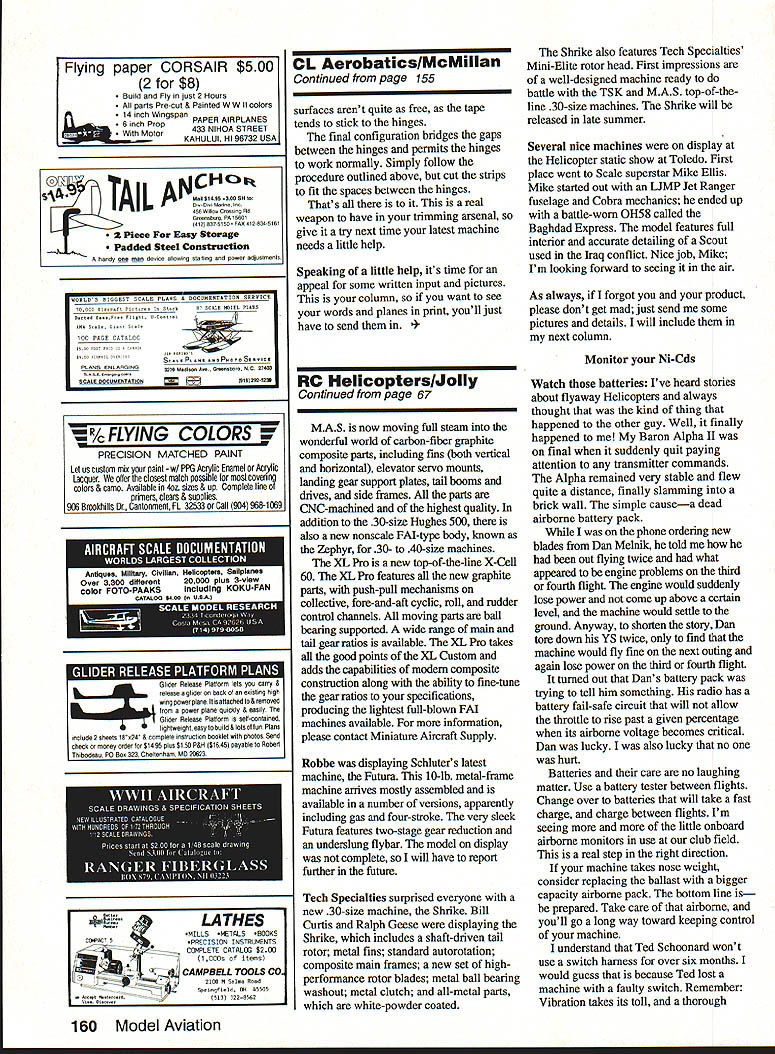
All parts are CNC-machined and high quality. In addition to the .30-size Hughes 500, there is a new nonscale FAI-type body called the Zephyr for .30– to .40-size machines.
The XL Pro is a new top-of-the-line X-Cell 60 and features:
- Graphite composite parts throughout
- Push-pull mechanisms on collective, fore-and-aft cyclic, roll, and rudder control channels
- All moving parts supported by ball bearings
- Wide range of main and tail gear ratios available
The XL Pro takes the best points of the XL Custom and adds modern composite construction plus fine-tunable gear ratios for one of the lightest, full-blown FAI machines available.
Robbe / Schluter Futura Robbe was displaying Schluter’s latest machine, the Futura — a roughly 10-lb. metal-frame machine that arrives mostly assembled and appears to be offered in several versions (including gas and four-stroke). The sleek Futura features two-stage gear reduction and an underslung flybar. The model on display was not complete; I’ll report further when more details are available.
Tech Specialties — Shrike Tech Specialties surprised everyone with a new .30-size machine, the Shrike. Features include:
- Shaft-driven tail rotor
- Metal fins
- Standard autorotation
- Composite main frames
- New high-performance rotor blades
- Metal ball-bearing washout
- Metal clutch
- All-metal parts with white powder-coat finish
The Shrike also uses Tech Specialties’ Mini-Elite rotor head. First impressions: a well-designed machine ready to compete with the TSK and M.A.S. top-of-the-line .30-size machines. The Shrike should be released in late summer.
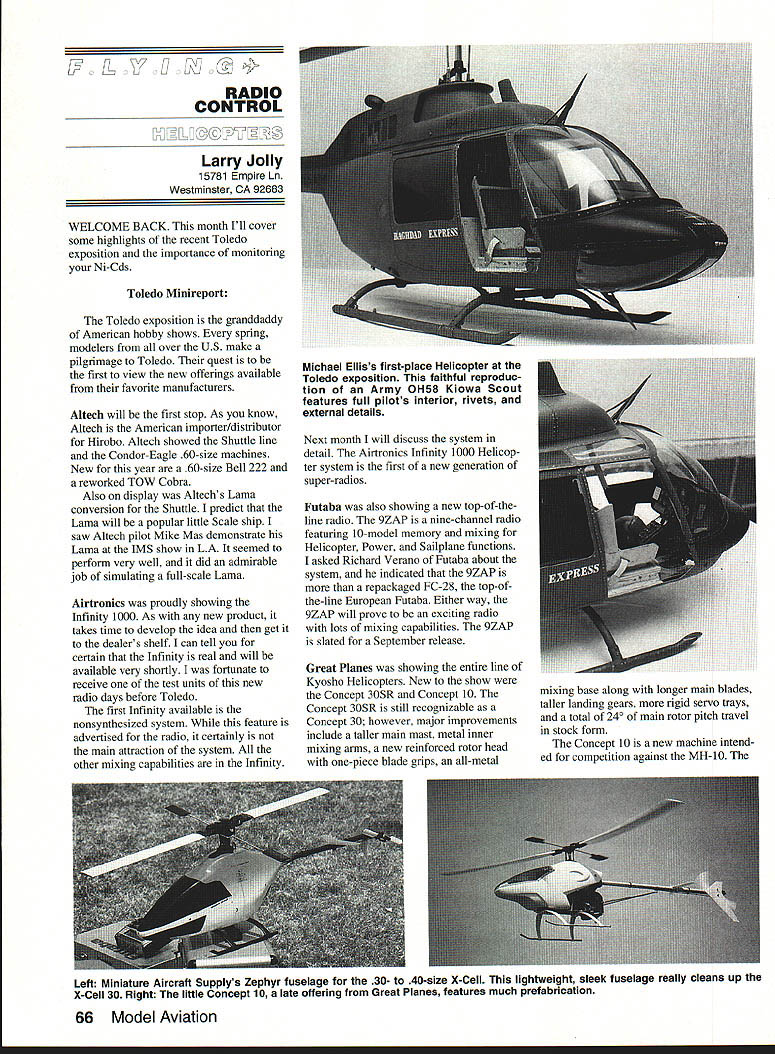
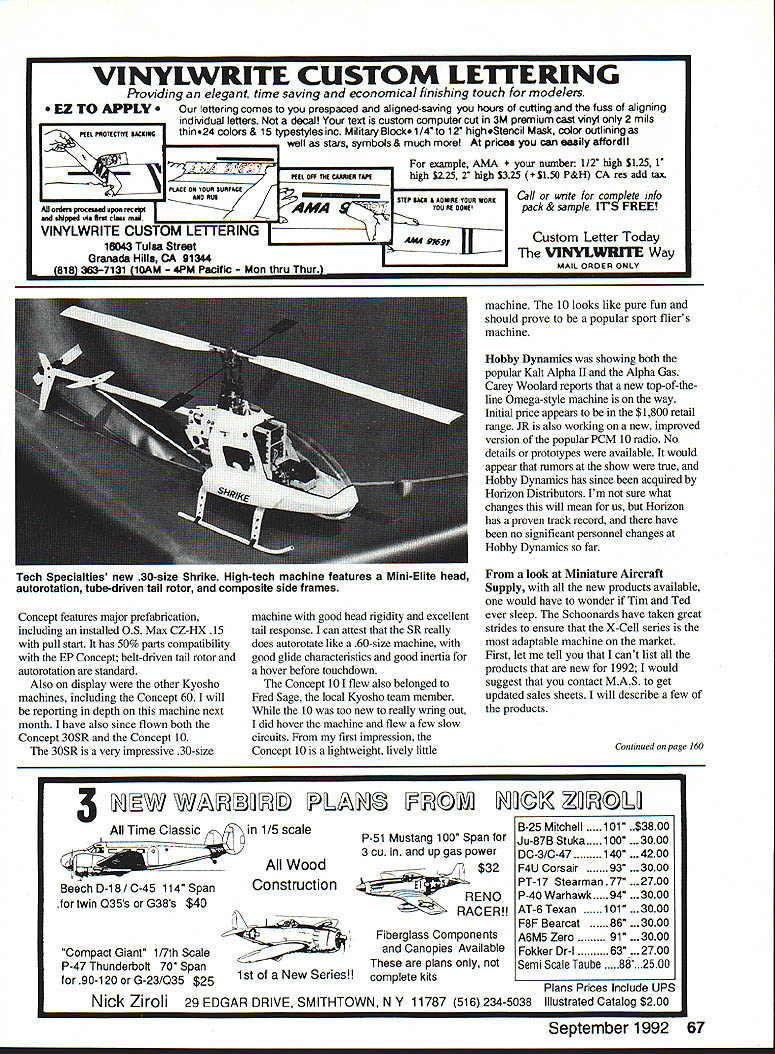
Toledo static show highlights Several nice models were on display at the helicopter static show at Toledo. First place went to scale sculptor Mike Ellis, who started with an LJMP Jet Ranger fuselage and Cobra mechanics and ended up with a battle-worn OH-58 called the Baghdad Express, complete with full interior and accurate detailing of a Scout used in the Iraqi conflict. Nice job, Mike — I’m looking forward to seeing it fly.
As always, if I forgot you and your product, don’t get mad — send pictures and details and I’ll include them in the next column.
Monitor your Ni-Cds
Watch those batteries. I’d heard stories about flyaway helicopters and thought that happened to someone else — until it happened to me. My Baron Alpha II was on final when it stopped responding to transmitter commands. It remained stable and flew quite a distance before slamming into a brick wall. The simple cause was a dead airborne battery pack.
Dan Melnik told me of similar problems: his engine would lose power on the third or fourth flight of a day, then fly fine the next outing. The problem was an airborne battery pack whose voltage had fallen to a critical level. Dan’s radio had a battery fail-safe that prevented the throttle from rising above a certain percentage when airborne voltage was low — a welcome feature.
Battery care is no laughing matter. Recommendations:
- Use a battery tester between flights. If you notice a big voltage swing, replace the pack.
- Use Ni-Cads that accept a fast charge and charge between flights.
- Consider onboard voltage monitors — I’m seeing more of these at the club field; they’re a real step in the right direction.
- If your machine requires nose weight, consider replacing the ballast with a larger-capacity airborne pack so it serves as both ballast and reliable power.
- Perform thorough preflight checks: inspect the radio for loose or worn wires, cracked servo arms, and faulty switches. Vibration takes its toll — a faulty switch can ground a machine for months (I understand Ted Schoonard won’t be flying his X-Cell 30 for six months after losing a machine to a faulty switch).
Bottom line: be prepared. Take care of the airborne battery and you’ll go a long way toward keeping control of your machine.
Transcribed from original scans by AI. Minor OCR errors may remain.

