
Radio Control: Helicopters
Larry Jolly 15781 Empire Ln., Westminster, CA 92683
THIS MONTH I'm going to review the Hobbico Kyosho Concept 60 and let you know what I find.
I remember how excited I was when I found out that Taya was really designing a .60-size version of the popular Kyosho Concept helicopter. I doubt that anyone who has been in the hobby the last few years is not familiar with the Concept 30, and no helicopter enthusiast can deny the positive effect these machines have had in bringing new faces into the hobby.
By now most of you will have seen the Concept 60. Probably you weren't too surprised to see that Kyosho kept the basic theme of the smaller Concept when it designed the .60-size machine. While the Concept 60 is unique, there is certainly a strong family resemblance. Why not? If something works for you, don't fix it!
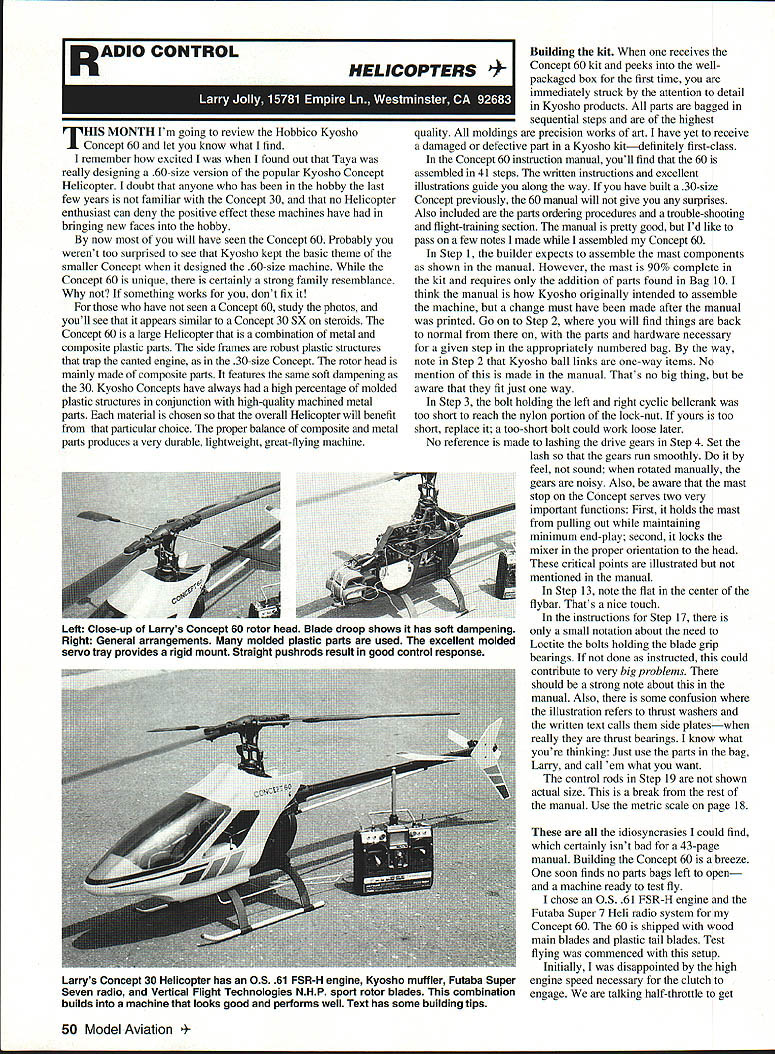
For those who have not seen a Concept 60, study the photos and you'll see that it appears similar to a Concept 30 SX on steroids. The Concept 60 is a large helicopter that is a combination of metal and composite plastic parts. The side frames are robust plastic structures that trap the canted engine, as in the .30-size Concept. The rotor head is mainly made of composite parts and features the same soft dampening as the .30. Kyosho Concepts have always had a high percentage of molded plastic structures in conjunction with high-quality machined metal parts. Each material is chosen so that the overall helicopter will benefit from that particular choice. The proper balance of composite and metal parts produces a very durable, lightweight, great-flying machine.
Building the kit
When one receives the Concept 60 kit and peeks into the well-packaged box for the first time, you are immediately struck by the attention to detail in Kyosho products. All parts are bagged in sequential steps and are of the highest quality. All moldings are precision works of art. I have yet to receive a damaged or defective part in a Kyosho kit—definitely first-class.
In the Concept 60 instruction manual you'll find that the 60 is assembled in 41 steps. The written instructions and excellent illustrations guide you along the way. If you have built a .30-size Concept previously, the 60 manual will not give you any surprises. Also included are parts-ordering procedures and a troubleshooting and flight-training section. The manual is pretty good, but I'd like to pass on a few notes I made while I assembled my Concept 60.
Assembly notes and idiosyncrasies:
- Step 1: The builder expects to assemble the mast components as shown in the manual. However, the mast is about 90% complete in the kit and requires only the addition of parts found in Bag 10. I think the manual is how Kyosho originally intended to assemble the machine, but a change must have been made after the manual was printed.
- Step 2 onward: Parts and hardware are given in appropriately numbered bags and things are back to normal from there.
- Ball links: Kyosho ball links are one-way items. No mention of this is made in the manual. It's not a big deal, but be aware they fit only one way.
- Step 3: The bolt holding the left and right cyclic bellcrank was too short to reach the nylon portion of the lock-nut on my kit. If yours is too short, replace it—a too-short bolt could work loose later.
- Step 4: No reference is made to lashing the drive gears. Set the lash so that the gears run smoothly. Do it by feel, not by sound; when rotated manually, the gears are noisy.
- Mast stop: The mast stop on the Concept serves two important functions: it prevents the mast from pulling out while maintaining the minimum end-play, and it locks the mixer in the proper orientation to the head. These points are illustrated but not mentioned in the manual.
- Step 13: Note the flat in the center of the flybar—handy detail.
- Step 17: The instructions only have a small notation about the need to Loctite the bolts holding the blade grip bearings. If not done, this could contribute to very big problems. There should be a stronger warning in the manual.
- Thrust washers vs. side plates: The illustration refers to thrust washers while the written text calls them side plates—really they are thrust bearings. Use the parts in the bag.
- Step 19 / control rods: Control rods are not shown actual size. Use the metric scale on page 18.
These are all the idiosyncrasies I could find, which certainly isn't bad for a 43-page manual. Building the Concept 60 is a breeze. One soon finds no parts bags left to open—and a machine ready to test fly.
Setup and test flying
I chose an O.S. .61 FSR-H engine and the Futaba Super 7 Heli radio system for my Concept 60. The 60 is shipped with wood main blades and plastic tail blades. Test flying was commenced with this setup.
Initially, I was disappointed by the high engine speed necessary for the clutch to engage.
Photos (from the test/fly events):
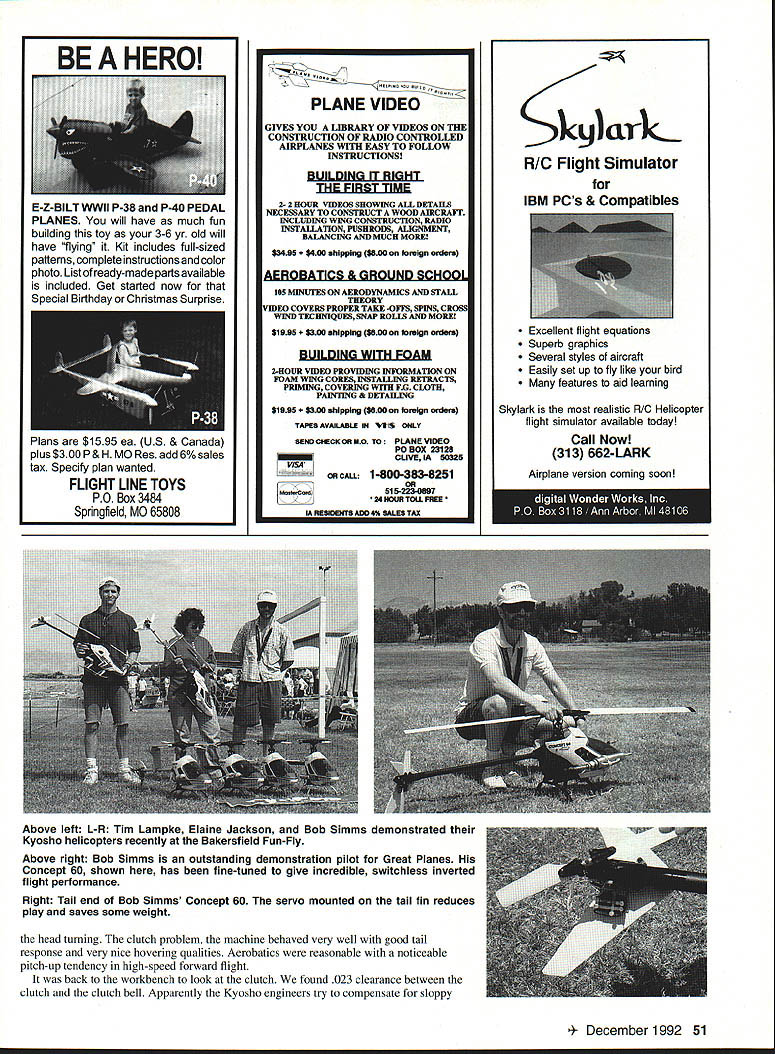
- Above left: L–R: Tim Lampke, Elaine Jackson, and Bob Simms demonstrated their Kyosho helicopters recently at the Bakersfield Fun-Fly.
- Above right: Bob Simms is an outstanding demonstration pilot for Great Planes. His Concept 60, shown here, has been fine-tuned to give incredible, switchless inverted flight performance.
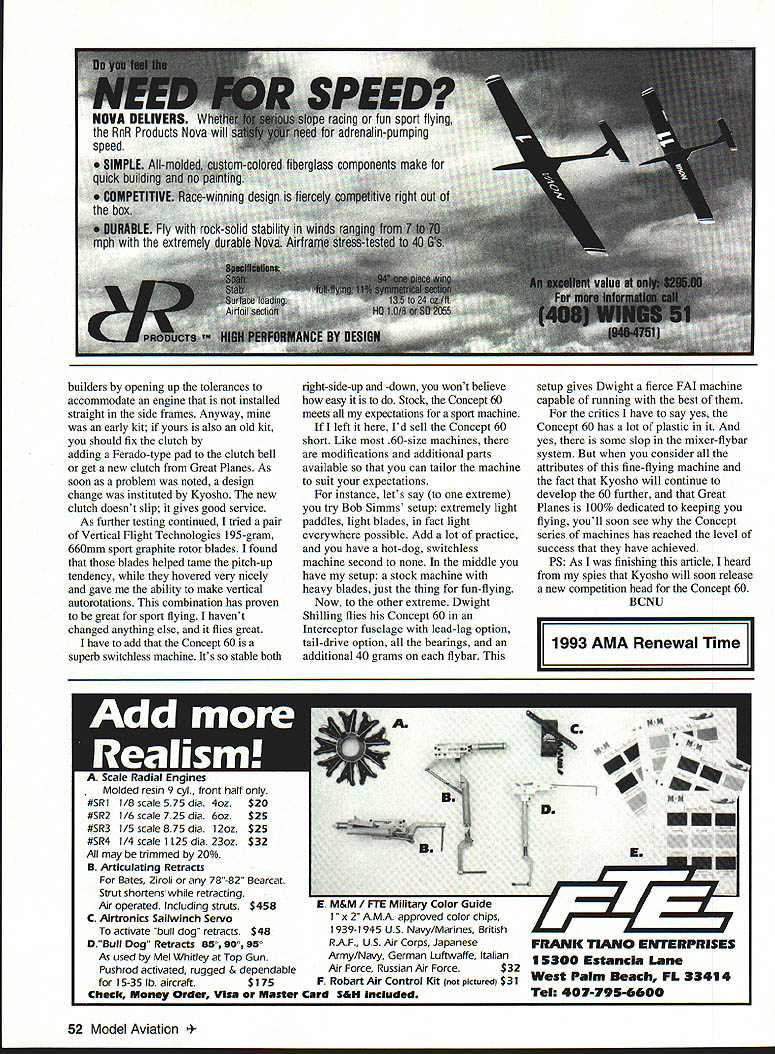
- Right: Tail end of Bob Simms' Concept 60. The servo mounted on the tail fin reduces play and saves some weight.
Apart from the clutch problem, the machine behaved very well with good tail response and very nice hovering qualities. Aerobatics were reasonable with a noticeable pitch-up tendency in high-speed forward flight.
Back at the workbench to inspect the clutch, we found .023" clearance between the clutch and the clutch bell. Apparently Kyosho engineers try to compensate for sloppy builders by opening up tolerances to accommodate an engine that is not installed perfectly straight in the side frames. Anyway, mine was an early kit; if yours is also an early kit, you should fix the clutch by adding a Ferodo-type pad to the clutch bell or get a new clutch from Great Planes. As soon as the problem was noted, Kyosho instituted a design change. The new clutch doesn't slip and gives good service.
As further testing continued, I tried a pair of Vertical Flight Technologies 195-gram, 660 mm sport graphite rotor blades. I found those blades helped tame the pitch-up tendency, hovered very nicely, and allowed me to make vertical autorotations. This combination has proven to be great for sport flying. I haven't changed anything else, and it flies great.
I have to add that the Concept 60 is a superb switchless machine. It's so stable both right-side-up and -down, you won't believe how easy it is to do. Stock, the Concept 60 meets all my expectations for a sport machine.
Modifications and alternative setups
If I left it here, I'd sell the Concept 60 short. Like most .60-size machines, there are modifications and additional parts available so that you can tailor the machine to suit your expectations.
Examples:
- Bob Simms' setup (extreme): Extremely light paddles, light blades, light everywhere possible. Add a lot of practice, and you have a hot-dog, switchless machine second to none.
- My setup (middle): Stock machine with heavier blades—just the thing for fun-flying.
- Dwight Shilling's setup (competition): Concept 60 in an Interceptor fuselage with lead-lag option, tail-drive option, all the bearings, and an additional 40 grams on each flybar. This gives a fierce FAI-capable machine that can run with the best.
Conclusions
For the critics: yes, the Concept 60 has a lot of plastic in it. And yes, there is some slop in the mixer–flybar system. But when you consider all the attributes of this fine-flying machine, the fact that Kyosho will continue to develop the 60 further, and that Great Planes is 100% dedicated to keeping you flying, you'll soon see why the Concept series has achieved the level of success it has.
PS: As I was finishing this article, I heard from my spies that Kyosho will soon release a new competition head for the Concept 60.
BCNU
Transcribed from original scans by AI. Minor OCR errors may remain.

