
Radio Control: Helicopters
Larry Jolly, 15781 Empire Ln., Westminster, CA 92683
Welcome back. I've got several things to cover this month, so let's just jump in and take them one at a time.
Airtronics Infinity 1000H heli radio
If you've been flying RC helicopters for any length of time, you've had some experience with a dedicated RC helicopter radio system. I've been flying RC helicopters since 1976, and started with an American RC Revolution that I attempted to steer with a brown-box Futaba, which was state of the art at the time.
The Futaba, of course, was a basic four-channel airplane system. When I look at Airtronics' new heli system and think back to where we came from, it seems like science fiction. There is no way that I could have foreseen the possibility of a system like the Infinity. Though I haven't seen the new, top-of-the-line Futaba or JR systems, I'll bet I'm safe in saying that I doubt they surpass the new Infinity 1000. In fact, after studying the Infinity's capabilities, I doubt this system will be surpassed—or even equaled—for many years.
Airtronics started from the ground floor with the Infinity. The company had a single goal: to produce the most capable, sophisticated helicopter system yet offered the modeler. From the moment you see it, you'll know the Infinity is in a class of its own.
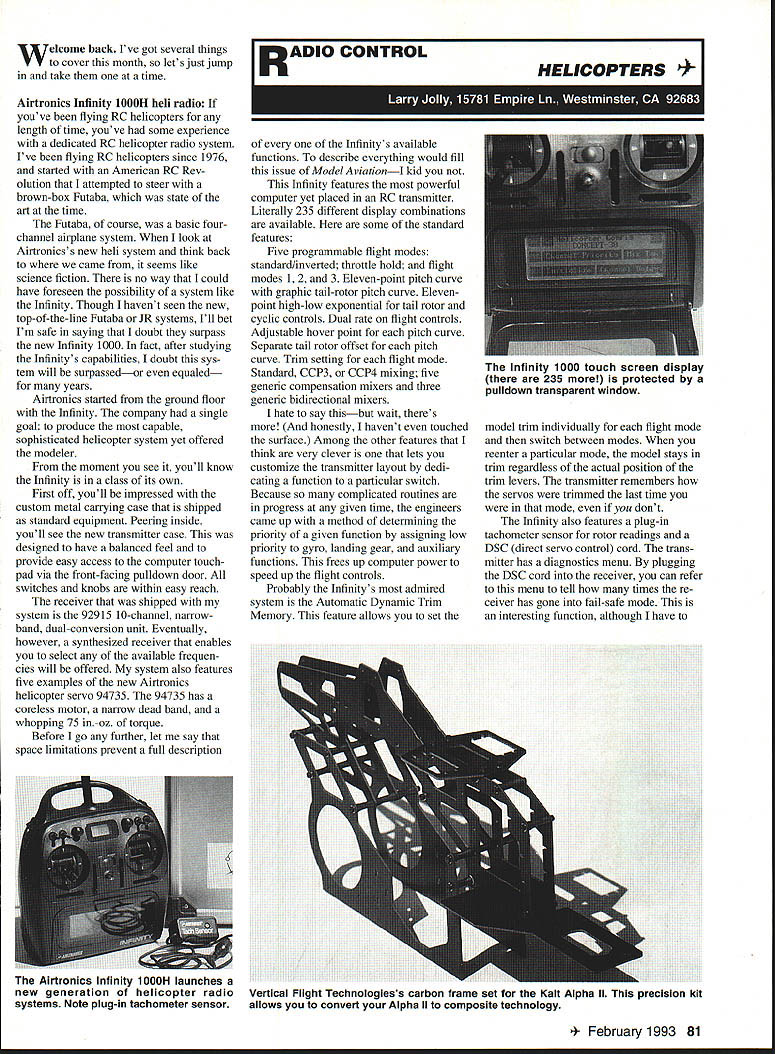
First off, you'll be impressed with the custom metal carrying case that is shipped as standard equipment. Peering inside, you'll see the new transmitter case. This was designed to have a balanced feel and to provide easy access to the computer touchpad via the front-facing pulldown door. All switches and knobs are within easy reach.
The receiver that was shipped with my system is the 92915, a 10-channel, narrow-band, dual-conversion unit. Eventually, however, a synthesized receiver that enables you to select any of the available frequencies will be offered. My system also features five examples of the new Airtronics helicopter servo 94735. The 94735 has a coreless motor, a narrow dead band, and a whopping 75 in.-oz. of torque.
Before I go any further, let me say that space limitations prevent a full description of every one of the Infinity's available functions. To describe everything would fill this issue of Model Aviation—I kid you not.
This Infinity features the most powerful computer yet placed in an RC transmitter. Literally 235 different display combinations are available. Here are some of the standard features:
- Five programmable flight modes: standard/inverted; throttle hold; and flight modes 1, 2, and 3.
- Eleven-point pitch curve with graphic tail-rotor pitch curve.
- Eleven-point high-low exponential for tail rotor and cyclic controls.
- Dual rate on flight controls.
- Adjustable hover point for each pitch curve.
- Separate tail rotor offset for each pitch curve.
- Trim setting for each flight mode.
- Standard, CCP3, or CCP4 mixing.
- Five generic compensation mixers and three generic bidirectional mixers.
I hate to say this—but wait, there's more! (And honestly, I haven't even touched the surface.) Among the other features that I think are very clever is one that lets you customize the transmitter layout by dedicating a function to a particular switch. Because so many complicated routines are being performed at any given time, the engineers came up with a method of determining the priority of a given function by assigning low priority to gyro, landing gear, and auxiliary functions. This frees up computer power to speed up the flight controls.
Probably the Infinity's most admired system is the Automatic Dynamic Trim Memory. This feature allows you to set the model trim individually for each flight mode and then switch between modes. When you reenter a particular mode, the model stays in the last position of the trim levers. The transmitter remembers how the servos were trimmed the last time you were in that mode, even if you don't.
The Infinity also features a plug-in tachometer sensor for rotor readings and a DSC (direct servo control) cord. The transmitter has a diagnostics menu. By plugging the DSC cord into the receiver, you can refer to this menu to tell how many times the receiver has gone into fail-safe mode. This is an interesting function, although I have to confess that it does you little good, since you must take this reading on the ground.
Basically, the Airtronics 1000H has unbelievable computer power. It can store eight separate models or setups. You have unparalleled authority over five separate pitch curves for main and tail rotors. You can literally mix anything with anything and set up time delays or stick-position authority. This system can do things that I can't figure out why I'd want to do—but that's what makes it so impressive. You won't be limited with an Infinity.
Check out an Infinity at a trade show or through a fellow modeler, if you happen to know someone lucky enough to own one of these advanced systems. The Infinity 1000H is not inexpensive; I understand that it will be priced in the $1,300 to $1,500 range. It's available only from Airtronics. I tested my Infinity in my Concept 30SX and have had nothing but good luck in flying with the system. I have now installed it in my X-Cell 60 Custom and will add further updates as I delve into the Infinity's capabilities. Contact Airtronics at 11 Autry, Irvine, CA 92718.
Vertical Flight Technologies carbon fiber frames
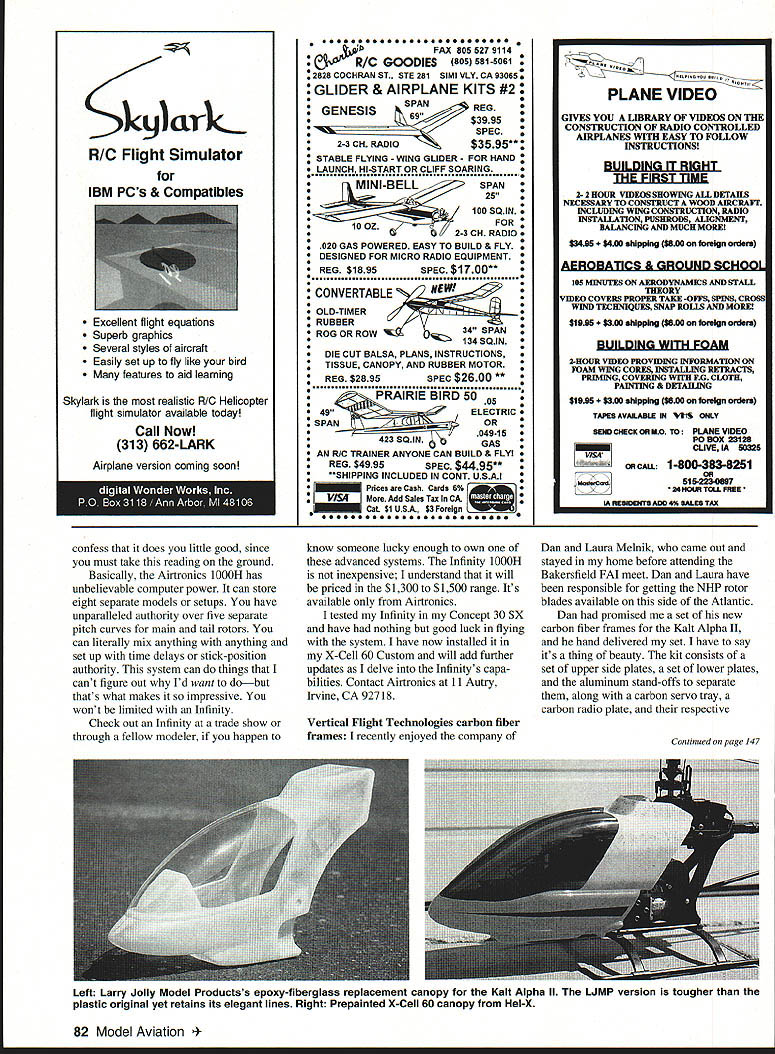
I recently enjoyed the company of Dan and Laura Melnik, who came out and stayed in my home before attending the Bakersfield FAI meet. Dan and Laura have been responsible for getting the NHP rotor blades available on this side of the Atlantic. Dan had promised me a set of his new carbon fiber frames for the Kalt Alpha II, and he hand-delivered the set. I have to say it's a thing of beauty.
The kit consists of:
- A set of upper side plates and a set of lower plates.
- Aluminum stand-offs to separate the plates.
- A carbon servo tray and a carbon radio plate with their respective aluminum mounting plates.
- Enough screws and washers to assemble the frames and underpin the screw heads.
A six-page instruction manual is included. Assembly is very easy. All the carbon pieces were drawn on a CAD (computer-assisted drawing) machine and then drilled and routed on an NC (numerically controlled) machine. The unit is truly precision made, with everything fitting exactly.
My hat is off to Dan and Laura for having produced such a high-quality product and successfully brought it to market. The frames are $250—not inexpensive, but certainly worth it when you consider the high quality and potentially low sales volume. Carbon fiber is the latest "in" thing for the FAI crowd. It enables you to make a lighter, stiffer machine that is virtually bulletproof. Contact Vertical Flight Technologies at 1527 S.W. 116 Ave., Pembroke Pines, FL 33025.
Hel-X Corporation
I became friends with A.E. Stanley when he was putting on the Top Gun Heli Tournament. Stan told me that he worked with Hel-X and painted canopies for them. I told Stan that I was finishing an X-Cell 60 and would like to try one of Hel-X's prefinished canopies.
I was very pleased with the canopy the company sent me. It's white with three-color neon and a black splatter finish. The tail fins match, and the cabin was well assembled with the latching button preinstalled. All my friends who have seen the canopy have remarked favorably. Hel-X does excellent work at a very fair price. Contact Hel-X at 558 Highland Ave., Upper Montclair, N.J. 07043, and ask for a catalog. Besides custom painting, the company offers a lot of neat accessories.
LJMP Baron Canopy
As many of you know, I have enjoyed the Baron Alpha II very much and in fact am finishing a gas version right now. While I have the lines of the Alpha II canopy, I have found that the ABS plastic cracks with age, particularly if, like me, you are clumsy with a starter. If you want a fiberglass Alpha II replacement canopy, contact LJMP at (714) 826-6861. The canopy is $75 and includes the molded windscreen as shown.
That wraps it up for this month. I hope you're getting in some flying. And I hope you got everything you wanted for Christmas. Happy 1993!
BCNU
AMA SINCE 1936
Transcribed from original scans by AI. Minor OCR errors may remain.

