
Radio Control: Helicopters
Larry Jolly, 15781 Empire Ln., Westminster, CA 92683
This is a difficult column for me to write, but as they say, all things must pass, and so it is that the time has come to pass this column to another dedicated scribe.
Next month Paul Tradelius will be the new helicopter columnist for Model Aviation. I hope all of you appreciate the commitment Paul has made to ensure Model Aviation has the finest up-to-date helicopter column available to the RC helicopter enthusiast.
Many of you are pondering and perhaps asking why the change. The truth of the matter is that when I accepted the responsibilities of this column in 1983, I had no idea I would be writing it 10 years later.
During the last 10 years, my life has changed drastically, and I am sure yours has as well. I have a deep appreciation for and interest in RC helicopters; however, I also developed a fascination for RC sailplanes. In fact, I have had the honor of representing the U.S. in two sailplane world championships with a third contest upcoming in August of this year.
My career has expanded so I no longer have the time it takes to bring the readers of Model Aviation the first-class monthly column they deserve. With some regret and some relief, then, I pass the reins to Paul.
You know, looking back at the last 10 years, it's amazing to note what has changed and what has stayed the same. Who could have predicted that the Schluter Heli Boy would become the definitive layout for an RC helicopter? Even the most opinionated will have to agree that all modern designs are but refinements of Dieter's Heli Boy, which was first presented in 1976.
I'd have to say that the most far-reaching change has been in radio equipment. Ten years ago a helicopter system was much simpler, and the thought of adding a microprocessor was still years away.
Futura update
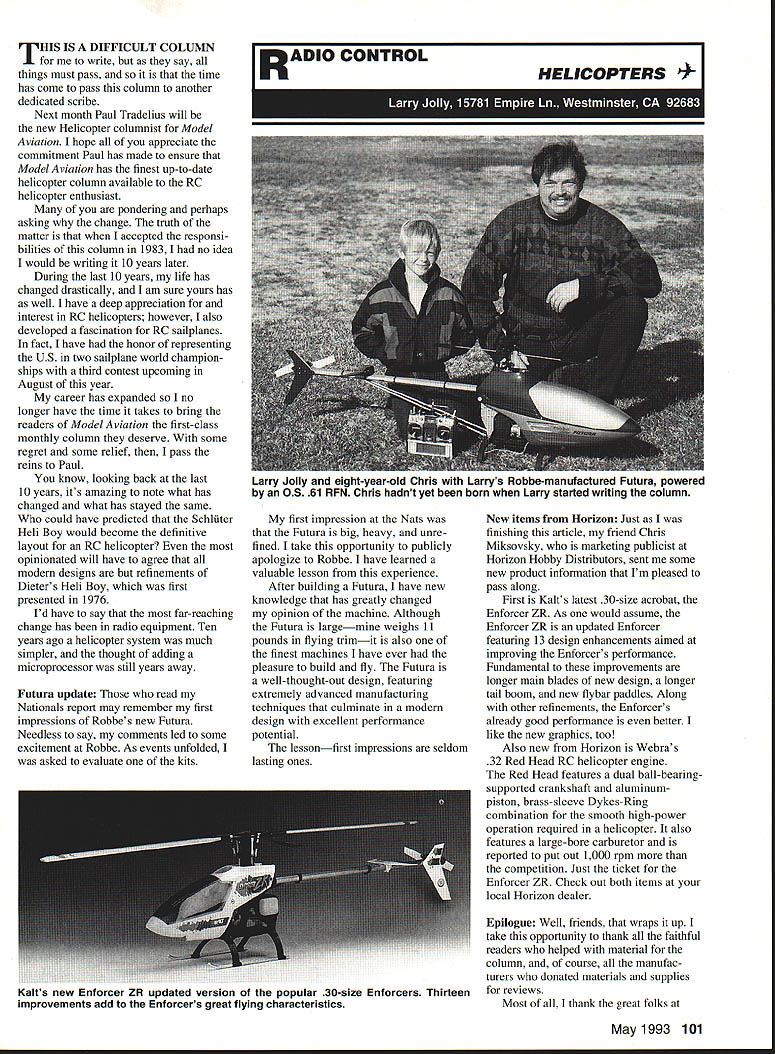
Those who read my Nationals report may remember my first impressions of Robbe's new Futura. Needless to say, my comments led to some excitement at Robbe. As events unfolded, I was asked to evaluate one of the kits.
My first impression at the Nats was that the Futura is big, heavy, and unrefined. I take this opportunity to publicly apologize to Robbe. I have learned a valuable lesson from this experience.
After building a Futura, I have new knowledge that has greatly changed my opinion of the machine. Although the Futura is large—mine weighs 11 pounds in flying trim—it is also one of the finest machines I have ever had the pleasure to build and fly. The Futura is a well-thought-out design, featuring extremely advanced manufacturing techniques that culminate in a modern design with excellent performance potential.
The lesson—first impressions are seldom lasting ones.
New items from Horizon
Just as I was finishing this article, my friend Chris Mikosovsky, who is marketing publicist at Horizon Hobby Distributors, sent me some new product information that I'm pleased to pass along.
First is Kalt's latest .30-size acrobat, the Enforcer ZR. As one would assume, the Enforcer ZR is an updated Enforcer featuring 13 design enhancements aimed at improving the Enforcer's performance. Fundamental to these improvements are longer main blades of new design, a longer tail boom, and new flybar paddles. Along with other refinements, the Enforcer's already good performance is even better. I like the new graphics, too.
Also new from Horizon is Webra's .32 Red Head RC helicopter engine. The Red Head features a dual ball-bearing-supported crankshaft and aluminum piston, brass-sleeve Dykes-Ring combination for the smooth, high-power operation required in a helicopter. It also features a large-bore carburetor and is reported to put out 1,000 rpm more than the competition. Just the ticket for the Enforcer ZR. Check out both items at your local Horizon dealer.
Epilogue
Well, friends, that wraps it up. I take this opportunity to thank all the faithful readers who helped with material for the column, and, of course, all the manufacturers who donated materials and supplies for reviews.
Most of all, I thank the great folks at Model Aviation, particularly my editor Ross McMullen, who put up with far more than he should have on my behalf.
Don't be surprised if I send in articles from time to time. Old habits are hard to break. God bless you all, and thank you for this experience. I wouldn't have missed it for anything. Be seeing you later.
Reader contributions and comments
Good. I get a lot of comments about its quality, and people seem surprised when I explain how easy it was to do. Those Coverite people have a great product with their 21st Century stuff.
"I put a K&B .65 Sportster on the front and installed the radio gear just about where shown on the plans. Wonder of wonders, it balanced exactly where it was supposed to.
"To date, I have only 13 flights on it. Takeoffs are really no problem if you've flown tail-draggers. Landings can get a bit scary; keep the speed up, yet when it continues its rollout, you've got to hold up to keep the tail down.
"In the air, the plane is very easy to fly. Good roll control (turns with ailerons only) and it really looks neat! When it goes by on a low flyby and the pilot's scarf is flapping in the slipstream, you can almost hear the twin machine guns chattering away. The Red Baron lives!"
Mr. Claunch lives in Sherman, Texas, and he must be a very valuable asset to his club's membership roster at meeting time. The man builds both proficiently and incessantly, and he is a wealth of knowledge and information. I'll bet a buck he knows what silk feels like! Thanks for the contribution, Gerald. It's always a pleasure to hear from you.
Greg Bartling sent a picture of his PT-19, built from Wendell Hostetler's plans at 26% scale. Greg says the model is a superb flier, and he credits this quality to the airplane's extremely light wing loading — only 20.4 ounces per square foot.
The letter accompanying Greg's photos contained several interesting comments concerning light vs. heavy aircraft wing loading, so perhaps it's appropriate to ask for your opinions.
Most modelers believe that light airplanes fly best, but several years' experience with competition sailplanes has shown me that conditions do exist where the lightest airplane is not always best. How can that be? Have a look:
- Most of us will accept that maximum wing loading is the condition where a model is having as much as it can get and still manage to maintain flight, making maximum wing loading a pretty undesirable goal all-around.
- On the other hand, minimum wing loading may be achievable when you build something as light as possible. Minimum wing loading may sound pretty good on paper, but I'm no fancier of throwing toilet paper in the wind, especially when it comes to radio-controlled airplanes that must respond smartly when a command is given.
- Optimum wing loading is where an airplane's loading is adjusted to deliver maximum performance for the task to be flown on the day in question.
I can tell you firsthand—and with a great many reputable witnesses—that my eight-foot Blériot XI, weighing 15 pounds and...
Transcribed from original scans by AI. Minor OCR errors may remain.

