
RADIO CONTROL HELICOPTERS
Paul Tradelius, 6704 Santiago, Fort Worth, TX 76133
Introduction
To start off my first helicopter column for Model Aviation, I would like to thank Larry Jolly for all the great work he has done to promote helicopters. He has devoted a tremendous amount of time and effort to our hobby, and I know I speak for the staff at Model Aviation and all his readers in wishing Larry the best in his future endeavors.
About me
I started modeling in the early 1950s with free flights, moving to radio control in the Lorenz two-tube days of the mid-1950s. Because of my love for airplanes, I majored in aeronautical engineering in college and then spent 23 years in the Air Force, mainly flying fighters. About 10 years ago, while stationed in Germany, I started flying helicopters, and the rest is history.
Helicopters presented both a challenge and a needed change, so I rarely fly fixed-wing anymore. I retired from the Air Force about four years ago and spend half my time in Fort Worth and the other half flying large airplanes for USAir out of Pittsburgh. Although this means a lot of commuting, I enjoy it because I get to fly helicopters in Pittsburgh with the Pittsburgh Area Roto Runners (PARR) and in Texas with the Mid-West Helicopter Association.
Column objectives
One objective of this column is to help you increase your knowledge about helicopters in every issue. Topics may include:
- Tips for novice fliers to avoid common learning problems.
- Aerodynamics and advanced maneuvers.
- Setup techniques and performance tuning.
To make the column useful, I need your input. Tell me what interests you, what helicopter projects you are working on, and what types of articles you would like to see. If you are working on a project that would interest others, let me know and include pictures if you can. My address is at the top of this column. I hope to receive quick responses.
Another objective is to keep you informed about products and news from companies dealing with helicopters. This could include product improvements by established manufacturers or introductions from smaller makers with good products but limited advertising budgets.
Products I'm using
Two products I have been using with a lot of success:
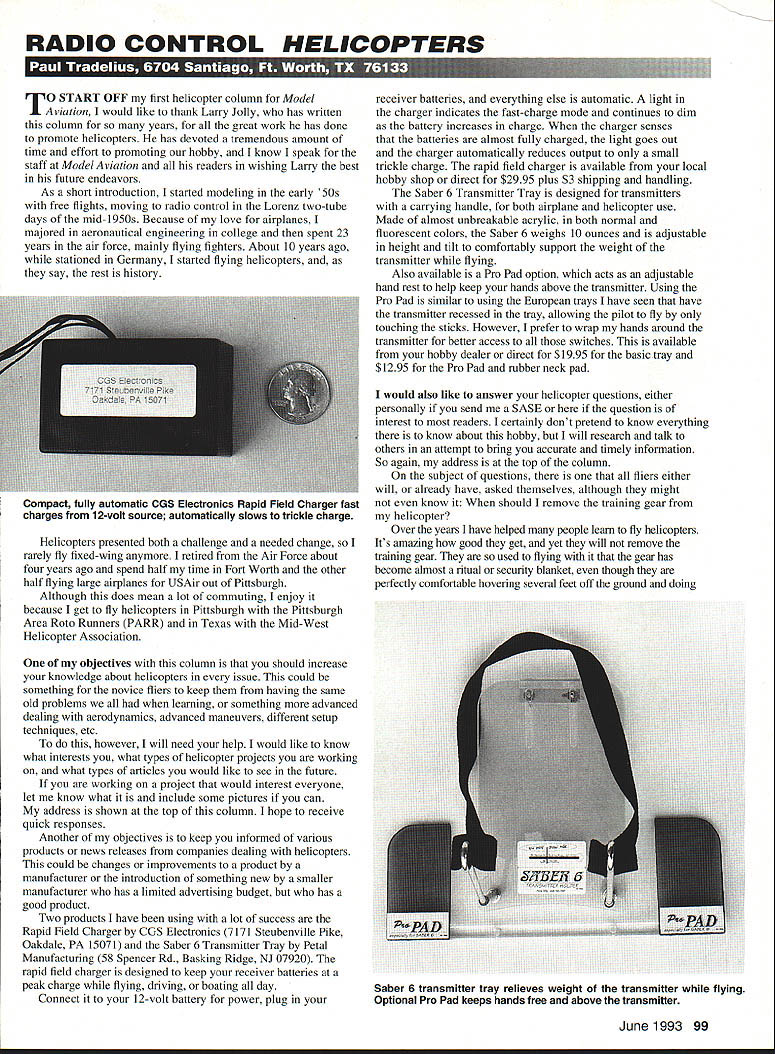
- Rapid Field Charger — CGS Electronics
- Manufacturer: CGS Electronics, 7171 Steubenville Pike, Oakdale, PA 15071.
- Purpose: Keeps your receiver batteries at peak charge while flying, driving, or boating all day.
- Operation: Connect to a 12-volt battery for power, plug in your receiver batteries, and everything else is automatic.
- Indicator: A light shows fast-charge mode and dims as the battery charges. When batteries are nearly full, the light goes out and the charger reduces output to a small trickle charge.
- Availability/price: Available from hobby shops or direct for $29.95 plus $3 shipping and handling.
- Saber 6 Transmitter Tray — Petal Manufacturing
- Manufacturer: Petal Manufacturing, 58 Spencer Rd., Basking Ridge, NJ 07920.
- Design: For transmitters with a carrying handle (airplane and helicopter use). Made of nearly unbreakable acrylic, available in normal and fluorescent colors.
- Specs: Weighs 10 ounces; adjustable in height and tilt to comfortably support the transmitter while flying.
- Pro Pad option: Acts as an adjustable hand rest to help keep your hands above the transmitter.
- Notes: The Pro Pad is similar in purpose to European trays that recess the transmitter, allowing the pilot to fly by touching only the sticks. I prefer to wrap my hands around the transmitter for better access to switches.
- Availability/price: Available from hobby dealers or direct. Basic tray $19.95; Pro Pad and rubber neck pad $12.95.
Questions and correspondence
I would like to answer your helicopter questions, either personally if you send me a SASE (self-addressed stamped envelope) or here in the column if the question would interest most readers. I don't pretend to know everything about this hobby, but I will research and consult others to bring accurate and timely information. Again, my address is at the top of the column.
When to remove training gear
One question all fliers eventually ask is: When should I remove the training gear from my helicopter?
Over the years I've helped many people learn to fly helicopters. It's amazing how good they get, yet many will not remove the training gear. They become so used to it that the gear becomes almost a ritual or security blanket, even though they are perfectly comfortable hovering several feet off the ground and doing figure-eight circuits. At that distance from the ground, the training gear doesn't offer meaningful protection.
Initially, training gear is used as a wide bumper to protect the helicopter from hitting the ground in less-than-controlled flight. But after a little practice you become comfortable with your ability to control the helicopter and can keep it relatively stable, landing and taking off without tipping over.
Once you can do this consistently, it's time to remove the training gear—or it will actually impede your learning process. Certainly no one wants to remove the gear and have an accident, but that chance must be taken sometime. The longer you keep the training gear on, the more psychologically dependent you become. Also, you may rely on the gear to determine the helicopter's attitude, making the transition to normal flying even harder.
So, if you are using training gear—or helping someone who is—ask whether the gear is really needed at the demonstrated level of flying proficiency.
Next issue / MIT project
Next issue I'll describe ways to hop up the Concept EP for maximum performance for a very interesting project I'm working on with the Massachusetts Institute of Technology (MIT). One objective is to get a computer to aggressively fly a helicopter without human input. That requires sensors to determine the helicopter's position and attitude and to send appropriate commands to the computer so it can fly and navigate to its destination.
Because large computers can't go to the flying field, the helicopter must go to the laboratory; therefore an electric helicopter is needed. To give the computer the best chance to control, maneuver, and recover the helicopter from unusual attitudes, the Concept EP must be as near the best performance possible—maximizing the Concept EP's performance has been my objective.
Ron Ossinski, also a PARR member, has been working with me on this project for several months. In the next issue we'll describe what we did, what the results are, and invite your suggestions for even better performance.
Transcribed from original scans by AI. Minor OCR errors may remain.

