
Radio Control: Helicopters
Paul Tradelius 6704 Santiago, Ft. Worth, TX 76133
Did you miss the interesting "Attack of the Killer Helicopter," which appeared in the April issue of MA in Gary Shaw's "Safety Comes First" column? If you did, I suggest you dig out the April issue and read it.
This does not mean that helicopters are more dangerous than airplanes or any other form of RC. Lessons can be learned that apply to our flying and will improve safety in general.
To recap the story, a person was flying a helicopter in the backyard when the helicopter went out of control. Whether it was an errant control input or some malfunction in the helicopter was not specified, but it really doesn't matter.
Helicopters can go out of control for any number of reasons. Even a good flier may experience occasional brain lock or input a bad command. The helicopter itself can just malfunction. The battery might go bad, the switch might fail, a servo might fail, or another unforeseen problem might occur. Never completely trust your helicopter, and always have a plan for the unexpected.
Going back to the story, once the helicopter went out of control, the pilot found himself pinned between his house and a line of trees with nowhere to go. The helicopter did hit him; luckily, he sustained only minor injuries.
One of the points of the article was not to fly near your house, but rather in an open field with more room to run if necessary.
Although I basically agree with this logic, you should plan to evade an uncontrollable helicopter no matter where you fly. I test many helicopters in my backyard, but I always make sure I have a place to retreat.
But there is more to safe flying than just having a place to run from an errant aircraft. Rather, you should constantly be aware of what you are doing and determining if there is a safer way. Let's take a look at a few examples.
- If your on/off switch is exposed, such as not being under the canopy, mount it so the on position is toward the rear of the helicopter. In some cases, people have reported modelers flying over tall grass or having minor tipovers, where the switch was pushed back to the off position after contact with the grass, a twig, or any other surface.
- After your helicopter batteries have been charged, give all your equipment a once‑over inspection to make sure everything is secure and in good working order. Some parts may need to be lubricated or adjusted. This is a good time to do it, rather than at the field when you are more likely to be thinking about flying.
- Don't fly by yourself. Although I agree that flying at a large field gives you more room to run, it's still important to have someone else around to summon help should an accident occur.
- If you have used a radio that has just been repaired and have doubts about its performance, give it a range check before flying. Most fliers perform a range check before the first flight of the day.
- When starting a helicopter always assume it is going to start at full throttle. The throttle stick may be idle, the idle-up switch may be on, a servo may be bad, linkage may come loose, or other problems may occur. To protect myself I position the helicopter with the fuel line going to the engine at the right front, and have a hand firmly on the rotor head so I can hold the head and try to bring the throttle under control. As a last-ditch backup, I can always pull the fuel line off.
- Carry the helicopter away from the pit area before running up the engine. Seems basic, and I should have mentioned it. I'd still rather hover-taxi and carry the helicopter a safe distance away.
- When using a two-stick radio (throttle on the left stick), carry the helicopter in your right hand and hold the radio in your left. Use your left thumb to hold the throttle stick at idle. I have had the throttle stick brush up against clothing or a neck strap, causing the engine to go to full power while carrying the helicopter. Now that really gets your attention.
- When hovering, stand well clear to the side of the helicopter. If the helicopter should malfunction, your first thought will be to give a control input. This may help, and your next thought is to make a bigger correction. After two or three attempted corrections, you may finally realize you don't have control and start to take evasive action — which means run. If you are standing too close to the helicopter you may not be able to get away in time.
These are just some safety techniques to use. I'm sure there are a lot of good ideas out there. Let me know if you have any; I can present them in a later article.
New products
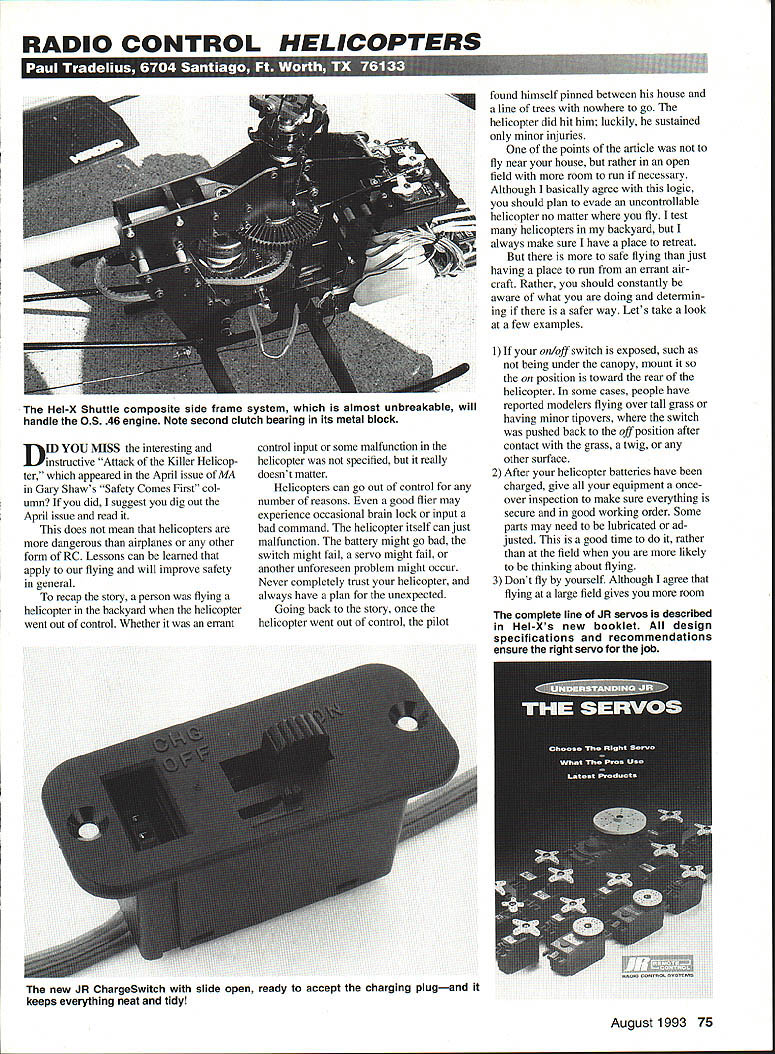
Hel-X Corp., 558 Highland Ave., Upper Montclair, NJ 07043; Tel: (201) 744-4962, has come out with a composite side frame system and a second clutch bearing for the popular Shuttle helicopter.
Although the side frames are not advertised as being unbreakable, they are made of a composite material that appears to be strong enough to withstand any crash I could imagine. I'm sure the composite side frames help to reduce vibration, but what I really like is that now the original main shaft bearings are in metal bearing blocks, rather than the original plastic side frames. This combination of composite side frames and metal bearing blocks will add a lot of life to the Shuttle.
If you would like to turn your Shuttle into a rocket, these side frames are designed to take the extra stresses of the O.S. .46 engine. Hel-X has a list of all the Hirobo parts needed to make this conversion.
The kit comes complete with the upper and lower side frames for each side, all the spacers, metal bearing blocks, metal tail boom mounting blocks, and additional hardware needed to convert your Shuttle. The only part that is required but not included is a Hirobo SE cabin lock, part #0402-262.
The instructions are also great — easy to read and understand, with plenty of diagrams.
Also from Hel-X is its second clutch bearing for the Shuttle. The original design has only one bearing, which is between the main gear pinion and the tail rotor drive pinion gear. This second clutch bearing mounts on top of the TR pinion gear to provide a stronger and more stable power takeoff from the clutch through each pinion gear.
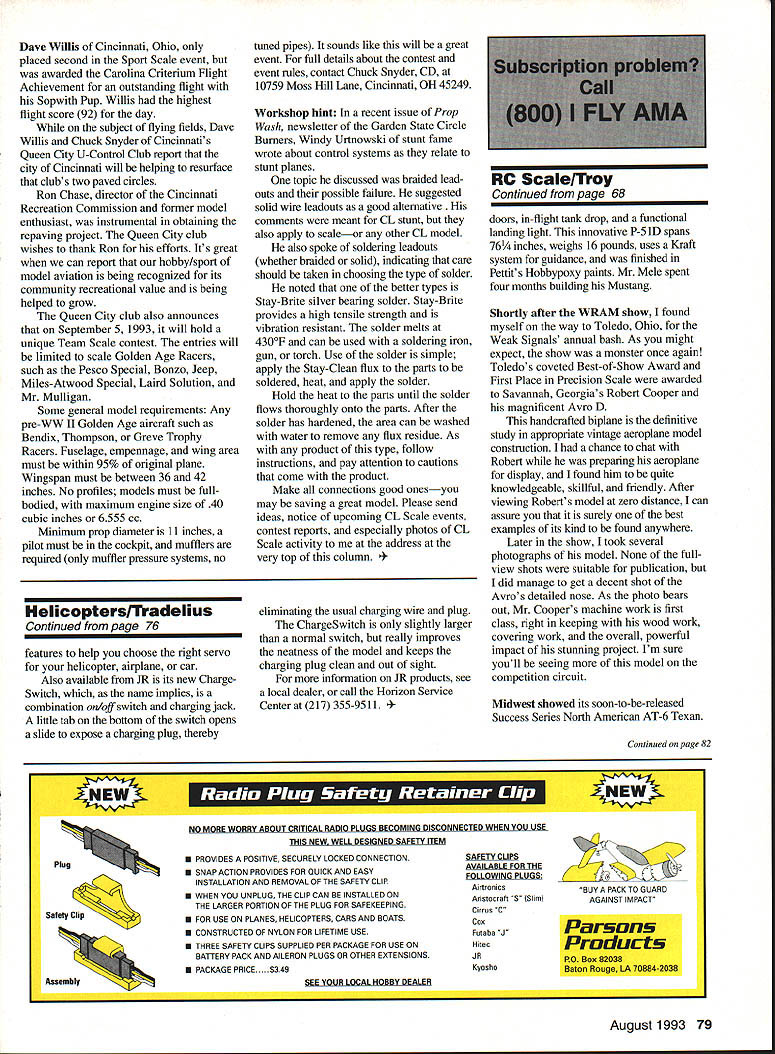
JR Radio has recently published a 28-page servo guide called Understanding JR: The Servos. We have all needed this for some time now.
If you ever wondered about surface-mount technology, cored or coreless motors, or the best servo for a given application, this booklet is for you. A complete description of each servo in the JR line is presented with specifications, pictures, and general design features to help you choose the right servo for your helicopter, airplane, or car.
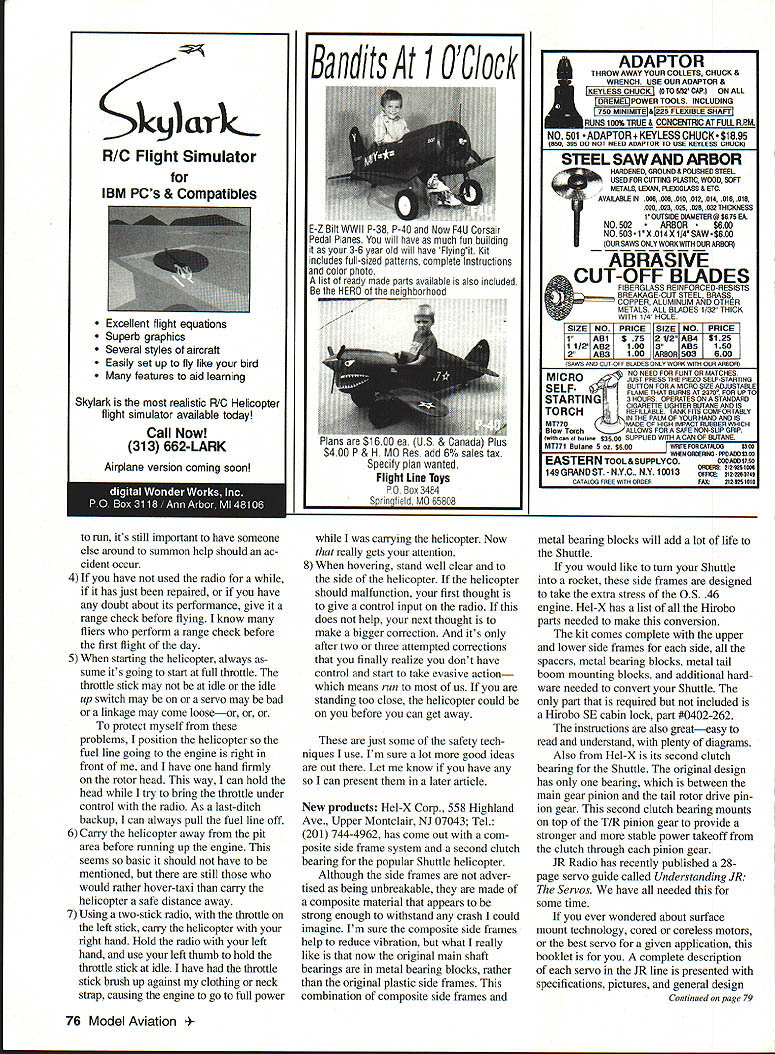
Also available from JR is its new ChargeSwitch, which, as the name implies, is a combination on/off switch and charging jack. A little tab on the bottom of the switch opens a slide to expose a charging plug, thereby eliminating the usual charging wire and plug. The ChargeSwitch is only slightly larger than a normal switch, but really improves the neatness of the model and keeps the charging plug clean and out of sight.
For more information on JR products, see a local dealer, or call the Horizon Service Center at (217) 355-9511.
Workshop hint
In a recent issue of Prop Wash, newsletter of the Garden State Circle Burners, Windy Untworski of stunt fame wrote about control systems as they relate to stunt planes.
One topic he discussed was braided leadouts and their possible failure. He suggested solid wire leadouts as a good alternative. His comments were meant for CL stunt, but they also apply to scale—or any other CL model.
He also spoke of soldering leadouts (whether braided or solid), indicating that care should be taken in choosing the type of solder. He noted that one of the better types is Stay-Brite silver-bearing solder. Stay-Brite provides a high tensile strength and is vibration resistant. The solder melts at 430°F and can be used with a soldering iron, gun, or torch. Use of the solder is simple; apply the Stay‑Clean flux to the parts to be soldered, heat, and apply the solder. Hold the heat to the parts until the solder flows thoroughly onto the parts. After the solder has hardened, the area can be washed with water to remove any flux residue. As with any product of this type, follow instructions, and pay attention to cautions that come with the product.
Make all connections good ones—you may be saving a great model. Please send ideas, notice of upcoming CL Scale events, contest reports, and especially photos of CL Scale activity to me at the address at the very top of this column.
Transcribed from original scans by AI. Minor OCR errors may remain.

