
Radio Control: Helicopters
Paul Tradelius 6704 Santiago, Ft. Worth, TX 76133
Pitch gauges
In the September issue of MA I talked about using a computer heli radio to set up a straight-line pitch curve once you have determined the high and low pitch end points. However, measuring these high and low end points requires the use of a pitch gauge.
If the helicopter is to fly as designed and to your personal desires, the pitch gauge—which enables you to set the pitch or angle of attack of the rotor blades to whatever position or range you desire—must be set correctly and within certain limits.
There are several pitch gauges on the market, and sometimes it's difficult to determine which is best. I recommend one that is both easy to use and gives repeatable results. Notice I did not say it has to be accurate. First, we have no way of knowing if any of the pitch gauges are accurate; we take a reading and assume the manufacturers made the gauge correctly.
Saying one gauge is more accurate than another depends largely on the manufacturing process, which we cannot evaluate. Plus, as we will see later, the accuracy of readings depends not only on the gauge but also on how level the flybar and swashplate are and how well we visually align everything.
There are two pitch gauges that are easy to use, give repeatable results, and are reasonably priced: one made by Miniature Aircraft and the other by Kalt. Both slip on the blade easily, are easy to align visually, and have large, easy-to-read numbers. Some other gauges are more complicated and require levels to hold the gauge in position; they are not very easy to use at the flying field, and their overall accuracy isn't any better.
Whatever pitch gauge you use, follow a few basic principles to get accurate, repeatable readings:
- Place the gauge on the rotor blade near the root rather than the tip, so it's easier to line up.
- Make sure the flybar and swashplate are level and parallel before taking any readings.
- Take readings with the helicopter on a level surface and minimize visual parallax when aligning the gauge.
Using the Kalt Cyclone II and the Kalt gauge
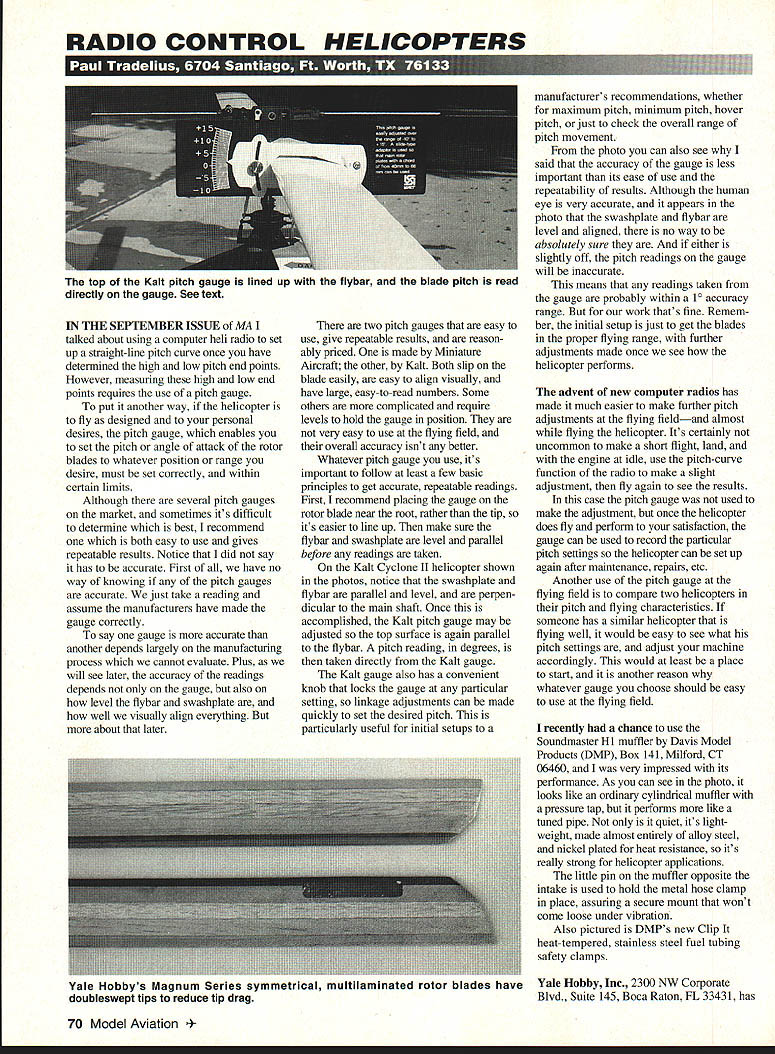
On the Kalt Cyclone II helicopter shown in the photos, the swashplate and flybar are parallel and level and are perpendicular to the main shaft. Once this is accomplished, the Kalt pitch gauge may be adjusted so the top surface is again parallel to the flybar. A pitch reading, in degrees, is then taken directly from the Kalt gauge.
The Kalt gauge also has a convenient knob that locks the gauge at any particular setting, so linkage adjustments can be made quickly to set the desired pitch. This is particularly useful for initial setups to a manufacturer's recommendations—whether for maximum pitch, minimum pitch, hover pitch—or just to check the overall range of pitch movement.
Accuracy and repeatability
From the photo you can see why I said that the accuracy of the gauge is less important than its ease of use and the repeatability of results. Although the human eye can be very accurate and it may appear the swashplate and flybar are level and aligned, there is no way to be absolutely sure. If either is slightly off, the pitch readings on the gauge will be inaccurate.
Any readings taken from the gauge are probably within a ±1° accuracy range. For our work that's fine. The initial setup is just to get the blades in the proper flying range; further adjustments are made once we see how the helicopter performs.
Using computer radios and field adjustments
The advent of new computer radios has made it much easier to make further pitch adjustments at the flying field—and almost while flying the helicopter. It's common to make a short flight, land, idle the engine, use the radio's pitch-curve function to make a slight adjustment, then fly again to see the results.
In that case the pitch gauge is not used to make the adjustment, but once the helicopter performs to your satisfaction the gauge can be used to record the particular pitch settings so the helicopter can be set up again after maintenance or repairs.
Comparing helicopters at the field
Another use of the pitch gauge at the flying field is to compare two helicopters in their pitch and flying characteristics. If someone has a similar helicopter that is flying well, you can check his pitch settings and adjust your machine accordingly. That gives you a good place to start and is another reason to choose a gauge that is easy to use at the flying field.
Equipment notes
I recently had a chance to use the Soundmaster H1 muffler by Davis Model Products (DMP), Box 141, Milford, CT 06460, and I was very impressed with its performance. It looks like an ordinary cylindrical muffler with a pressure tap but performs more like a tuned pipe. Not only is it quiet, it's lightweight, made almost entirely of alloy steel, and nickel plated for heat resistance—so it's strong for helicopter applications.
The little pin on the muffler opposite the intake holds the metal hose clamp in place, assuring a secure mount that won't come loose under vibration. Also pictured are DMP's new Clip II heat-tempered stainless steel fuel tubing safety clamps.
Yale Hobby, Inc., 2300 NW Corporate Blvd., Suite 145, Boca Raton, FL 33431, has released its new Magnum Series rotor blades: a symmetrical, multilaminated wood blade with double-swept tips to reduce tip drag. I have been using these on my Shuttle ZX. The blades come in three versions:
- Standard: you install the slots and weights.
- Pre-weighted: weights are installed but you still finish the blades.
- Finished: ready to bolt on and fly.
The photo shows a top and bottom view where I had just finished sanding the epoxy that holds the weights in position.
Rossi rear-exhaust adapter
I was recently flying with Dave Davison of Uniontown, Pennsylvania, when he was flying his X-Cell 60 with a rear-exhaust Rossi .60. I was curious how he was mounting the header to the engine, and he showed me a neat adapter he'd bought at this year's Toledo show. Unfortunately, he does not remember from whom.
This adapter clamps to the Rossi exhaust and is drilled and tapped to accept a standard rear exhaust header. If someone knows where I can get one, please let me know—I've got a Rossi on the shelf that could use it.
Blade recommendation for Shuttle/O.S. .46
I received a letter from Loyal Chamberlin of Snohomish, Washington, asking my recommendation on a set of rotor blades to use on his Shuttle/O.S. .46. Although I have not flown this combination, most 30-size blades are too small to handle all the power of the .46.
Since Century Helicopter Products has a .46 conversion for the Shuttle, I called them for advice. They recommended Horizon Hobby Distributors' NHP blades as a place to start. If anyone has a better suggestion, please let me know so I can pass it along.
Transcribed from original scans by AI. Minor OCR errors may remain.

