
RADIO CONTROL HELICOPTERS
Paul Tradelius 6704 Santiago, Ft. Worth, TX 76133
Acknowledgements
Thanks to the following people for their contributions to this report:
- Chris Miksovsky and Len Sabato (Horizon Hobby Distributors)
- Ted Schoonard (Miniature Aircraft)
- Robert Gorham (Futaba Corporation of America)
- Don Chapman (DC Design Corporation)
- Mark Powelson and Roger Cirelli (Robbe Model Sport)
Nats overview
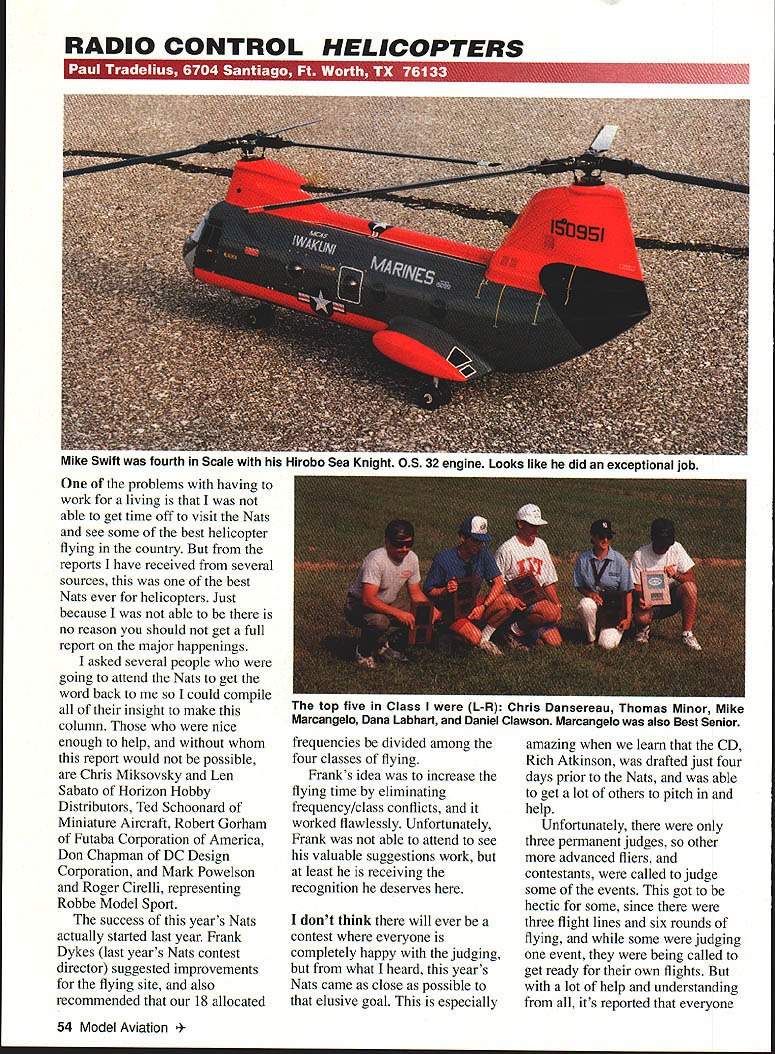
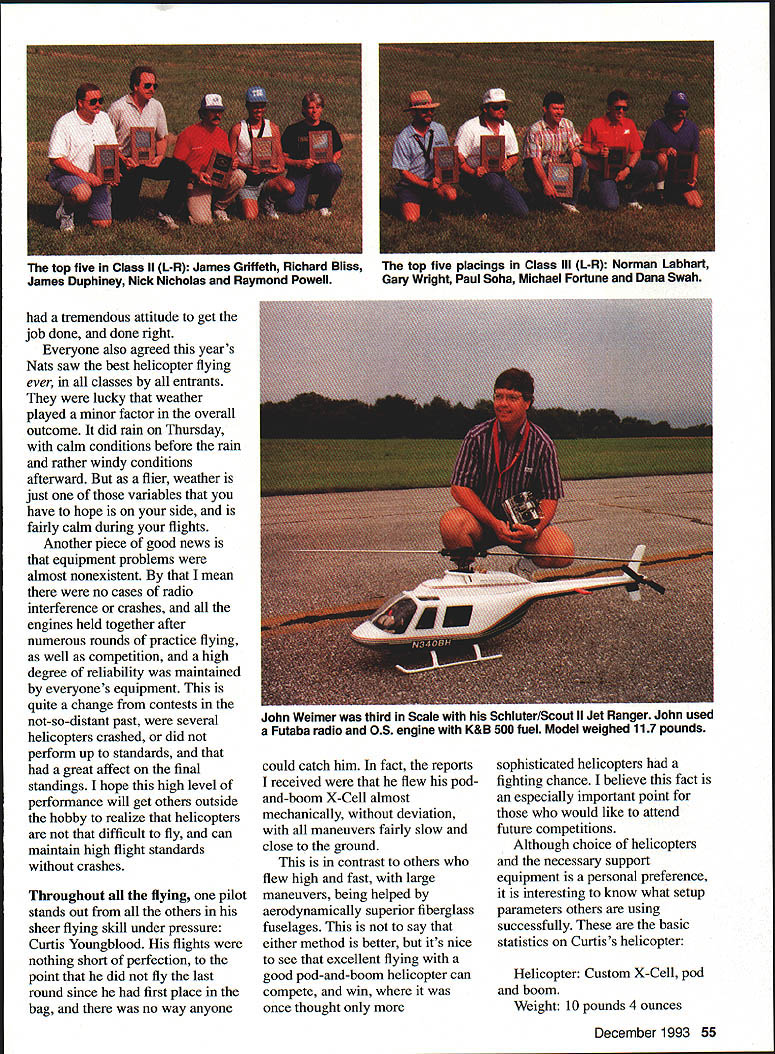
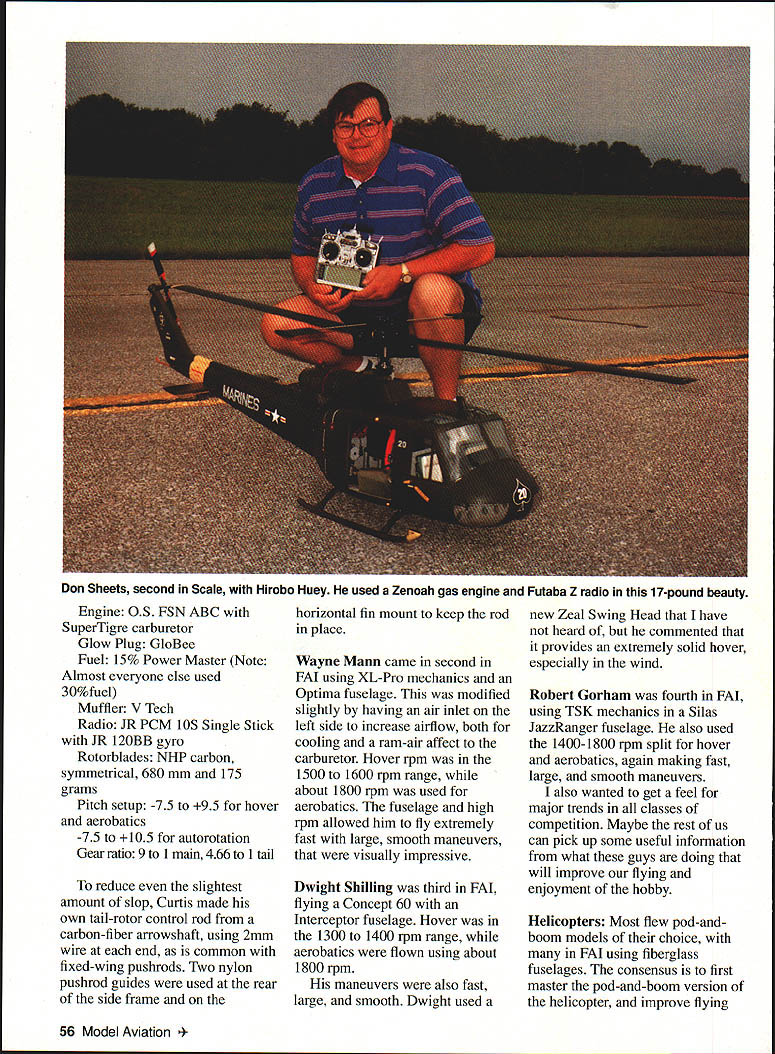
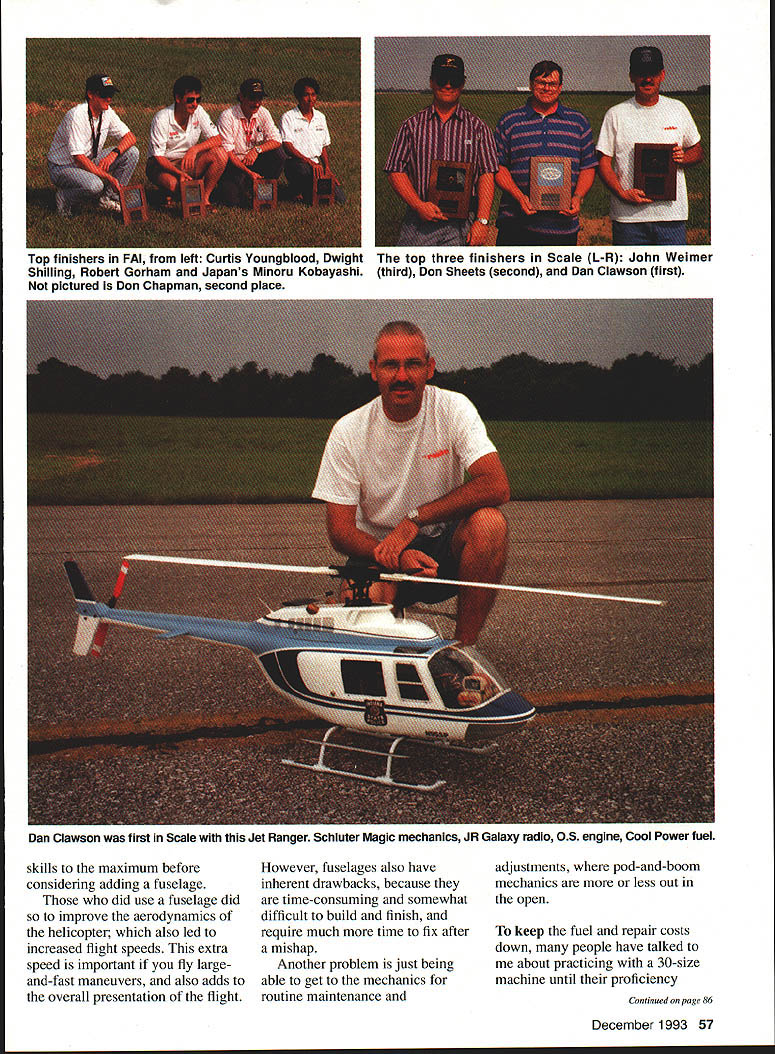
Although I was unable to attend the Nats in person, reports from several reliable sources indicate this was one of the best Nationals ever for helicopter competition. Improvements to the flying site and frequency allocation, solid organization despite last-minute changes, excellent judging cooperation, minimal equipment problems, and outstanding flying all contributed to a very successful event.
Organization and judging
- Last year's Nats contest director, Frank Dykes, suggested site improvements and recommended dividing the 18 allocated frequencies among the four classes. This eliminated many frequency/class conflicts and increased flying time.
- Rich Atkinson served as contest director (drafted four days before the event) and organized a strong volunteer effort.
- There were only three permanent judges, so advanced fliers and contestants were asked to judge events as needed. With three flight lines and six rounds, scheduling was hectic at times, but judges, pilots, and volunteers managed well.
Weather and equipment reliability
- Weather was a minor factor overall. It rained on Thursday; conditions were calm before the rain and rather windy afterward. As always, weather is a variable you hope favors you during your flights.
- Equipment problems were almost nonexistent: virtually no radio interference, few crashes, and engines held up through practice and competition rounds. This high level of reliability is a marked improvement over contests of a few years ago.
Standout pilot: Curtis Youngblood
Curtis Youngblood flew with remarkable consistency and skill under pressure. His flights were near-perfect; he secured first place before the final round and did not need to fly again. Notably, he flew a pod-and-boom X-Cell configuration very precisely—slow and close to the ground—demonstrating that pod-and-boom helicopters can still win against aerodynamically superior fiberglass-fuselage models.
Curtis's helicopter setup (basic statistics):
- Helicopter: Custom X-Cell pod-and-boom
- Weight: 10 lb 4 oz
- Engine: O.S. FSN ABC with SuperTigre carburetor
- Glow plug: GloBee
- Fuel: 15% Power Master (note: almost everyone else used 30%)
- Muffler: V Tech
- Radio: JR PCM 10S single-stick with JR 120BB gyro
- Rotor blades: NHP carbon, symmetrical, 680 mm, 175 g
- Pitch setup:
- Hover and aerobatics: -7.5° to +9.5°
- Autorotation: -7.5° to +10.5°
- Gear ratio:
- Main: 9:1
- Tail: 4.66:1
Tail-rotor control modification:
- Curtis made his own tail-rotor control rod from a carbon-fiber arrow shaft, using 2 mm wire fittings at each end (a common fixed-wing pushrod technique).
- Two nylon pushrod guides were installed—one at the rear of the side frame and one on the horizontal fin mount—to keep the rod in place and eliminate slop.
Other top FAI finishers
- Wayne Mann — 2nd in FAI
- Mechanics: XL-Pro
- Fuselage: Optima (modified with a left-side air inlet to increase cooling and provide a ram-air effect to the carburetor)
- RPM: hover 1500–1600, aerobatics ~1800
- Style: extremely fast, large, smooth maneuvers aided by fuselage and high RPM
- Dwight Shilling — 3rd in FAI
- Helicopter: Concept 60 with Interceptor fuselage
- RPM: hover 1300–1400, aerobatics ~1800
- Notable: used a new Zeal Swing Head for a very solid hover, especially in wind
- Robert Gorham — 4th in FAI
- Mechanics: TSK
- Fuselage: Silas JazzRanger
- RPM: 1400–1800 split for hover and aerobatics
- Style: fast, large, smooth maneuvers
Trends and observations
#### Helicopter choices
- Most competitors flew pod-and-boom models; many in FAI used fiberglass fuselages.
- Consensus: master pod-and-boom flying first to develop skills before adding a fuselage.
- Fuselages improve aerodynamics and top speed (helpful for large, fast maneuvers and presentation), but:
- They are time-consuming and difficult to build and finish.
- They require more repair time after mishaps.
- Accessing mechanics for routine maintenance is harder than with pod-and-boom setups.
#### Practice and helicopter sizes
- Many pilots practice with smaller machines (e.g., .30-size) before moving to a .60-size helicopter for competition.
- Smaller helicopters do not perfectly mimic the flight characteristics of larger ones; adjust helicopter or radio settings on the small machine to better simulate the full-size behavior to reduce the transition gap.
#### Accessories and add-ons
- Common add-ons: speed controllers for RPM stabilization, in-flight mixture controls, neck straps, and radio trays.
- More pilots are using trays to take transmitter weight off their fingers, allowing greater stick precision.
- Recommendation: focus on getting the helicopter mechanically well set up before relying on add-on equipment to “fix” flying problems.
#### Engines and fuel
- Most competitors used O.S. engines (FSN and SX were popular).
- Debate exists over ringed vs. ABC engines; carburetor consistency remains a concern, particularly when using different RPM settings for hover and aerobatics.
- The new SX carburetor showed promise but still had issues; modifications were in development.
- Fuel: most pilots used 30% fuel with Enya #3 or O.S. #8 glow plugs for cooler running; Curtis Youngblood was an exception using 15% Power Master.
#### Rotor blades
- Composite (glass or composite) blades are common because they:
- Offer better aerodynamic quality
- Are available in various airfoils
- Come weighted and balanced from the factory, requiring little or no truing
- Are more expensive than some alternatives
- Miniature Aircraft pilots used XL Super blades successfully.
#### Radio equipment and setup
- Futaba radios were common; Curtis used a modified JR single-stick to great effect.
- Many pilots now use computer radios, but some rely too heavily on computer corrections instead of ensuring sound basic mechanical setups.
- Experienced fliers like Robert Gorham still spend time helping others with radio setup.
#### Training aids: simulators and video
- Two major contributors to improved flying skills:
- Computer flight simulators: allow pilots to practice maneuvers without risk or repair costs, accelerating learning.
- Video cameras: enable pilots to review and critique their flying objectively; the camera reveals mistakes you might not notice in real time.
Closing
I hope this report gives you a useful summary of this year’s Nats and inspires you to improve your flying and try competition. Thanks again to everyone who contributed information, and congratulations to all the fliers for making this one of the best Nationals ever. I look forward to seeing you next year.
Transcribed from original scans by AI. Minor OCR errors may remain.

