
Radio Control: Helicopters
Paul Tradelius, 6704 Santiago, Ft. Worth, TX 76133
FOR THE PAST several months I have had the pleasure of flying the new Airtronics Infinity 660 Series radio, and am impressed not only with its improved capabilities but also with the obvious thought and effort that went into its design. This radio neither looks nor feels like anything we have seen before. The layout is easy to use and understand, requiring minimal instruction-manual reading.
Because this radio presents such a volume of capabilities, it is impossible to adequately describe all its features in just one article. What I will do is describe the Infinity 660's main features, and use it to support future articles.
The Infinity 660 is a six-channel radio, available in either FM or PCM modulation, with individual computer programs to optimize flying helicopters, airplanes, or sailplanes. The 660 is also capable of storing information on up to four models, so several helicopters can be flown with the same transmitter by simply purchasing additional airborne packs.
It is available in several configurations: with standard servos and battery; with ball-bearing contest servos and a large 1,000 mAh battery; or with the Airtronics SGX gyro with integral servo.
The airborne pack is fairly standard for top-of-the-line equipment. Although an electronics expert could give more technical information on the receiver, it is sufficient to say that the receiver is state-of-the-art, small, lightweight, and reliable.
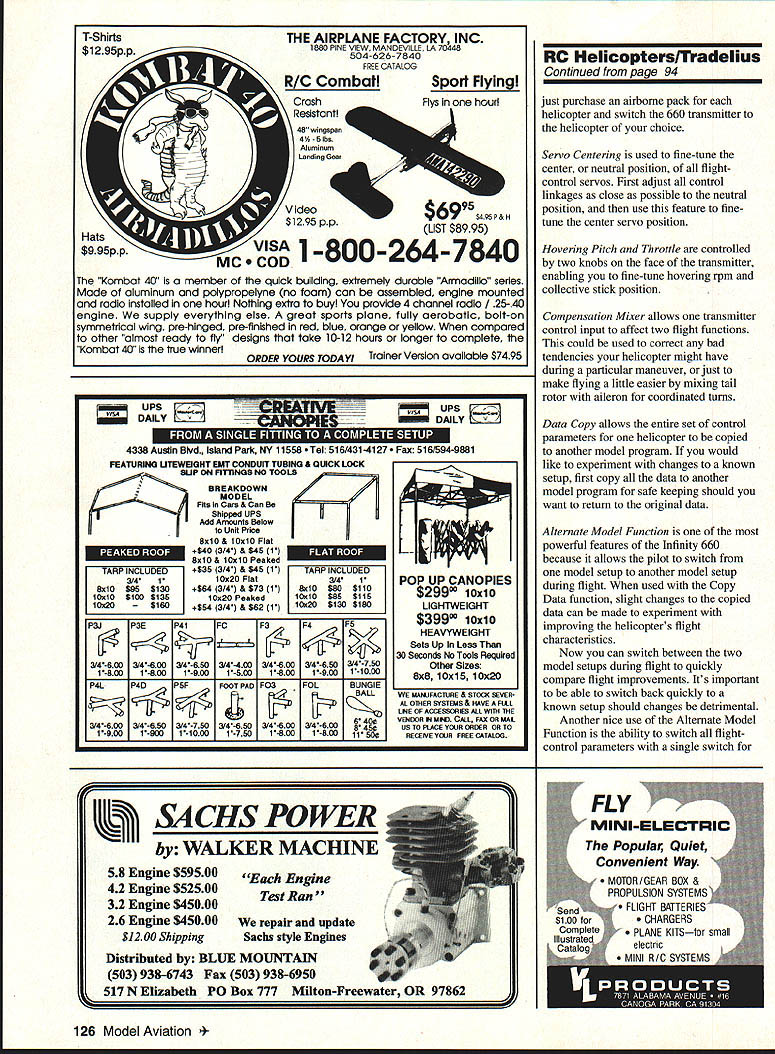
My radio came with five Airtronics 94735 servos, which are ball-bearing, coreless-motor, contest-type servos. No torque or speed specifications were presented, but they are as fast and powerful as any servo I have used. The battery is a large 1,000 mAh pack with an appropriate charger for both transmitter and receiver; together with a standard on/off switch, this combination represents an excellent airborne system for virtually any helicopter.
As with almost any modern-day radio, the uniqueness of this system is in the transmitter. One glance shows how modern and completely redesigned this radio is from anything Airtronics has previously presented. The Infinity 660 may initially seem complicated and even overwhelming in its capabilities, but it is actually very user friendly and easy to program. All the 660's capabilities and options are clearly explained in one of the best-written instruction manuals I have seen.
Not only is enough information presented to understand the functions of the radio, but guidance on how these individual functions may be used in your helicopter is also clearly explained. Individual setup sheets are provided, so once you get the radio programmed you have a permanent record of the setup.
Now let's take a detailed look at some exciting features of the radio.
New Molded Plastic Transmitter
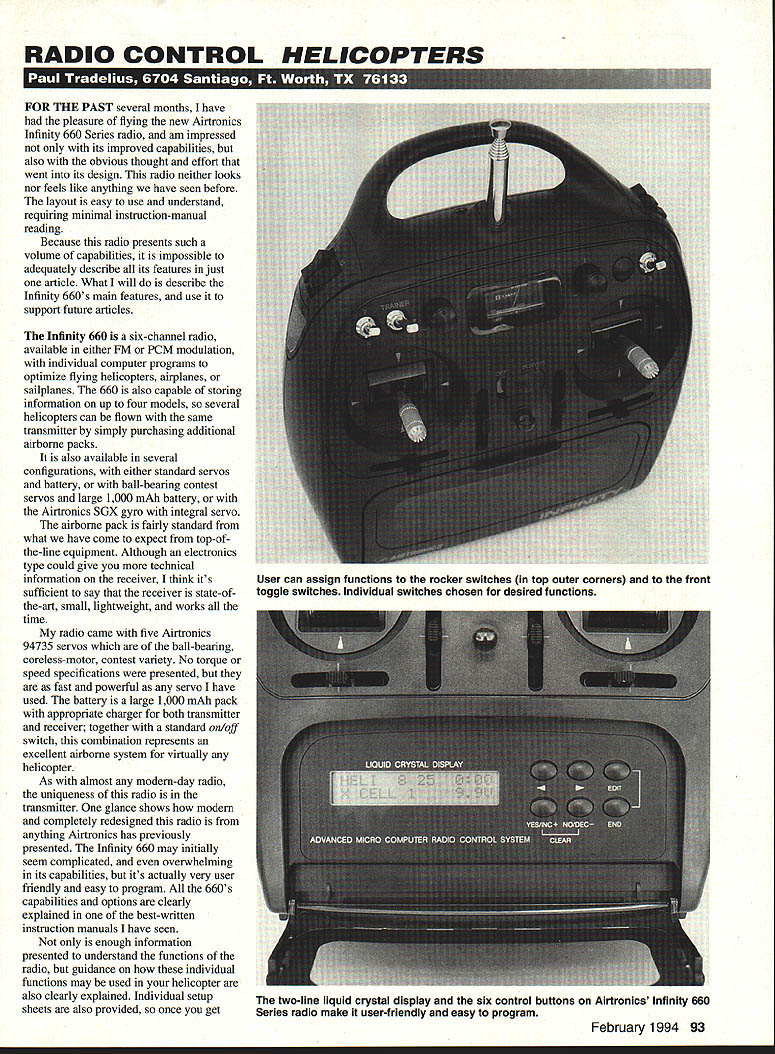
The first feature you will notice about the Infinity 660 transmitter is its unique molded plastic design, which keeps needed switches within easy reach and provides a comfortable feel. Standard toggle switches on the top of the transmitter have been replaced by rocker switches. At first they took a little getting used to, but with a little practice the rocker switches have a comfortable feel. If you prefer standard toggle switches, the left-front transmitter panel can be changed to accept them.
Assignable Switches
An especially nice feature is that individual switch functions—whether rocker or toggle—can be designated by the user. This means you can use whichever switch you want for idle-up, throttle hold, etc. This is a departure from other radios where the manufacturer has determined individual switch functions.
Computer Controls
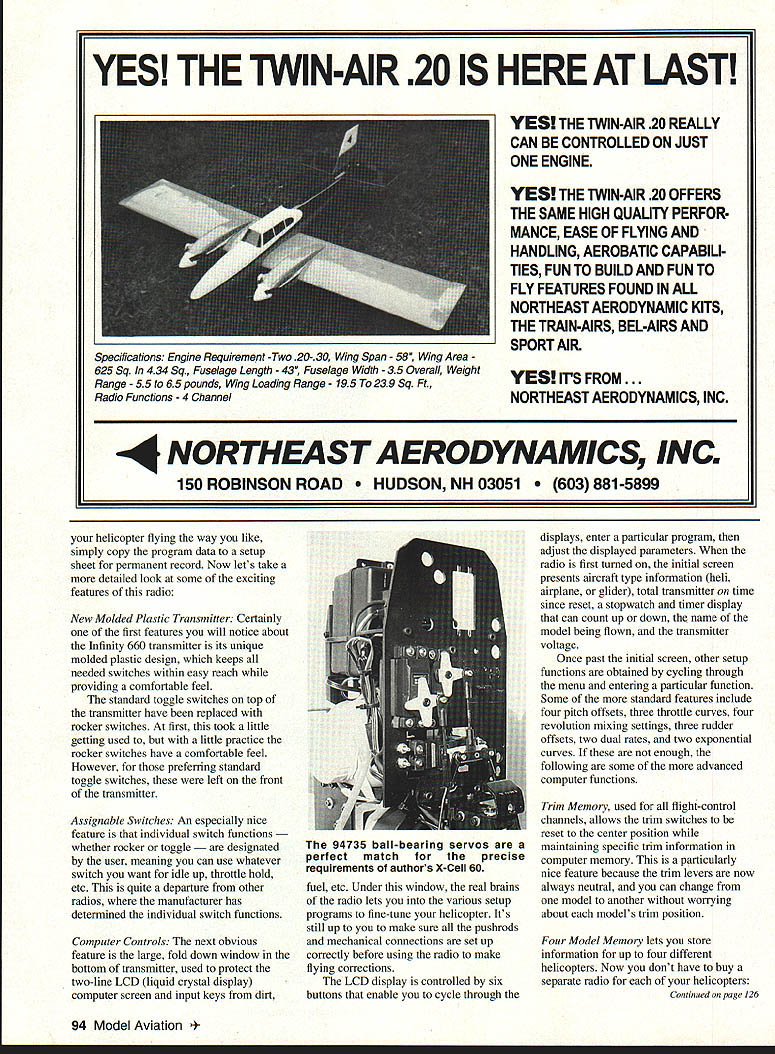
A large fold-down window on the bottom of the transmitter protects the two-line liquid crystal display (LCD) and input keys. Under the window are the real brains of the radio, which let you use various setup programs to fine-tune the helicopter. It's still up to you to make sure pushrods and mechanical connections are set up correctly before using the radio to make flying corrections.
The LCD display is controlled by six buttons that enable you to cycle through displays, enter a program, and adjust displayed parameters. When the radio is first turned on, the initial screen presents:
- aircraft type information (heli, airplane, glider)
- total transmitter time since reset
- a stopwatch/timer display that can count up or down
- the name of the model being flown
- transmitter voltage
Other setup functions are obtained by cycling through the menu and entering particular functions. Some of the more standard features include:
- four pitch offsets
- three throttle curves
- four revolution-mixing settings
- three rudder offsets
- two dual rates
- two exponential curves
If these are not enough, the following are some of the more advanced computer functions.
Trim Memory
Trim Memory, used for all flight-control channels, allows the trim switches to be reset to the center position while maintaining specific trim information in computer memory. This is a particularly nice feature because the trim levers are always neutral, and you can change from one model to another without worrying about each model's trim position.
Four Model Memory
Four Model Memory lets you store information for up to four different helicopters. You don't have to buy a separate radio for each helicopter—just purchase an airborne pack for each helicopter and switch the 660 transmitter to the helicopter of your choice.
Servo Centering
Servo Centering is used to fine-tune the center, or neutral, position of all flight-control servos. First adjust all control linkages as close as possible to neutral, and then use this feature to fine-tune the servo center positions.
Hovering Pitch and Throttle
Hovering Pitch and Throttle are controlled by two knobs on the face of the transmitter, enabling you to fine-tune hovering RPM and collective-stick position.
Compensation Mixer
The Compensation Mixer allows one transmitter control input to affect two flight functions. This can be used to correct bad tendencies your helicopter might have during a particular maneuver, or simply to make flying easier—for example, mixing tail rotor with aileron for coordinated turns.
Data Copy
Data Copy allows the entire set of control parameters for one helicopter to be copied to another model program. If you want to experiment with changes to a known setup, first copy all the data to another model program for safekeeping should you want to return to the original setup.
Alternate Model Function
Alternate Model Function is one of the most powerful features of the Infinity 660 because it allows the pilot to switch from one model setup to another model setup during flight. When used with the Data Copy function, slight changes can be made to the copied data to experiment with improving flight characteristics. You can switch between the two model setups during flight to quickly compare changes, and switch back quickly to a known setup should a change be detrimental.
In all my test flying of the Infinity 660, the only negative I can think of concerns the instruction manual. Although detailed and well written, many of the early manuals had pages falling out after only moderate use. A newer binding has already been developed to solve this problem and is being shipped with current radios. If you have one of the older instruction manuals, it's easy to use a three-hole punch and put everything in a three-ring notebook.
As you can see from this report, the Airtronics Infinity 660 radio presents a tremendous number of features to make flying easier and more precise. Additional information on the Infinity 660 will be presented in future columns as this radio is used to support in-depth helicopter setup and flying subjects.
For more information on the Airtronics Infinity 660 Series radio, contact your local hobby shop, or write Airtronics Inc., 11 Autry, Irvine, CA 92718.
Transcribed from original scans by AI. Minor OCR errors may remain.

