
RADIO CONTROL HELICOPTERS
Paul Tradelius, 6704 Santiago, Ft. Worth, TX 76133
One of the nice things about being a helicopter enthusiast—and the main reason I continue to write this column—is the help given to and received from others in our hobby.
I've been in modeling for more years than I care to admit, and into helicopters for the past 12 years or so, and have never come close to knowing it all. It seems there is always someone out there who has a little different way of doing something, or a neat new idea. It's always a pleasure to hear from such a person so I can pass that information along to you.
A Helicopter with Wings
One such idea came recently in a letter from Michael Homic of Austin, Texas. It seems Michael has been in the hovering process for more than two years but he did not feel comfortable progressing into forward flight without having help.
Michael's hovering was advanced:
"I could do figure eights 50 feet in front of me all day long, and even stand in the center of a circle and fly the helicopter around me in 100- to 150-foot circles from near hover to high speed; yet I could not break that last barrier. In fact, my hovering and swooping skills were getting advanced to the point where most pilots didn't realize I couldn't perform forward flight."
Mike was now at the crossroads every helicopter flier has either faced (or will face in the near future): when to make the transition from hovering to forward flight, and how to maximize success while minimizing the chance of hurting your much-loved helicopter.
I have actually seen many fliers in Mike's position, still with their training gear firmly attached to the helicopter. Training gear may help you keep oriented to the helicopter as it gets further away, but I believe training gear is mainly a security blanket that is to be discarded.
After giving this a lot of thought, Mike came up with a middle-of-the-road solution that replaces the training gear with something else to keep the flier oriented to the helicopter.
Michael's idea was to replace the training gear with a six-foot aluminum flag pole—the kind that comes in those $5.99 flag kits. It's easy to transport because it comes in two sections.
Michael painted it white with one red and one blue tip for orientation. He mounted this to the skids with rubber bands—with the red tip to the right—creating a highly visible "wing" that prevents disorientation as he practices forward flight. Michael states:
"My first flight with it was just like I'd returned to my old, trusty high-wing trainer airplane. On the third flight, I was making inside turns before I even realized what I was doing.
"My flying buddies were completely dumbfounded. One week I'm off hovering in the corner, and the next I'm standing in the normal pilot's position flying the standard aircraft traffic pattern. As my proficiency and comfort level increases, I plan to gradually shorten the 'wing' until it ceases to exist."
This sounds like a great idea, especially for those of you who have flown airplanes. If you decide to give Mike's idea a try, please let me know how it works for you, and if you have any ideas to make it even better.
The "Bull's Eye" Rotor Disk
Another technique for staying oriented to the helicopter, and increasing its visibility in distant flight, is to turn the top portion of the rotor disk into a bull's eye.
On .60-size helicopters with white blades, I cut black covering material (MonoKote, etc.) into three-inch strips. I put a piece on each blade tip—leaving three inches of regular white blade—and add another three-inch black strip. Just attach the black strips to the top of the blade by trimming along the trailing edge and wrapping about 1/8 inch around the leading edge to keep the air from picking it up. This produces a black-and-white bull's eye on top of the rotor disk that is easy to see—the normally harder-to-see plain white rotor disk on the bottom. Now when I see the bull's eye in flight, I know the rotor disk is tilted toward the visible distance I care to fly.
Focus Heli 5E Radio
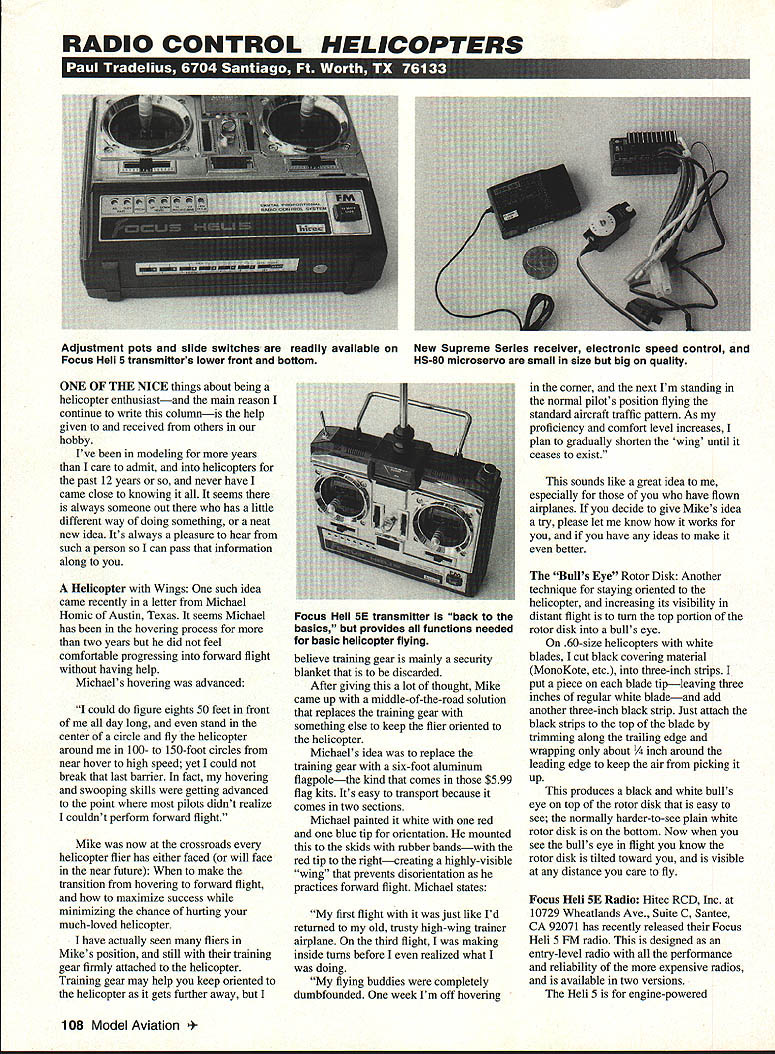
Hitec RCD, Inc., 10729 Wheatlands Ave., Suite C, Santee, CA 92071, has recently released their Focus Heli 5 FM radio. This is designed as an entry-level radio with all the performance and reliability of the more expensive radios, and is available in two versions. The Heli 5 is for engine-powered helicopters. The Heli 5E is sold specifically for use with electric helicopters. Being an entry-level radio at a modest price, the Focus Heli 5E does not intimidate the user with a lot of switches and knobs, yet provides all functions needed for basic helicopter flying.
I was actually impressed to see so many helicopter features incorporated in the Heli 5E radio. These include:
- Up-and-down revolution mixing
- Pitch high and low end-point adjustments
- Hovering pitch and throttle adjustments
- Aileron and elevator servo throw adjustments
- Ability to adjust stick length and tension to suit your particular feel
For those of us who enjoy flying electric helicopters—especially now, as we wait for the spring thaw—the airborne package also has a lot of nice features. Included are:
- Hitec’s new RCD 3000 Supreme Series receiver: a dual-conversion, eight-channel receiver that is smaller than their seven-channel Platinum receivers, with higher adjacent-channel rejection, greater sensitivity, and less susceptibility to vibration
- HS-80 microservos: among the smallest and fastest servos available, with a respectable 32-inch-ounce torque rating (a metal-gear version, the HS-80MG, is available for added gear strength)
- SP-1803 H speed control: intended for either helicopters or airplanes; it's the most compact variable-speed controller I have seen
- Proper adapter plugs to connect to the helicopter’s 6- to 9.6-volt battery pack, the electric motor, and the receiver
- An on/off switch and a start button to prevent accidental activation of the motor
Although the Focus Heli 5 is an entry-level, moderately priced radio system, it gives the same solid performance as many higher-priced radios, only without all the bells and whistles. This may actually be a big plus for many fliers, especially those flying electrics, because you are only paying for what you need. Because of the more limited performance of electric helicopters, this radio provides all the basic control needed, without wasting money on advanced electronic and mixing circuits that would not be used anyway.
So those of you who would like to try electric helicopters, or are just looking for an entry-level radio that is small on complexity but large on basic performance, this is certainly one to consider.
Transcribed from original scans by AI. Minor OCR errors may remain.

