
RADIO CONTROL HELICOPTERS
Paul Tradelius, 6704 Santiago, Ft. Worth, TX 76133
New magazine: Model Helicopter Technique
A new helicopter publication called Model Helicopter Technique (4926 Verdura Ave., Lakewood, CA 90712-3018) has recently hit the streets and is being published by Ray Hostetler. To give us the most helicopter information for Ray's publishing dollar, this quarterly publication is printed on black-and-white stock paper and is bound with staples.
I'm really impressed with the attitude of the magazine—cutting down on the frills and beefing up the informative and interesting articles helps all classes of fliers. I hope you all give this publication your support, because we are the ones who will benefit in the long run.
One of the MHT articles is a pilot profile: Curtis Youngblood responds to Ray's questions. Although I have never met Curtis or even seen him fly (except in videos), I'm impressed with his basically stock X-Cell and his down-to-earth attitude of relying on the basic helicopter.
Curtis Youngblood and the Delta offset
When asked if he used a Delta offset in the rotor head, he said no because, contrary to all the claims, he never saw it do what it was supposed to do. This was refreshing to read, because I know many who feel they need the latest trick item available to improve their flying. I also believe the Delta offset in our rotor system offers no added flight improvement—let's take a closer look to see why.
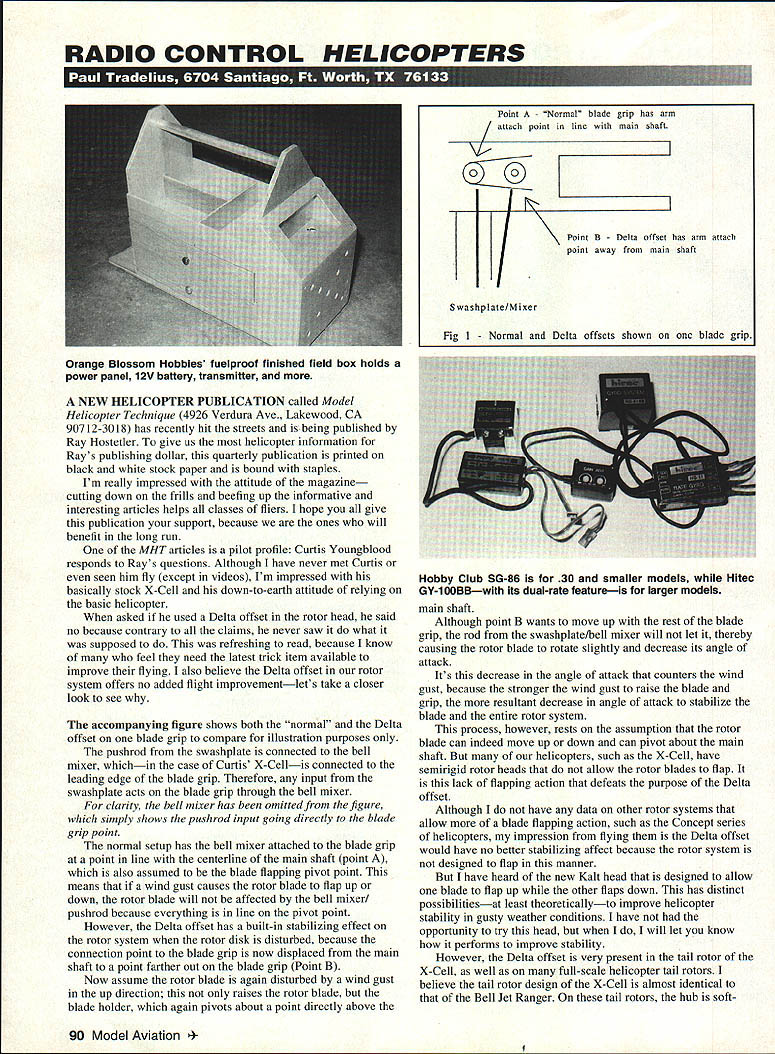
The accompanying figure (not shown) compares both the "normal" and the Delta offset on one blade grip for illustration purposes only.
The pushrod from the swashplate is connected to the bell mixer which—in the case of Curtis' X-Cell—is connected to the leading edge of the blade grip. Therefore, any input from the swashplate acts on the blade grip through the bell mixer.
For clarity, the bell mixer has been omitted from the figure, which simply shows the pushrod input going directly to the blade grip point.
The normal setup has the bell mixer attached to the blade grip at a point in line with the centerline of the main shaft (point A), which is also assumed to be the blade flapping pivot point. This means that if a wind gust causes the rotor blade to flap up or down, the rotor blade will not be affected by the bell mixer/pushrod because everything is in line on the pivot point.
However, the Delta offset has a built-in stabilizing effect on the rotor system when the rotor disk is disturbed, because the connection point to the blade grip is now displaced from the main shaft to a point farther out on the blade grip (point B).
Now assume the rotor blade is again disturbed by a wind gust in the up direction; this not only raises the rotor blade, but the blade holder, which again pivots about a point directly above the main shaft.
Although point B wants to move up with the rest of the blade grip, the rod from the swashplate/bell mixer will not let it, thereby causing the rotor blade to rotate slightly and decrease its angle of attack.
It's this decrease in the angle of attack that counters the wind gust, because the stronger the wind gust to raise the blade and the grip, the more resultant decrease in angle of attack to stabilize the blade and the entire rotor system.
This process, however, rests on the assumption that the rotor blade can indeed move up or down and can pivot about the main shaft. Many of our helicopters, such as the X-Cell, have semirigid rotor heads that do not allow the rotor blades to flap. It is this lack of flapping action that defeats the purpose of the Delta offset.
Although I do not have any data on other rotor systems that allow more of a blade flapping action, such as the Concept series of helicopters, my impression from flying them is the Delta offset would have no better stabilizing effect because the rotor system is not designed to flap in this manner.
I have heard of the new Kalt head that is designed to allow one blade to flap up while the other flaps down. This has distinct possibilities—at least theoretically—to improve helicopter stability in gusty weather conditions. I have not had the opportunity to try this head, but when I do, I will let you know how it performs to improve stability.
Delta offset on tail rotors
The Delta offset is very present in the tail rotor of the X-Cell, as well as on many full-scale helicopter tail rotors. I believe the tail rotor design of the X-Cell is almost identical to that of the Bell Jet Ranger. On these tail rotors, the hub is soft-mounted to the tail rotor shaft, thereby allowing it to flap, and the blade grip attach points are displaced away from the output shaft.
You can see the Delta stabilizing effect by viewing an X-Cell tail rotor from above, with the blades in the horizontal position. While looking at the left blade ball link, push the blade tip away from the tail boom. You will see both the tail rotor blade and the blade grip move away from the tail boom, but the pushrod holds the ball link stationary. This results in a slight decrease in angle of attack of the tail rotor blade. For the Delta offset principle to work on the main rotor, this same type of flapping action must be present.
S&S Heli Products
S&S Heli Products—806 W. Harrison Rd., Longview, TX 75608; Tel.: (903) 759-1706—is manufacturing quality CNC-machined accessories for our helicopters at prices that I consider very reasonable. I have had a chance to try several of their products, as shown in the photo. Unfortunately, the photo just does not do these items justice.
Available items I tried include:
- A machined rotor head, complete with bolt-on head button, for the X-Cell .60. It is highly polished aluminum and gives the helicopter a distinctive look.
- Machined Bell-Hiller mixers ready to accept the original bearings and extended balls.
- A gold-anodized T6 head button for X-Cells.
- An X-Cell flybar lock.
- A Magna-Pipe bracket for the X-Cell .50/.60.
These represent only a few of the items available from S&S, and they are coming up with new ideas and products all the time—send for an updated complete list.
Orange Blossom Hobbies
Orange Blossom Hobbies—1975 N.W. 36th St., Miami, FL 33142—is selling a complete, ready-to-use all-wood field box suitable for model helicopters, airplanes, or any type of RC activity.
It has plenty of room for a power panel on top of an enclosed and vented battery compartment, two large pull-out drawers, a transmitter shelf, and three large separated compartments below the strong metal handle. This is a very sturdy and well-built unit, made from finished plywood and coated with a clear fuel-proof finish that should last for many flying seasons. I am also using their new power panel and will report on it in a later column.
Hobby Club SG-86 Super Micro Gyro
Hobby Club—23141 Arroyo Vista #210, Rancho Santa Margarita, CA 92688—is selling their new SG-86 Super Micro Gyro for electric to .30-size helicopters. This is a two-piece unit with a gyro and electronics powered from your receiver power supply.
Features:
- Weighs only 64 grams.
- Fully ball-bearing supported.
- Chrome cover completely around the gyro to block radiated motor noise.
- Reverse switch and sensitivity adjustment pot.
- Easy hookup—only two connectors (one to the receiver and the other to the servo).
- Connectors supplied can be used with either JR or Futaba radios; Airtronics radios require a conversion connector.
Hitec RCD GY-100BB gyro
Hitec RCD, Inc.—10729 Wheatlands Ave., Suite C, Santee, CA 92071—is distributing their GY-100BB ball-bearing series gyro. Weighing 115 grams, it's powered by the receiver 4.8-volt battery with a 120 mA drain.
The three-piece unit has dual sensitivity settings that can be changed in flight using a spare channel. A reverse switch and two sensitivity adjustments make it very easy to set up, and double-sided tape is already applied to the gyro body.
The GY-100BB would be perfect for .30 and larger-size helicopters, with the dual rates being handy to switch between hovering and aerobatic settings.
Transcribed from original scans by AI. Minor OCR errors may remain.

