
Radio Control: Helicopters
Paul Tradelius 6704 Santiago, Ft. Worth, TX 76133
Introduction
One of the most frustrating aspects of our hobby is getting the vibration out of our helicopters. Although some causes of vibration are hard to find, there is always a definite engineering cause. All you have to do is play Dick Tracy and find the part of the helicopter that is causing the trouble. Then the cure is usually easy.
The first cure for vibration is to build your helicopter exactly according to the instructions, taking time with each step to ensure it is done right. Because some people can't wait to get their machines in the air, they rush through the building process. This is where many causes of vibration can be "built in."
Diagnosing vibration
Whether your helicopter is new or old, assume you just started it up, brought it into a hover, and noticed some degree of vibration. First, note the type of vibration: is it a relatively low-frequency vibration — the type that would come from the main rotor head? Or is it a faster vibration — the type that would come from the engine? Also note where the helicopter is vibrating: is there foam in the fuel tank, skids vibrating, the tail rotor jumping up and down, or something else?
Since you are at the flying field and would like to fix the problem rather than going home, here are a few things to check right away.
Quick field checks
- Although out-of-track blades are not a major source of vibration, they could be part of the problem. Make sure they are in track and adjust as necessary.
- If the tail is jumping up and down, check the tightness of the tail rotor blades. They will sometimes cause this type of vibration if they are too loose. They should be snug, but loose enough to move into proper position as the tail rotor comes up to speed.
- Sometimes a rich-running engine will cause the fuel to foam, or the tail to be twitchy — to move suddenly right and left. This is because a rich-running engine will run rough, or the engine speed itself will be slightly erratic, causing the tail rotor speed to change slightly, thereby moving the tail right and left.
- In either case, lean out the mixture slightly and see if that makes any improvement. However, be extremely cautious that the engine is not run too lean — that will cause it to overheat, resulting in permanent engine damage.
- If nothing has worked so far, the only thing left to do at the field is to make some slight changes to the balance of the head (both the rotor blades and the flybar). Adjust one thing at a time.
- Start with the main rotor blades: place a small piece of electrical tape once around either rotor blade at the CG. Since you don't know which blade is out of balance, pick one and assume it's the light blade. Bring the helicopter into a hover. Has the vibration decreased? If so, the blades were out of balance and you guessed correctly. Add or remove tape until the vibration is gone. If the vibration got worse, you picked the wrong blade — remove the tape, add a piece to the other blade, and repeat the process.
- If adding tape to a rotor blade doesn't eliminate the vibration, try a minor balance adjustment to the flybar. If your flybar has weights installed, move one weight about 1/4 inch. If the vibration got worse, move the weight back and move the other weight slightly. Hopefully some slight movement of the weights will bring the flybar into better balance. If your flybar does not have weights, install a small wheel collar on each half of the flybar while building it. It doesn't take much change in weight to bring the flybar into balance, and these wheel collars are more than enough weight.
If you still have the vibration blues, it's time to take the machine back to the workbench; not much more can be accomplished at the flying field.
High-frequency vibration and starter shaft alignment
If you think the problem is a high-frequency vibration — like that which would cause fuel to foam — the most probable cause is a misaligned starter shaft (if your helicopter has one). In this case, the engine and starter shaft combination will have to come out, and the starter shaft checked for proper alignment with a dial indicator. Get the runout as close to zero as possible. The generally accepted runout figure for maximum performance and vibration-free operation is .002 inches.
After all this work, and after rechecking the balance of the main and tail rotors, there is always the possibility that the cause of the vibration has not been found — and this is where the frustration can really set in.
Systematic disassembly as a last resort
As a last resort, start disassembling the helicopter at the field to find the source of the vibration. Disconnect one part of the helicopter at a time, run up the engine, and see if the vibration is gone. The last piece you removed will be the source.
Common sequence:
- Disconnect the tail rotor drive wire where it exits the main gear. With no tail rotor, the helicopter can't be brought into a hover, but the engine can be started to see if the vibration is gone.
- If the vibration is still there, remove the main rotor blades and check again.
- Next, remove the entire head and associated linkages and again try an engine run-up check.
Using this technique you will eventually get down to the engine and starter shaft, and somewhere along the line you should find the cause of the vibration.
Closing advice
This process may sound complicated and time-consuming, but it doesn't take much time. The real benefit is acquiring an appreciation for building the helicopter correctly the first time so it comes off the building board as close to being in balance as possible.
Make every effort to remove vibration; it does nothing but cause the helicopter to wear prematurely, fly poorly, and is one of the leading causes of radio failure.
Product notes
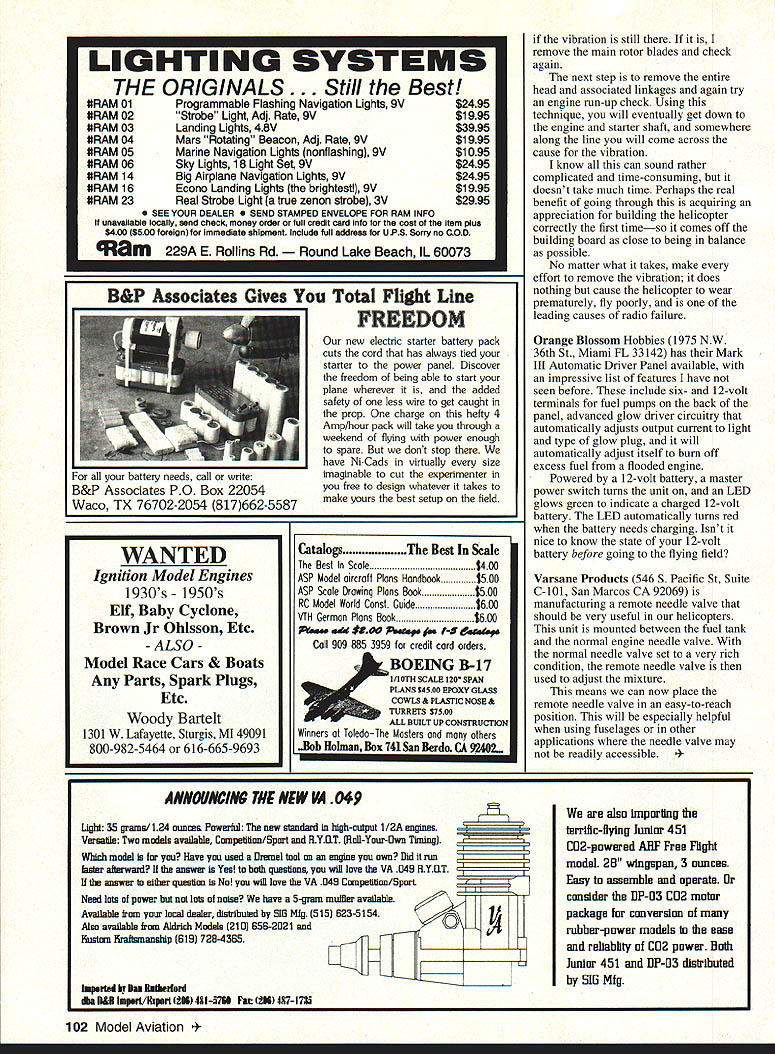
Orange Blossom Hobbies (1975 N.W. 36th St., Miami, FL 33142) has the Mark III Automatic Driver Panel available, with an impressive list of features. These include six- and 12-volt terminals for fuel pumps on the back of the panel, advanced glow driver circuitry that automatically adjusts output current to light any type of glow plug, and automatic adjustment to burn off excess fuel from a flooded engine.
Powered by a 12-volt battery, a master power switch turns the unit on, and an LED glows green to indicate a charged 12-volt battery. The LED automatically turns red when the battery needs charging — it's useful to know the state of your 12-volt battery before going to the flying field.
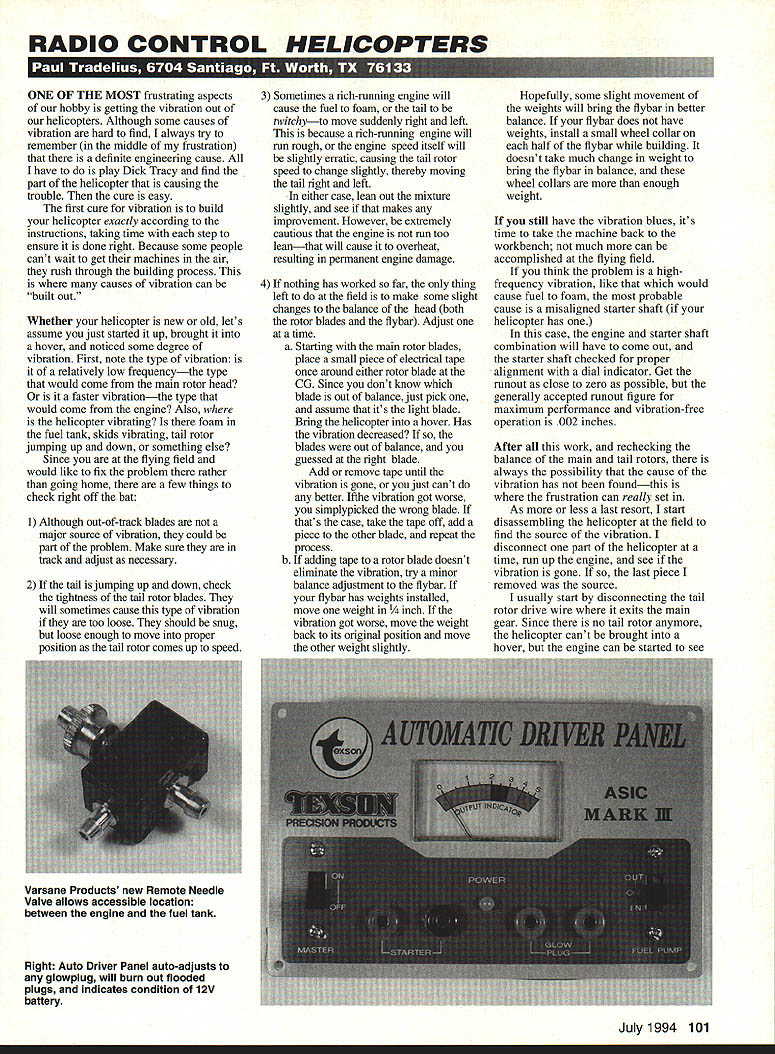
Varsane Products (546 S. Pacific St., Suite C-101, San Marcos, CA 92069) is manufacturing a remote needle valve that should be very useful in helicopters. This unit is mounted between the fuel tank and the normal engine needle valve. With the normal needle valve set to a very rich condition, the remote needle valve is then used to adjust the mixture.
This allows the remote needle valve to be placed in an easy-to-reach position, which is especially helpful when using fuselages or in other applications where the needle valve may not be readily accessible.
Transcribed from original scans by AI. Minor OCR errors may remain.

