

Helicopters
Walt Schoonard
AS I TOLD YOU in last month's column, the Super-Baby left a great deal to be desired in transitional flight but that the problems had been solved, so read on.
Takeoff Collective:
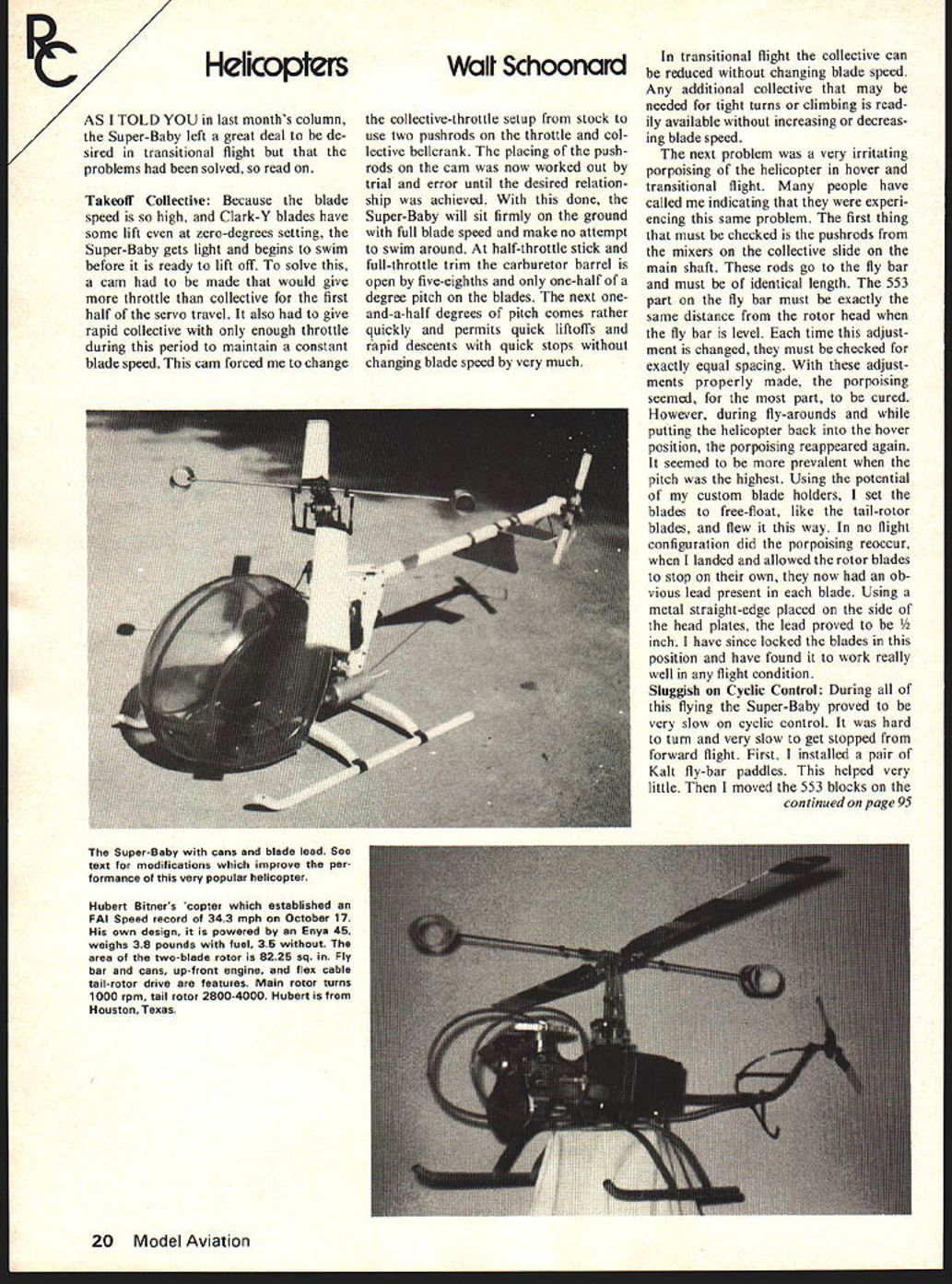
Because the blade speed is so high, and Clark-Y blades have some lift even at zero-degrees setting, the Super-Baby gets light and begins to swim before it is ready to lift off. To solve this, a cam had to be made that would give more throttle than collective for the first half of the servo travel. It also had to give rapid collective with only enough throttle during this period to maintain a constant blade speed. This cam forced me to change the collective-throttle setup from stock to use two pushrods on the throttle and collective bellcrank. The placing of the pushrods on the cam was now worked out by trial and error until the desired relationship was achieved. With this done, the Super-Baby will sit firmly on the ground with full blade speed and make no attempt to swim around. At half-throttle stick and full-throttle trim the carburetor barrel is open by five-eighths and only one-half of a degree pitch on the blades. The next one-and-a-half degrees of pitch comes rather quickly and permits quick liftoffs and rapid descents with quick stops without changing blade speed by very much.
In transitional flight the collective can be reduced without changing blade speed. Any additional collective that may be needed for tight turns or climbing is readily available without increasing or decreasing blade speed.
The next problem was a very irritating porpoising of the helicopter in hover and transitional flight. Many people have called me indicating that they were experiencing this same problem. The first thing that must be checked is the pushrods from the mixers on the collective slide on the main shaft. These rods go to the fly bar and must be of identical length. The 553 part on the fly bar must be exactly the same distance from the rotor head when the fly bar is level. Each time this adjustment is changed, they must be checked for exactly equal spacing. With these adjustments properly made, the porpoising seemed, for the most part, to be cured. However, during fly-arounds and while putting the helicopter back into the hover position, the porpoising reappeared again. It seemed to be more prevalent when the pitch was the highest. Using the potential of my custom blade holders, I set the blades to free-float, like the tail-rotor blades, and flew it this way. In no flight configuration did the porpoising reoccur. When I landed and allowed the rotor blades to stop on their own, they now had an obvious lead present in each blade. Using a metal straight-edge placed on the side of the head plates, the lead proved to be 1/2 inch. I have since locked the blades in this position and have found it to work really well in any flight condition.
Sluggish Cyclic Control:
During all of this flying the Super-Baby proved to be very slow on cyclic control. It was hard to turn and very slow to get stopped from forward flight. First, I installed a pair of Kalt fly-bar paddles. This helped very little. Then I moved the 553 blocks on the Then I moved the 553 blocks on the fly bar outward a quarter of an inch at a time. I had to lengthen the pushrods from the mixers each time an adjustment was made. If you don't do this, it will change the pitch setting to the rotor blades. All of this adjusting helped very little to quicken the cyclic control. The next thing was to remove the mixers from the collective slider, remove the balls from these and lay out hole spacing so that one additional #32 hole can be drilled between the two existing holes. Be sure that this is laid out so that the holes are in line and equally spaced. Re-install balls and nuts with blue Lock-Tite and place on slider block. After the pushrods were replaced and everything checked out, I flew again the Super-Baby, and it's a good thing that I have a dual rate on cyclic because now I had cyclic control to burn and had to move the 553 blocks back to a more normal setting. They are now set at one and a half inches from the rotor hub. The measurements are inside measurements with the balls facing inward. It has also been flown with cans, and this increases the cyclic response even more.
Excessive Rotor Tilt:
With the rotor head free to tilt to the limit of the mechanical stops, the helicopter tends to act as a pendulum. This reaction can be very irritating, especially during fast takeoffs and stops. It seemed that a more rigid system would be desirable. A simple solution was to cover the stops with 1/8 in. I.D. surgical tubing. One piece was installed on each stop, and the helicopter was retested. The improvement was obvious, but some tilt still remained. An additional piece of surgical tubing was forced over the first one. This reduced the tilt to an acceptable level while still permitting free movement.
RC Helicopters (continued)
made the head semi-rigid but it could still be tilted with some pressure. The head now would snap back to center on its own. Upon flying the helicopter now the cyclic response was very positive, and the feel was very good. The whole helicopter now tilts on cyclic commands, and it will stand on its tail on quick stops.
One other problem soon became apparent. The Super-Baby seemed to have plenty of forward control, but it lacked in rearward control. On close inspection it was obvious that the fly-bar-control arm was hitting the head-side plates on a rearward command. To fix this, I repositioned the control arm upward 45 degrees to the paddles and lengthened the control pushrod from the swashplate appropriately. This simple adjustment cured the back-up problem, and now it will back up as fast as you wish!
Tail-Rotor Mix: If you fly very gently and never make fast starts and rapid stops, then you do not need tail-rotor mix. However, I don't fly that way, and it soon became apparent that some way must be found to have an automatic tail-rotor mix. There are two types that can be used: mechanical and electrical. Next month's column will cover these in detail. Someone asked me why I was spending so much time on the Heli-Baby, and I gave them a very simple answer - the Heli-Baby is the most popular .40-size helicopter in the world! They fly extremely well and are very rugged. The high rotor speed and its corresponding stability was introduced by the Heli-Baby.
If you aren't flying, you're not trying!
Walt Schoonard, 2080 Sharon Road, Winter Park, FL 32789; 305-647-1335.
Transcribed from original scans by AI. Minor OCR errors may remain.

