


RADIO CONTROL: HELICOPTERS
Paul Tradelius, 6704 Santiago, Ft. Worth, TX 76133
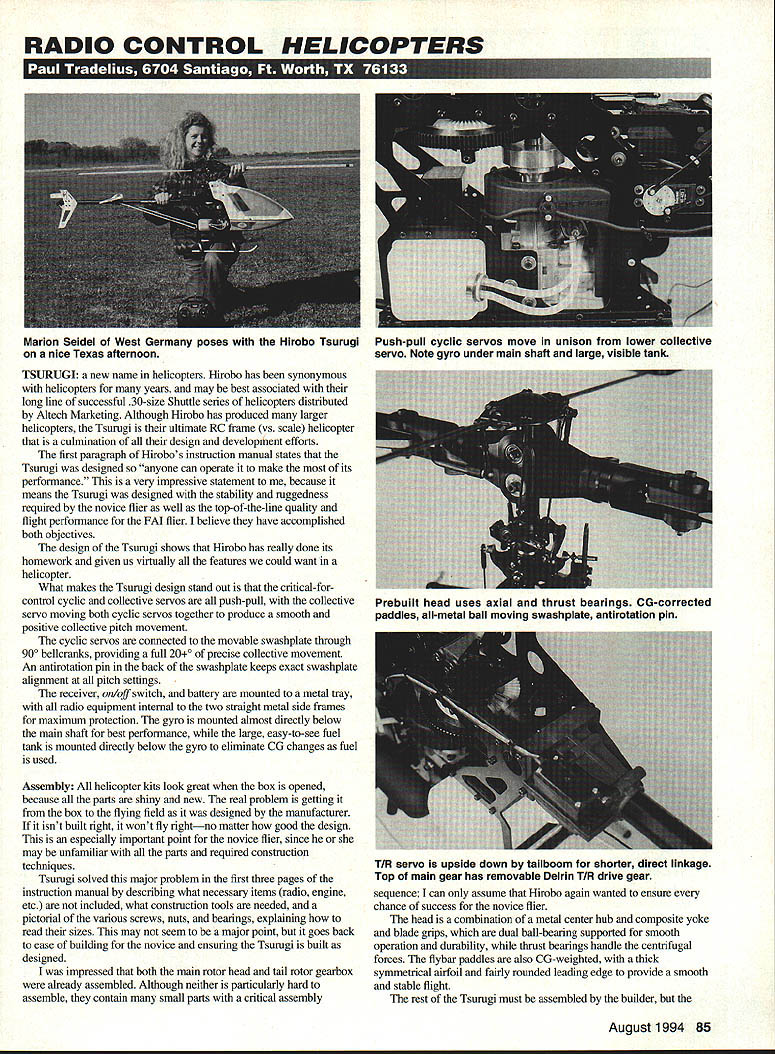
Tsurugi: a new name in helicopters. Hirobo has been synonymous with helicopters for many years and may be best associated with their long line of successful .30-.32 size Shuttle series of helicopters distributed by Altech Marketing. Although Hirobo has produced many larger helicopters, the Tsurugi is their ultimate RC frame (vs. scale) helicopter — a culmination of all their design and development efforts.
The first paragraph of Hirobo's instruction manual states that the Tsurugi was designed so "anyone can operate it to make the most of its performance." This is a very impressive statement, because it means the Tsurugi was designed with the stability and ruggedness required by the novice flier as well as the top-of-the-line quality and flight performance for the FAI flier. I believe they have accomplished both objectives.
The design of the Tsurugi shows that Hirobo has really done its homework and given us virtually all the features we could want in a helicopter.
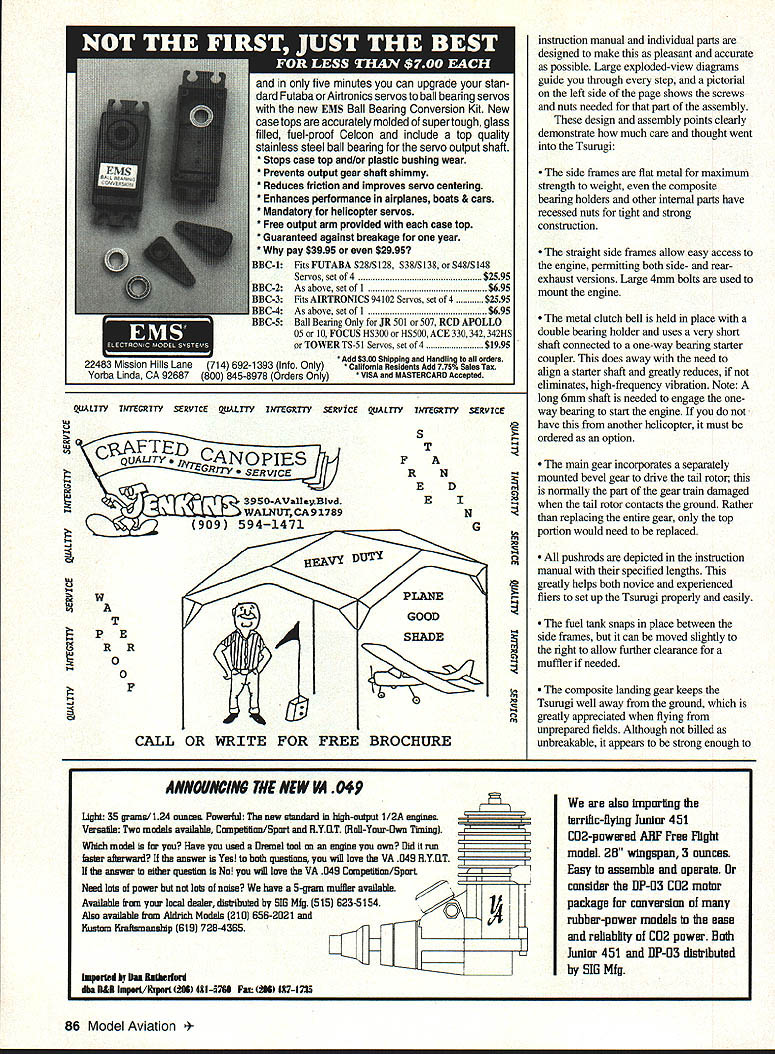
What makes the Tsurugi design stand out is that the critical-for-control cyclic and collective servos are all push-pull, with the collective servo moving both cyclic servos together to produce a smooth and positive collective pitch movement.
The cyclic servos are connected to the movable swashplate through 90° bellcranks, providing a full 20° of precise collective movement. An anti-rotation pin in the back of the swashplate keeps exact swashplate alignment at all pitch settings.
The receiver, on/off switch, and battery are mounted to a metal tray, with all radio equipment internal to the two straight metal side frames for maximum protection. The gyro is mounted almost directly below the main shaft for best performance, while the large, easy-to-see fuel tank is mounted directly below the gyro to eliminate CG changes as fuel is used.
Assembly All helicopter kits look great when the box is opened, because all the parts are shiny and new. The real problem is getting it from the box to the flying field as it was designed by the manufacturer. If it isn't built right, it won't fly right — no matter how good the design. This is an especially important point for the novice flier, since he or she may be unfamiliar with all the parts and required construction techniques.
Tsurugi solved this major problem in the first three pages of the instruction manual by describing what necessary items (radio, engine, etc.) are not included, what construction tools are needed, and by providing a pictorial of the various screws, nuts, and bearings, explaining how to read their sizes. This may not seem to be a major point, but it goes back to ease of building for the novice and ensuring the Tsurugi is built as designed.
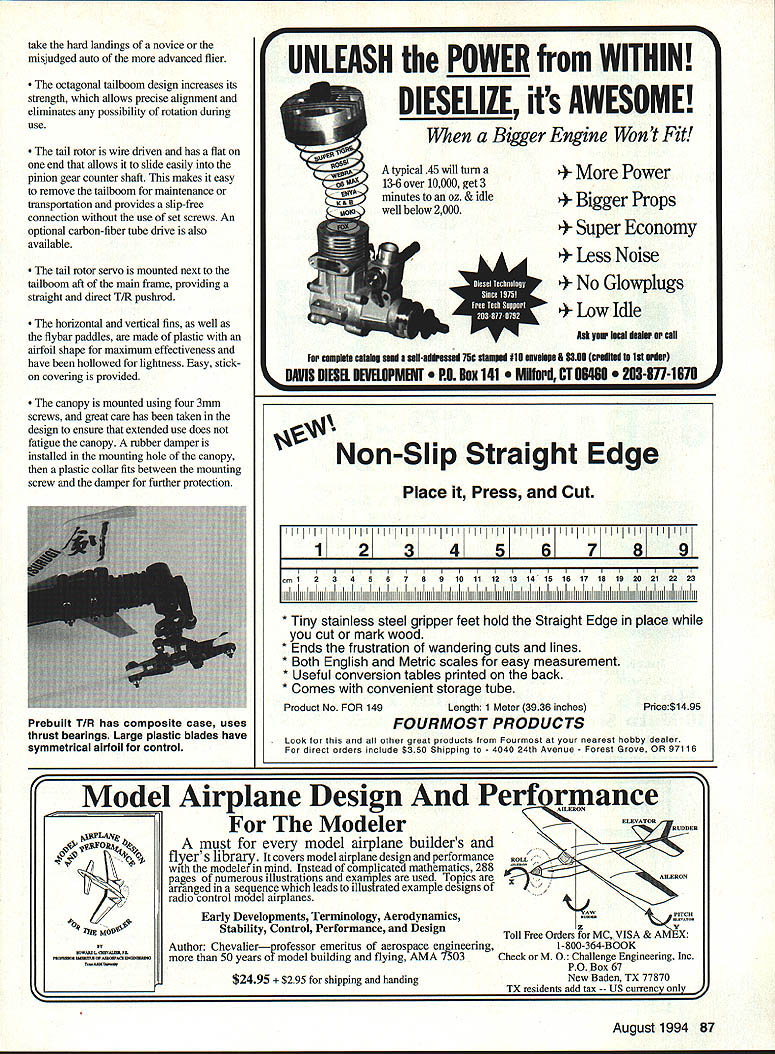
I was impressed that both the main rotor head and tail rotor gearbox are already assembled. Although neither is particularly hard to assemble, they contain many small parts with a critical assembly sequence; I can only assume that Hirobo again wanted to ensure every chance of success for the novice flier.
The head is a combination of a metal center hub and composite yoke and blade grips, which are dual ball-bearing supported for smooth operation and durability, while thrust bearings handle the centrifugal forces. The flybar paddles are also CG-weighted, with a thick symmetrical airfoil and fairly rounded leading edge to provide a smooth and stable flight.
The rest of the Tsurugi must be assembled by the builder, but the instruction manual and individual parts are designed to make this as pleasant and accurate as possible. Large exploded-view diagrams guide you through every step, and a pictorial on the left side of the page shows the screws and nuts needed for that part of the assembly. These design and assembly points clearly demonstrate how much care and thought went into the Tsurugi.
The side frames are flat metal for maximum strength-to-weight; even the composite bearing holders and other internal parts have recessed nuts for tight and strong construction.
The straight side frames allow easy access to the engine, permitting both side- and rear-exhaust versions. Large 4mm bolts are used to mount the engine.
The metal clutch bell is held in place with a double bearing holder and uses a very short shaft connected to a one-way bearing starter coupler. This does away with the need to align a starter shaft and greatly reduces, if not eliminates, high-frequency vibration. Note: a long 6mm shaft is needed to engage the one-way bearing to start the engine. If you do not have this from another helicopter, it must be ordered as an option.
The main gear incorporates a separately mounted bevel gear to drive the tail rotor; this is normally the part of the gear train damaged when the tail rotor contacts the ground. Rather than replacing the entire gear, only the top portion would need to be replaced.
All pushrods are depicted in the instruction manual with their specified lengths. This greatly helps both novice and experienced fliers to set up the Tsurugi properly and easily.
The fuel tank snaps in place between the side frames, but it can be moved slightly to the right to allow further clearance for a muffler if needed.
The composite landing gear keeps the Tsurugi well away from the ground, which is greatly appreciated when flying from unprepared fields. Although not billed as unbreakable, it appears to be strong enough to:
- take the hard landings of a novice or the misjudged auto of the more advanced flier.
- The octagonal tailboom design increases its strength, which allows precise alignment and eliminates any possibility of rotation during use.
- The tail rotor is wire driven and has a flat on one end that allows it to slide easily into the pinion gear counter shaft. This makes it easy to remove the tailboom for maintenance or transportation and provides a slip-free connection without the use of set screws. An optional carbon-fiber tube drive is also available.
- The tail rotor servo is mounted next to the tailboom aft of the main frame, providing a straight and direct T/R pushrod.
- The horizontal and vertical fins, as well as the flybar paddles, are made of plastic with an airfoil shape for maximum effectiveness and have been hollowed for lightness. Easy, stick-on covering is provided.
- The canopy is mounted using four 3mm screws, and great care has been taken in the design to ensure that extended use does not fatigue the canopy. A rubber damper is installed in the mounting hole of the canopy, then a plastic collar fits between the mounting screw and the damper for further protection.
To ensure proper setup for the novice flier, a pitch gauge is provided, and many pages of the instruction manual are devoted to matching the controls of the transmitter to the proper movements of the helicopter. Several pitch curves are also graphically displayed for those using computer radios.
As you can tell from this long list of features, I'm impressed with the thought and attention to detail that went into the design of the Tsurugi. However, there are a few areas I would like to see changed:
- Although ball bearings are widely used throughout the helicopter, the moving servo tray and bellcranks are supported with plastic bearings. I imagine this is in an attempt to keep the price down; ball bearings are available as an option.
- The 4mm main blade bolts are completely threaded, but would be stronger if only the last portion was threaded.
Other Equipment
My Tsurugi is powered by an Enya .60X using the optional Hirobo muffler. I have been using this engine for several years, and it continues to start easily, provide plenty of power, and is very reliable — all the qualities needed for helicopter flying.
In previous columns, I featured the Airtronics Infinity 660 radio as well as Hitec's line of radio control equipment, and I decided to use this combination in the Tsurugi. The Airtronics 660 computerized transmitter makes the initial setup easy and provides all the computerized mixing heli features I could want.
The airborne electronics are powered by a 1,000 mAh SR battery pack. I have always been more than pleased with SR packs for their capacity-to-weight ratio as well as their reliability and aircraft-quality construction.
The rest of the flight pack includes Hitec's new Supreme Series receiver — an improvement over their already "bullet-proof" Platinum receiver, which is smaller, has better technical specs, and is more immune to vibration.
Servos are Hitec's HS-425s, which are high-speed, dual ball-bearing servos with a torque of 43 ounce-inches. Servos of this quality and power are a must for the movable servos and to take advantage of the push-pull flight controls.
Final setup was checked using an ElectroDynamics EDR-201 Eye Test current probe to measure individual servo current drain. This can be used to identify servo, gyro, or charger problems before they cause crashes, or in setup to check for high current readings as the servos are moved throughout their full travel limits, which would indicate control binding.
Flight Tests
Initial test hovering in my backyard showed the Tsurugi to be a smooth and stable helicopter. There are many variables in designing a rotor head, and Hirobo has managed to keep the same feel of the well-known Shuttle, which has been a good friend to many new fliers. On calm days, precise hovering with soft-feel controls can be achieved with rotor speeds in the 1300 rpm range, while higher rotor speeds are needed for windy conditions or general flying.
Taking the Tsurugi upstairs with a head speed in the 1700 rpm range made it come alive in both performance and capability. General flying was even enjoyable on a windy Texas day, with plenty of power from the Enya enabling it to perform any maneuver desired. The large pitch window allows full freedom in aerobatic and freestyle flying while still allowing sufficient positive pitch for easy autos with the Tsurugi's large 60-inch rotor diameter.
Except for the relatively minor points noted, I would be hard-pressed to find fault with the Tsurugi for either the novice or expert flier. Hirobo has come up with the design parameters that make the Tsurugi extremely stable in hover for the novice pilot, yet maneuverable enough for the advanced and hot-dog fliers as well. I hope you like it as much as I do.
Tsurugi Specifications
- Main rotor: 60 inches
- Tail rotor: 11 inches
- Body length: 52 inches
- Weight: 10 pounds
- Engine: .60
- Radio required: five-channel heli
Altech Marketing, P.O. Box 391, Edison, NJ 08818
Airtronics, Inc., 11 Autry, Irvine, CA 92718
Hitec RCD, Inc., 10729 Wheatlands Ave., Suite C, Santee, CA 92071
SR Batteries, Box 287, Bellport, NY 11713
ElectroDynamics, Inc., 9557 Crosley, Redford, MI 48239
Transcribed from original scans by AI. Minor OCR errors may remain.

