
RADIO CONTROL HELICOPTERS
Paul Tradelius, 6704 Santiago, Ft. Worth, TX 76133
BLADE BALANCING TECHNIQUES
In a previous column I discussed how to find and eliminate vibration in our model helicopters. Although there are many possible sources of vibration, one of the biggest is the main rotor system—specifically the main rotor blades. Better blade balancing will not only reduce vibration but also improve the helicopter's flight characteristics.
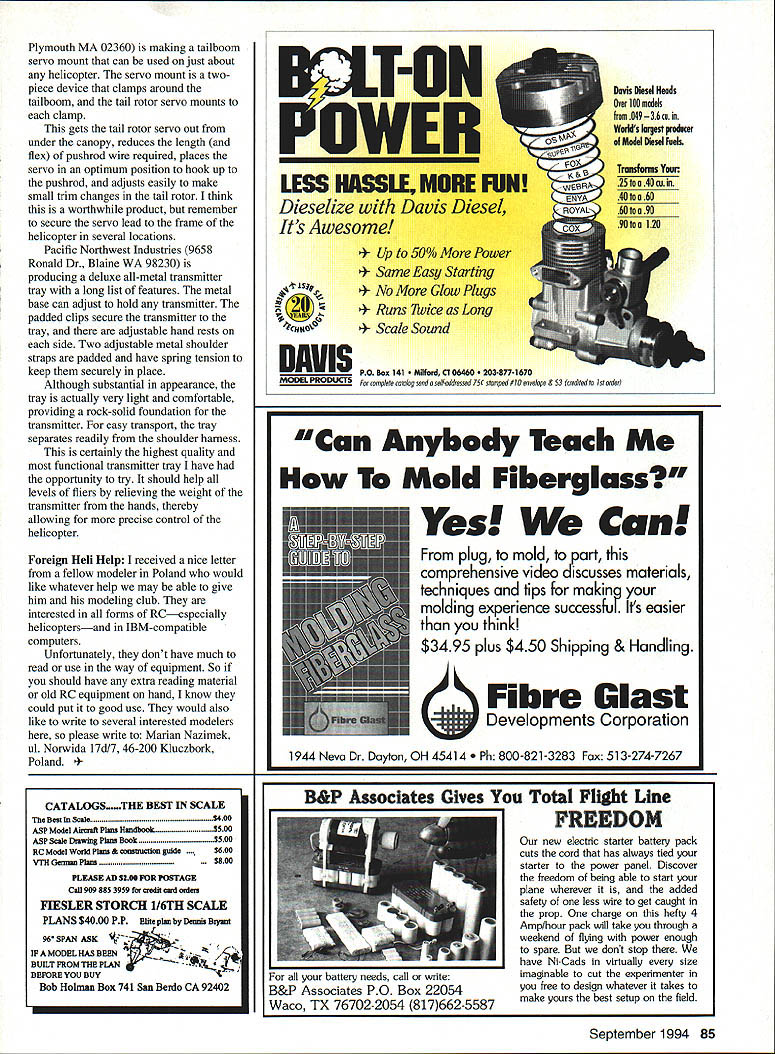
Blade balancing theory is fairly simple. Just three things are needed:
- The blades must be level on a balancer.
- The spanwise centers of gravity (CGs) must be the same.
- Their weights must be the same.
If any two of the above requirements are met, the third will automatically follow.
Two basic blade-balancing techniques have developed:
- Match the CGs of each blade.
- Use an accurate scale to match their weights.
In both techniques, blades are brought into balance using a device such as the High Point Revolution Blade Balancer (or a similar balancer).
Until recently, the most accurate (but more difficult, costly, and time-consuming) technique was matching weights on an accurate scale. Weight can be determined down to a tenth of a gram, while matching blade CGs to high accuracy had not been guaranteed—until the Koll Rotor Pro.
Koll Rotor Pro
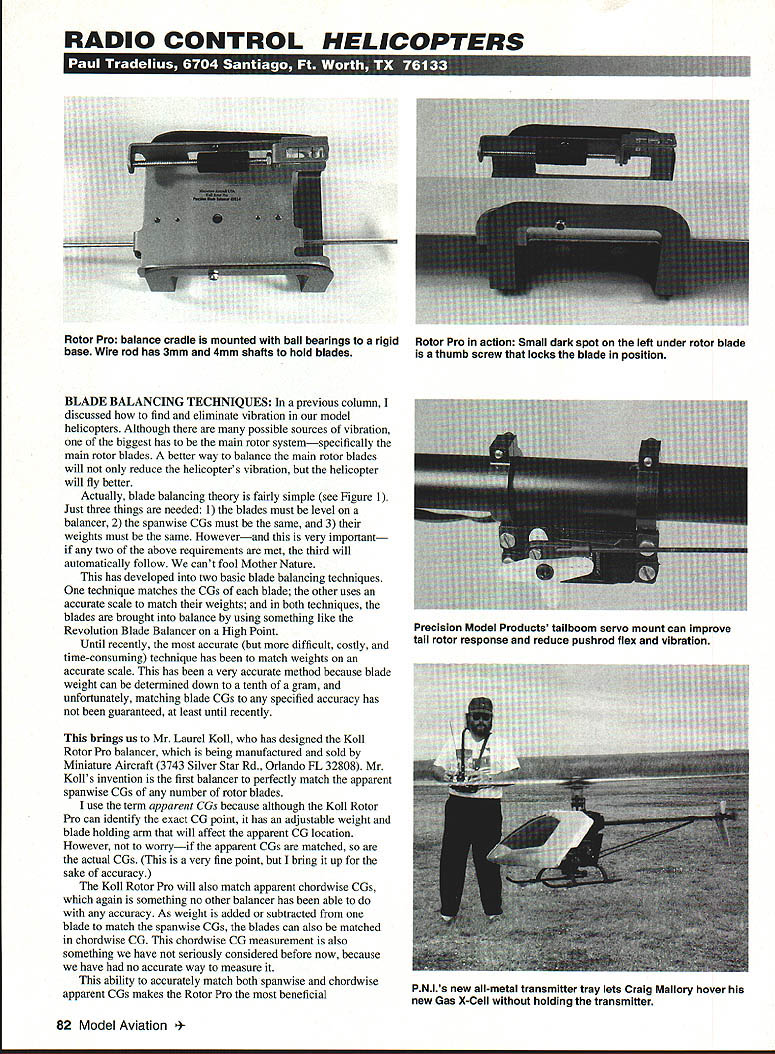
Laurel Koll designed the Koll Rotor Pro balancer, now manufactured and sold by Miniature Aircraft (3743 Silver Star Rd., Orlando, FL 32808). The Koll Rotor Pro is the first balancer to precisely match the apparent spanwise CGs of any number of rotor blades.
I use the term apparent CG because the Rotor Pro identifies the exact CG point but includes an adjustable weight and blade-holding arm that affect the apparent CG location. If the apparent CGs are matched, the actual CGs are matched as well.
The Rotor Pro also matches apparent chordwise CGs—something no other balancer has done accurately. As weight is added or subtracted to match spanwise CGs, the chordwise CG can also be adjusted by positioning that weight closer to the leading or trailing edge.
This ability to match both spanwise and chordwise apparent CGs makes the Rotor Pro a significant advancement in blade balancing since the introduction of the High Point Revolution.
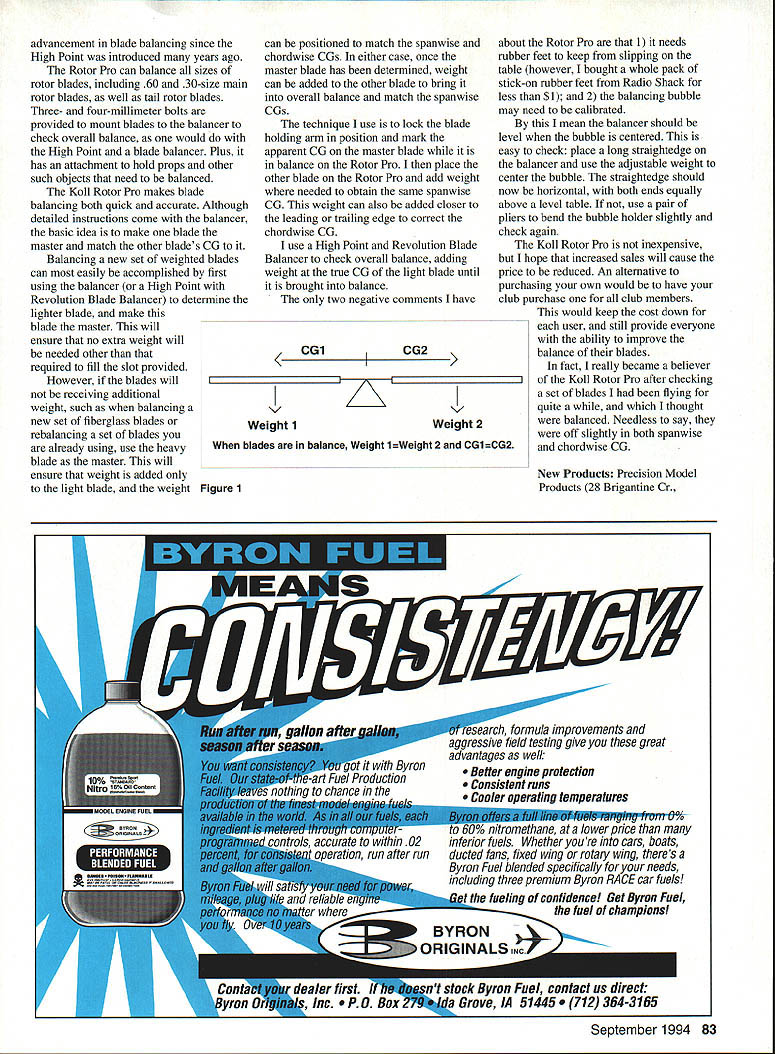
The Rotor Pro can balance main rotor blades (including 60- and 30-size) as well as tail rotor blades. Three- and four-millimeter bolts are provided to mount blades to the balancer. To check overall balance, use a High Point Revolution Blade Balancer. The High Point Revolution Blade Balancer Plus has an attachment to hold props and other objects that need balancing. The Koll Rotor Pro makes blade balancing both quick and accurate.
Balancing procedure
The basic idea is to make one blade the master and match the other blades' CGs to it.
- Using a High Point Revolution Blade Balancer, determine the lighter blade and make that the master. This ensures no extra weight will be needed on the other blades.
- If the blades will be receiving additional weight (for example, when balancing a new set of fiberglass blades or rebalancing in-service blades), use the heavy blade as the master. This allows the weight added to the light blade to be positioned to match spanwise and chordwise CGs.
- To match spanwise CGs: lock the blade-holding arm in position, mark the apparent CG on the master blade, and balance it on the Rotor Pro. Place the other blade on the Rotor Pro and add weight as needed to obtain the same spanwise CG.
- To correct chordwise CG: add weight closer to the leading or trailing edge as required.
- Use the High Point Revolution Blade Balancer to check overall balance, adding weight to the true CG of the light blade until the set is balanced.
I found that a set of blades I had been flying for a while, and thought were balanced, were actually slightly off in both spanwise and chordwise CGs—so the Rotor Pro makes a real difference.
Notes and criticisms
Two minor negatives about the Rotor Pro:
- It needs rubber feet to keep it from slipping on the table. I bought a pack of stick-on rubber feet at Radio Shack.
- The balancing bubble may need calibration. Check by placing a long straightedge on the balancer and use the adjustable weight to center the bubble. The straightedge should be horizontal; if not, bend the bubble holder slightly and check again.
The Koll Rotor Pro is not inexpensive. An alternative to buying one personally is for a club to purchase one for shared use, which reduces cost per user.
OTHER ACCESSORIES
Tailboom servo mount
- A manufacturer in Plymouth, MA (02360) is producing a tailboom servo mount that clamps around the tailboom and supports the tail rotor servo on the clamp. This moves the tail rotor servo out from under the canopy, reduces pushrod length and flex, places the servo in an optimal position for the pushrod, and allows easy small trim adjustments. Secure the servo lead to the frame in several locations.
Transmitter tray
- Pacific Northwest Industries (9658 Ronald Dr., Blaine, WA 98230) makes a deluxe all-metal transmitter tray with many features. The metal base adjusts to hold any transmitter. Padded clips secure the transmitter and there are adjustable hand rests on each side. Two adjustable padded metal shoulder straps with spring tension keep the tray in place. Although substantial in appearance, the tray is light and comfortable, providing a rock-solid foundation for the transmitter. The tray separates from the shoulder harness for easy transport. This high-quality, functional tray relieves transmitter weight from the hands and helps pilots achieve more precise control.
FOREIGN HELI HELP
I received a letter from a modeler in Poland seeking help for his club. They are interested in all forms of RC—especially helicopters—and in IBM-compatible computers, but they lack reading material and equipment.
If you have extra reading material or old RC equipment, they could put it to good use. They would also like to correspond with interested modelers. Write to: Marian Nazimek ul. Norwida 17/7 46-200 Kluczbork Poland
Transcribed from original scans by AI. Minor OCR errors may remain.

